%201.svg)
Ranger vs. Momentic


When it comes to AI-powered QA platforms, Ranger and Momentic offer two distinct approaches to software testing. Both aim to streamline testing processes, reduce manual effort, and avoid legacy QA bottlenecks to help teams release features faster while maintaining product quality. Here’s a quick breakdown:
- Ranger combines AI-generated Playwright test code with human QA expert reviews, offering a fully managed service that handles test creation, maintenance, and infrastructure. It integrates with tools like Slack and GitHub, making it ideal for teams looking to offload QA responsibilities.
- Momentic focuses on empowering teams to manage their own testing with a low-code platform. It converts plain English test descriptions into automated scripts and uses self-healing locators to minimize false positives. This approach is great for teams wanting full control over their test suites.
Quick Comparison
| Feature | Ranger | Momentic |
|---|---|---|
| Test Creation | AI-generated Playwright code with QA review | Plain English test descriptions |
| Maintenance | Adaptive web agents + human triage | Self-healing locators |
| Infrastructure | Fully managed | Hosted platform with 99.99% uptime SLA |
| Integration | Slack, GitHub | CI/CD pipelines |
| Target Audience | Teams wanting to offload QA management | Teams preferring in-house testing control |
Both platforms cater to different needs. Ranger is perfect if you want a hands-off, managed solution, while Momentic is better suited for teams looking to keep QA in-house with AI-driven tools. The choice depends on your team's priorities - outsourcing QA or maintaining direct control to improve engineering velocity.

Ranger vs Momentic: AI-Powered QA Platform Comparison
Overview of Ranger and Momentic
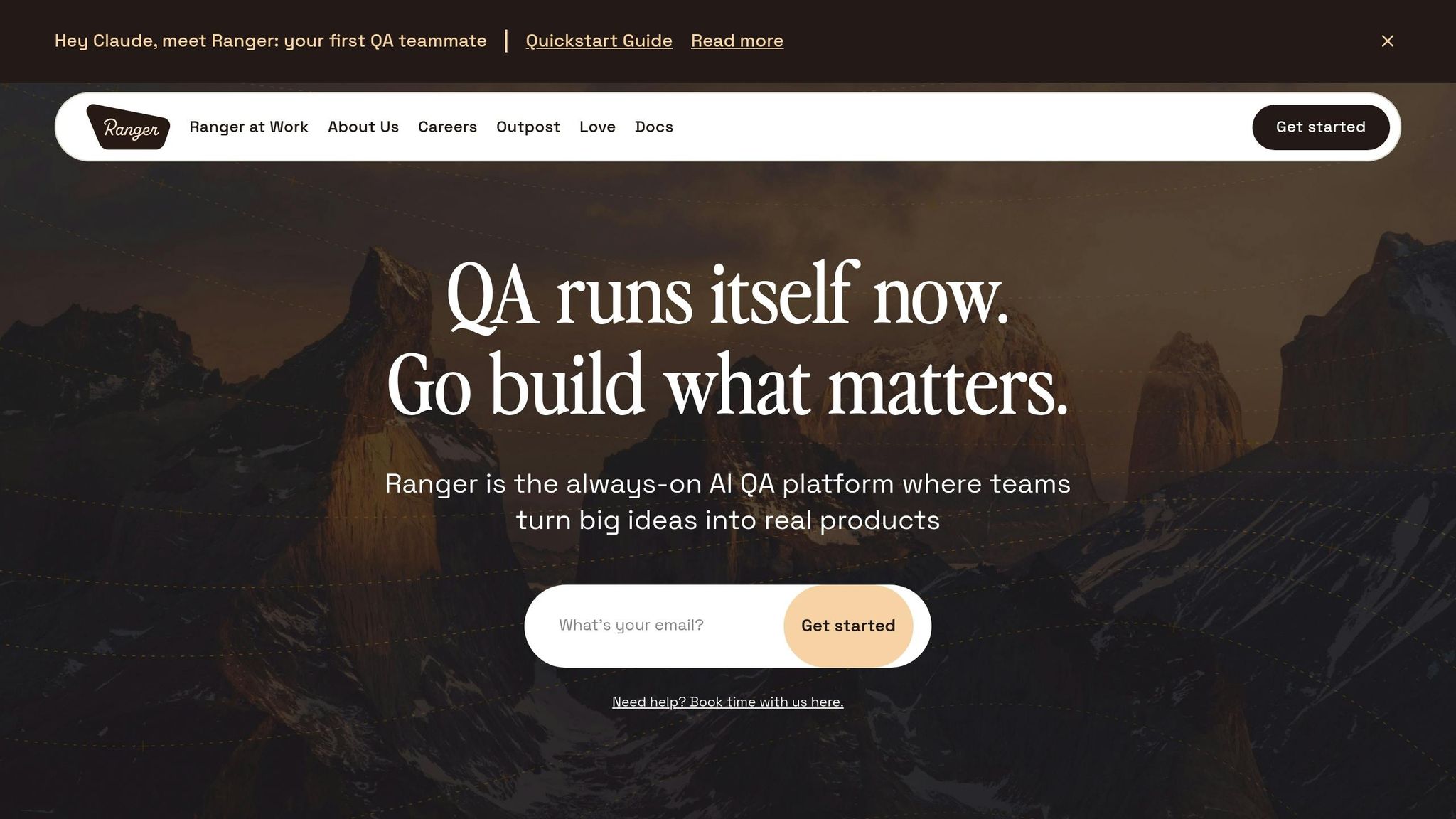
What is Ranger?
Ranger is an AI-powered QA platform designed to simplify and improve test generation with a blend of automation and human expertise. By leveraging AI agents, it generates Playwright test code, which is later reviewed by QA specialists to ensure the tests are easy to understand, dependable, and easy to maintain. Beyond test creation, Ranger handles the entire testing ecosystem - launching browsers, running tests on staging or production environments, and analyzing results to filter out low-priority issues, focusing only on critical risks.
The platform integrates seamlessly with tools like Slack, offering real-time notifications, and GitHub, where it attaches test results directly to pull requests, making it a natural fit for developer workflows. Companies such as Clay, Suno, and Yurts trust Ranger to maintain fast release cycles without compromising quality. In February 2025, OpenAI used Ranger to develop a web browsing harness to test the agentic abilities of their o3-mini models.
Brandon Goren, Software Engineer at Clay, shared his thoughts:
"Ranger has an innovative approach to testing that allows our team to get the benefits of E2E testing with a fraction of the effort they usually require."
What is Momentic?
Momentic transforms plain English test descriptions into automated tests, making it far easier for engineers to achieve comprehensive test coverage without needing deep technical expertise. Its low-code interface ensures accessibility, while its self-healing locators use intent-based automation to adapt to changes in the DOM, drastically reducing false positives by 99%. Additionally, Momentic employs an autonomous AI agent to explore applications, identify vital user flows, and automatically generate tests.
Momentic also excels in testing generative AI systems, validating unpredictable outputs from LLMs and chatbot responses - tasks that traditional tools often fail to handle effectively. Trusted by engineering teams at Notion, Webflow, and Retool, Momentic has proven its ability to speed up development cycles. For instance, in early 2026, Quora's Poe.com platform reduced its testing time from 7 hours to just 30 minutes using Momentic, ensuring efficient validation of AI chatbot functionality.
Alex, CTO of GPTZero, highlighted its impact:
"Momentic makes it 3x faster for our team to write and maintain end-to-end tests. Startups win by shipping faster and better, and Momentic enabled us to do exactly that."
Next, we’ll dive into a comparison of the key features offered by both platforms.
sbb-itb-7ae2cb2
Feature Comparison
AI-Powered Test Creation and Maintenance
Ranger and Momentic take two distinct paths when it comes to creating and maintaining tests. Ranger uses what it calls a "cyborg" model. Here, AI agents generate human-readable Playwright test code, which is then reviewed by skilled QA professionals. This combination of automation and human oversight ensures the tests are both fast to produce and reliable. Plus, engineering teams can easily understand and tweak these tests as needed.
Momentic, on the other hand, leans into a low-code approach. Engineers simply write test instructions in plain English, and the AI converts them into automated test scripts. This method can cut down automation time by as much as 70%. A great example of this efficiency was in January 2026, when Best Parents achieved 80% test coverage within two days - without writing any manual code.
For maintenance, Ranger uses adaptive testing. Web agents automatically navigate your site to update tests, while human experts step in to handle failures and weed out flaky results. Momentic relies on self-healing locators that adjust as the UI changes, which reduces false-positive alerts by an impressive 99%.
Momentic also features an autonomous testing agent that explores applications to identify key user flows and generate tests. It even includes AI-powered assertions to validate unpredictable outputs. Meanwhile, Ranger provides a "Feature Review" interface for quick feedback on screenshots and videos. It also supports a "closed-loop" development cycle, where coding agents can verify their own code before a human reviews the pull request.
Next, let’s dive into how real-time test feedback and traditional QA tools integrate into existing development workflows.
Integration with Existing Workflows
Ranger is designed to fit seamlessly into CI/CD workflows. It integrates directly with tools like Slack and GitHub, embedding test results into the development process. For example, it runs tests against staging and preview environments to catch issues early. Jonas Bauer, Co-Founder and Engineering Lead at Upside, shared that using Ranger allowed his team to release code faster, often deploying to production the same day after running tests.
"Ranger helps our team move faster with the confidence that we aren't breaking things. They help us create and maintain tests that give us a clear signal when there is an issue that needs our attention."
- Matt Hooper, Engineering Manager, Yurts
Momentic also integrates with CI/CD pipelines, running Playwright tests as part of the process. However, its documentation provides fewer details about integrations with tools like Slack or GitHub, which may be worth considering depending on your team's needs.
Now, let’s look at how these solutions scale to meet the demands of growing projects.
Scalability and Infrastructure
Ranger takes care of all infrastructure needs, including hosting and spinning up browsers for test execution. This eliminates the hassle of managing test environments in-house. The platform also scales automatically to match the pace of product development, ensuring new features are covered by tests as they’re introduced. Teams using Ranger report saving over 200 developer hours per engineer annually - time that would otherwise go into manual testing and maintenance.
Momentic offers a hosted platform with a 99.99% uptime SLA, focusing heavily on execution within CI/CD pipelines. In early 2026, Quora's Poe.com used Momentic to slash testing time from 7 hours to just 30 minutes. Some teams even saw an 8x boost in their release cadence after adopting the platform.
| Feature | Ranger | Momentic |
|---|---|---|
| Creation Method | AI-generated Playwright code with human expert review | Plain English test descriptions |
| Maintenance Approach | Adaptive web agents with human triage | Self-healing, intent-based locators |
| Infrastructure | Fully hosted and managed | Hosted platform with 99.99% uptime SLA |
| Code Output | Human-readable Playwright code | Automated low-code test coverage |
Ranger offers annual contracts based on the size of your test suite, while Momentic customizes its pricing to fit your organization’s specific needs.
Performance and Results
Bug Detection and Reporting
Ranger takes a unique "cyborg" approach by combining the strengths of AI agents with human QA experts. Together, they review AI-generated code before it goes live. This process automatically prioritizes failures and weeds out unreliable tests, ensuring that engineering teams only deal with high-risk issues that require attention.
Momentic, on the other hand, believes testing should remain an in-house responsibility. Its platform employs AI-driven tools for test stability and self-healing, while relying on human judgment to define contracts and validate AI-generated results. This strategy helps avoid what Momentic refers to as "AI slop", preventing unnecessary clutter in the codebase.
By streamlining the triaging process, both approaches aim to improve the reliability of tests while accelerating the overall development workflow.
Engineering Velocity Improvements
Ranger’s automation framework significantly enhances development speed. With its seamless CI/CD integration, tests are triggered automatically as code changes, and results are instantly shared on platforms like Slack and GitHub.
"I definitely feel more confident releasing more frequently now than I did before Ranger. Now things are pretty confident on having things go out same day once test flows have run."
- Jonas Bauer, Co-Founder and Engineering Lead, Upside
The transition to AI-driven testing slashes manual testing time from 2 hours to just 15 minutes. Additionally, AI-generated test data can increase coverage by 30% without requiring extra manual input. This is especially impactful for QA engineers, who often spend 60% of their time managing fragile test suites and troubleshooting unreliable tests - a challenge Ranger aims to solve.
Meanwhile, Momentic emphasizes empowering internal teams with tools to manage their own testing processes. Using low-code editors and self-healing features, Momentic supports organizations that view testing as a key in-house capability rather than something to be outsourced.
Implementation and Usability
Onboarding and Setup
Ranger simplifies the onboarding process by offering a fully managed, turnkey setup guided by a team of QA experts. From day one, they handle everything - test creation, maintenance, and infrastructure - making it easy for teams to get started without the hassle of configuring browsers, managing test environments, or building frameworks from scratch.
"Our team of QA experts will walk you through the process of putting testing on easy mode. We take care of everything, from creating and maintaining your tests to the infrastructure needed to run them." - Ranger
Momentic, on the other hand, takes a self-service, low-code approach. Users can write tests in plain English or use an autonomous agent to explore applications and generate test flows. While this model gives teams more control, it also requires them to manage their own test specifications, which can lead to a steeper learning curve. In contrast, Ranger’s hands-on support ensures teams are operational from the start, eliminating potential roadblocks.
Once onboarded, Ranger users can immediately take advantage of its intuitive platform and robust support system.
User Experience and Support
Ranger’s interface includes a dedicated Feature Review UI, which allows users to view screenshots and videos, making it easy to provide detailed feedback on specific UI elements. Seamless integrations with Slack and GitHub enable real-time test notifications and effortless sharing of results. For support, Ranger offers direct access to QA experts, a dedicated engineering email (eng@ranger.net), and the ability to schedule live sessions with their team. Users also have access to a Quickstart Guide and thorough documentation designed for developer-focused workflows.
Momentic prioritizes low-code accessibility with an editor that simplifies test creation, removing the need for deep technical expertise or specialized training. It also provides resources like documentation, a blog with best practices (e.g., Playwright E2E testing), and product demos to help teams get started. However, its approach requires internal teams to build and manage testing expertise independently, which may demand more effort upfront.
Pricing and Value
Cost Analysis
Ranger uses a custom pricing model tied to annual contracts, designed to match the scale of your test suite and specific testing requirements. This approach positions Ranger as more than just a tool - it acts as a fully managed QA department, combining an AI-driven platform with human expertise to oversee and maintain your tests. The pricing is tailored to your needs, ensuring that every aspect of test setup and maintenance is covered, eliminating the need for an internal QA team.
This all-in-one model simplifies costs by bundling everything from test creation to ongoing maintenance, providing a streamlined solution for QA management.
Return on Investment
The return on investment (ROI) with Ranger becomes clear when you look at the time and resources it saves. The platform claims to save engineering teams over 200 developer hours per engineer each year. By shifting the workload of test creation, maintenance, and infrastructure management to Ranger, your engineering team can concentrate on building new features rather than getting bogged down in testing tasks.
Brandon Goren from Clay highlighted how Ranger’s approach simplifies E2E testing, delivering results with much less effort.
Ranger’s ROI is largely driven by reducing the maintenance burden and speeding up launch cycles. With their experts handling updates whenever your UI changes, you avoid the hidden costs that often come with managing automation tools in-house. Matt Hooper, Engineering Manager at Yurts, shared:
"Ranger helps our team move faster with the confidence that we aren't breaking things. They help us create and maintain tests that give us a clear signal when there is an issue that needs our attention."
Instead of maintaining an internal QA department, you pay a predictable annual fee. For teams without dedicated QA resources or those struggling with test upkeep, this model offers measurable ROI by saving time and reducing technical debt. These benefits allow engineering teams to accelerate development without being weighed down by manual testing, aligning perfectly with the AI-driven QA approach discussed throughout this comparison.
Conclusion
Ranger and Momentic represent two contrasting approaches to quality assurance (QA). Ranger operates as a managed service, blending AI-generated Playwright tests with reviews by human QA experts. Essentially, they act as an external QA teammate, taking care of test creation, maintenance, and triage tasks. This "cyborg" model removes the hassle of managing test infrastructure and dealing with flaky tests, as Ranger's team ensures tests are updated with every change.
Momentic, on the other hand, views testing as a responsibility that should remain in-house. Wei-Wei Wu from Momentic emphasizes this point:
"Stop outsourcing QA - tests are now your product's executable spec for AI-generated code. Own testing to ship faster with verified quality."
Their platform offers low-code editors and self-healing tools, giving teams the ability to maintain full control over their test suites while minimizing the effort required for upkeep.
The key difference between these approaches lies in how they impact team workflows and efficiency. If your team is stretched thin and would benefit from offloading test management, Ranger’s managed service might be the better fit. On the other hand, if maintaining control over test specifications is a priority, Momentic’s tools provide the means to do so. As Martin Camacho from Suno noted:
"We've loved our experience with Ranger. They make it easy to keep quality high while maintaining high engineering velocity."
The choice ultimately comes down to who you want managing the work: Ranger’s team of experts or your own team empowered with AI-driven tools. Each option caters to different needs - whether you prefer a hands-off, fully managed solution or complete in-house control over testing.
FAQs
How much QA work does Ranger handle for my team?
Ranger takes quality assurance to the next level by automating much of the process with AI-driven tools. Think of it as a virtual QA engineer that handles everything - from writing and testing code to verifying it - without needing human intervention. This approach speeds up continuous testing, tightens feedback loops, and scales feature verification. The result? Less manual work and more dependable outcomes.
Can we edit the Playwright tests Ranger generates?
Ranger takes care of automatically sorting through failures, helping to cut through noise and unreliable test results. However, it's unclear if the Playwright tests it generates allow for manual editing.
How does Ranger reduce flaky tests and false alarms?
Ranger tackles the problem of flaky tests and false alarms with the help of AI-driven test maintenance and self-healing capabilities. Its AI takes care of updating test scripts automatically whenever there are code changes, eliminating disruptions caused by UI or locator changes. On top of that, it cuts down on false positives by analyzing past data to distinguish genuine bugs from minor UI tweaks, delivering more consistent and dependable test outcomes.
Related Blog Posts
Stop babysitting your coding agents. Use Ranger
%201%20(1).svg)
More signals, less noise, faster launches
Let Ranger be your guide to sustainable QA testing.

.png)