%201.svg)
How AI QA Prevents Costly Late-Stage Bugs


Late-stage software bugs are expensive and disruptive. Fixing a bug in production can cost up to 100x more than addressing it earlier in development. For example, a $100 design-phase fix could balloon to $1,500 post-deployment. Beyond costs, bugs can delay launches, hurt productivity, and damage brand trust - 70% of users lose confidence in a brand after encountering bugs.
AI-driven QA tools solve this by detecting issues earlier, automating repetitive tasks, and predicting high-risk areas. These tools reduce defect leakage by up to 30%, cut detection time by 90%, and improve test coverage significantly. Features like self-healing automation adapt to code changes, minimizing test maintenance costs. Combining AI with human oversight ensures accurate testing for complex workflows. The result? Faster releases, fewer bugs, and happier users.
Key Benefits of AI QA:
- Cost Savings: Early bug fixes save thousands of dollars per defect.
- Efficiency: Automates testing, reduces manual effort, and speeds up detection.
- Reliability: Lowers post-release bugs and improves software quality.
- Customer Trust: Fewer bugs mean better user experiences and retention.
AI QA, like Ranger, is transforming U.S. software teams by integrating seamlessly into CI/CD pipelines, offering predictive analytics, and reducing QA overhead. Teams adopting AI QA today gain a competitive edge by delivering high-quality software faster and more efficiently.
AI-Powered Test Automation: Self-Healing + Visual Testing - Selenium & Playwright
How AI QA Changes Bug Detection
AI QA is reshaping how teams find and fix bugs, turning testing into a proactive process rather than a reactive one. By leveraging automation and predictive analytics, AI-driven QA tools catch issues earlier and more efficiently than manual and automated testing methods. Instead of waiting for bugs to show up in late-stage testing or production, these tools analyze patterns, predict potential failures, and adapt to code changes in real time, saving teams from costly fixes down the line.
Automation and Predictive Analytics
AI-powered QA tools take over some of the most tedious parts of testing - like creating, running, and maintaining tests. These systems can even generate test cases from changelogs, specs, and user feedback, making it easier for the entire team to contribute to the process.
Predictive analytics is another game-changer. By analyzing historical defect data, code repositories, and test logs, AI can pinpoint areas in the application most likely to have bugs in future releases. This allows teams to focus their energy on high-risk areas instead of spreading themselves too thin. For example, in 2022, a major telecommunications company boosted its test coverage from 34% to 91% in just nine months using AI-based QA tools. This improvement not only led to earlier bug detection but also made their software far more reliable. Additionally, AI can perform predictive root cause analysis, which links code changes, test outcomes, and issue patterns. This helps teams quickly zero in on problems and resolve them faster, paving the way for more adaptive testing practices.
Self-Healing Test Automation
One standout feature of AI QA tools is self-healing test automation. This technology automatically adjusts test scripts when there are changes to the user interface (UI) or underlying code, drastically reducing the time spent on maintenance. Traditional test automation often breaks when even the smallest UI or code tweaks occur, forcing teams to manually update scripts - a time-consuming task. Self-healing automation solves this by using smart element locators and adaptive algorithms to keep tests functional as applications evolve.
This capability ensures that developers can focus on creating new features rather than constantly fixing broken tests. By monitoring application changes and automatically updating test parameters, self-healing tools minimize false test failures and keep the testing pipeline running smoothly.
Human Oversight for Critical Workflows
While AI excels at automating repetitive tasks, human expertise remains essential for complex, high-stakes testing scenarios. Testers validate AI-generated results, interpret ambiguous findings, and ensure that critical business logic is thoroughly examined. This combination of AI and human input enhances confidence in testing outcomes and reduces the risk of missed defects or false positives.
"Ranger helps our team move faster with the confidence that we aren't breaking things. They help us create and maintain tests that give us a clear signal when there is an issue that needs our attention." - Matt Hooper, Engineering Manager, Yurts
This partnership between AI and human testers is particularly valuable for evaluating intricate workflows, edge cases, or scenarios requiring deep business knowledge. While AI handles the heavy lifting - like executing tests and analyzing data - human testers bring strategic insight and quality validation to the table. This balanced approach ensures that teams benefit from the speed and efficiency of AI without losing the nuanced judgment that only humans can provide. The result? More dependable software that meets both technical standards and user expectations.
The Business Case for Early Bug Detection with AI
Catching bugs early can save companies a lot of money. Traditional QA methods often let defects slip through to production, which not only increases costs but also risks damaging customer trust. On the other hand, AI-driven testing helps teams identify issues sooner, significantly lowering development expenses and improving resource use.
Measuring ROI of Early Bug Detection
To showcase the value of AI in quality assurance, it’s essential to focus on measurable business outcomes. One key metric is the defect leakage rate, which measures the percentage of bugs that make it to production. AI-powered QA tools can reduce this rate by up to 30%, catching problems earlier in the development process.
Other important metrics include mean time to detect (MTTD) and mean time to resolve (MTTR). Studies reveal that AI-based root cause analysis can cut detection time by as much as 90% and boost resource efficiency from 60% to 85%. These improvements directly translate into cost savings, as teams spend less time troubleshooting and more time focusing on building new features.
Organizations that adopt AI-driven testing report up to a 21% increase in productivity, which lowers labor costs and reduces post-release bug fixes. For example, an electronics company improved its data preparation process, reducing missed defects by 30%. This led to fewer production issues and substantial cost savings. These results clearly show how early detection benefits businesses across multiple areas.
Early-Stage vs. Late-Stage Bug Costs
The cost of fixing bugs increases dramatically as they progress through the development cycle. This table highlights how expenses escalate and why early detection is key:
| Stage | Typical Cost per Bug (USD) | Risk Level | Time to Fix | Example Scenario |
|---|---|---|---|---|
| Requirements | $100–$500 | Low | Hours | Adjusting a feature spec before coding begins |
| Design | $500–$2,000 | Medium | Days | Revising a flawed architecture |
| Coding | $2,000–$5,000 | Medium | Days | Fixing a logic error during code review |
| Testing | $5,000–$15,000 | High | Weeks | Addressing a critical bug found during QA |
| Production | $15,000–$100,000+ | Very High | Weeks/Months | Emergency hotfix for a live security vulnerability |
This breakdown underscores the value of catching bugs early. For instance, a SaaS company using AI for predictive defect detection identified 90% of critical bugs before production and reduced their mean time to resolve issues by 75%. This allowed them to release updates more frequently, boosting customer confidence and improving their bottom line.
Beyond direct repair costs, production bugs can lead to increased support tickets, harm a company’s reputation, and drive customers away. Emergency patches often disrupt planned development schedules, delaying new features and causing further losses.
By reducing bug-related costs, companies can release updates faster and deliver a better experience for their users.
Faster Time-to-Market and Better Customer Satisfaction
Early bug detection not only saves money but also speeds up time-to-market. AI-powered testing can cut testing cycles by up to 50% by focusing on high-risk areas and automating repetitive tasks. This efficiency allows teams to push out new features faster, a critical advantage in competitive markets where being first can make all the difference.
In 2025, a U.S. software team working with Ranger's AI QA reduced bug-related delays by 40%, enabling faster feature launches and improving customer satisfaction by 25% within just six months. Their success was driven by continuous, end-to-end testing that aligned seamlessly with their development pace.
"Working with Ranger was a big help to our team. It took so much off the plates of our engineers and product people that we saw a huge ROI early on in our partnership with them." - Nate Mihalovich, Founder & CEO, The Lasso
When fewer bugs make it to production, customers enjoy smoother software with fewer interruptions. This leads to higher retention rates and positive word-of-mouth, as users trust the product more. For example, a major electronics manufacturer reduced missed defects by 30% after adopting AI QA, which resulted in fewer support tickets and higher customer retention. Faster, more dependable releases also help companies stay ahead of the competition and strengthen their relationship with users.
The combined impact of lower costs, quicker releases, and happier customers creates a ripple effect. Teams can reinvest the time and money saved into building new features, driving further growth and success.
sbb-itb-7ae2cb2
Ranger: AI QA for U.S. Software Teams
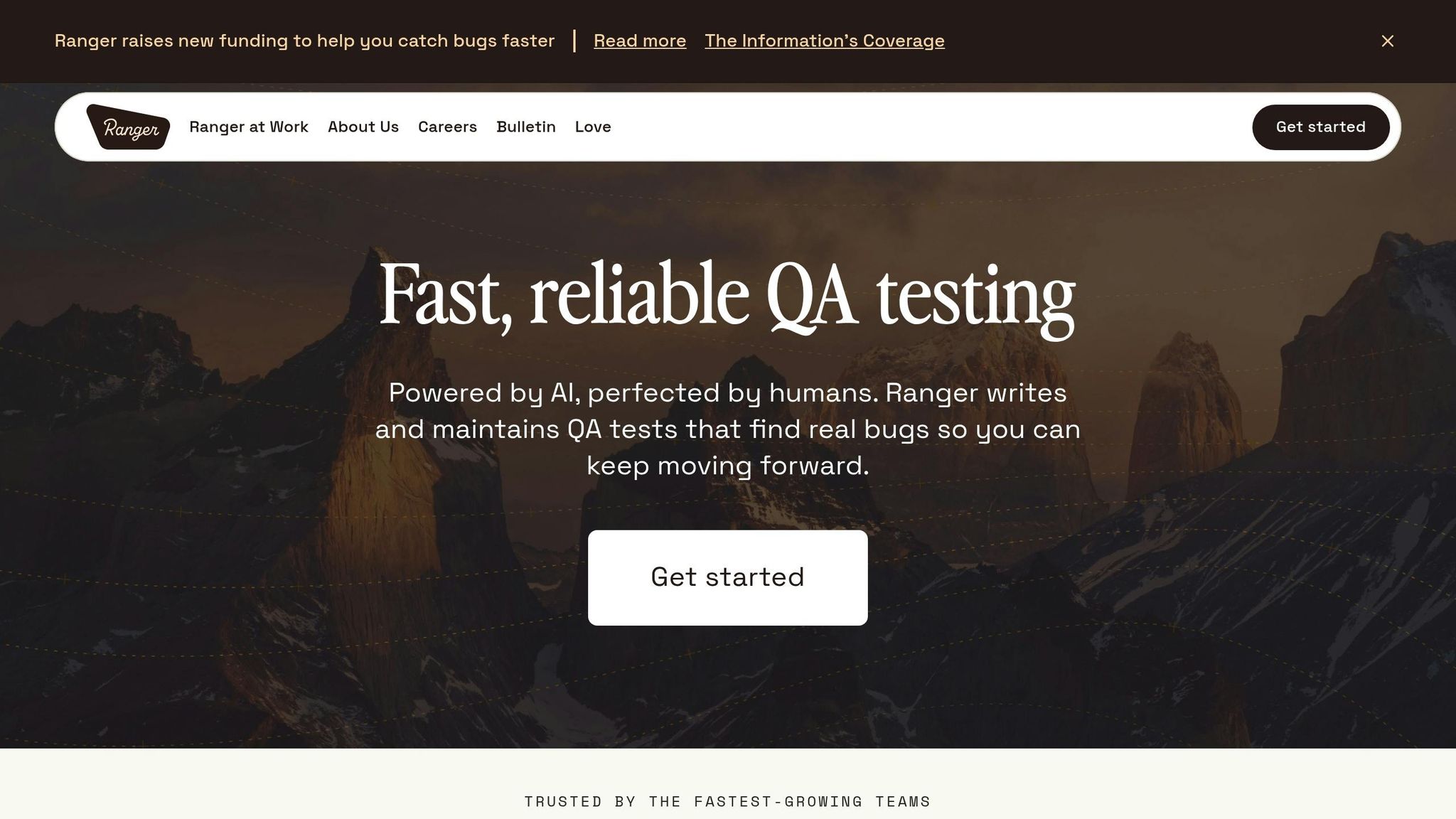
Software teams in the U.S. face a unique set of challenges - tight deadlines, complex applications, and strict privacy regulations like GDPR and CCPA. These factors often make traditional QA methods fall short. That’s where Ranger steps in with its hybrid solution, designed to meet the demands of modern software development.
Founded by Josh Ip, Ranger helps teams catch bugs early in the development cycle. By blending AI-driven automation with human QA expertise, it delivers the speed and precision today’s software teams need to stay ahead.
Key Features of Ranger
Ranger integrates seamlessly with tools like Slack and GitHub, ensuring smooth communication and instant access to test results. As tests run, results are automatically shared in GitHub, while Slack notifications keep the entire team in the loop and allow for quick tagging of key stakeholders.
One standout feature is Ranger’s AI-powered test creation. The platform generates test cases based on application behavior and code changes, which are then reviewed by experienced QA professionals. This eliminates the need for tedious manual scripting, saving teams valuable time.
Another game-changer is self-healing test automation. When UI elements or workflows are updated, the system adapts automatically, cutting down on maintenance work - a huge benefit for fast-moving U.S. teams.
Ranger also offers continuous end-to-end testing for staging and preview environments. This approach reduces the cost of late-stage bugs by detecting issues early, aligning perfectly with the CI/CD workflows that dominate American software development.
How Ranger Catches Bugs Early
Ranger’s ability to identify bugs early comes from its use of predictive analytics and continuous monitoring. The AI examines code changes, historical bug data, and test logs to flag potential issues before they escalate. Automated bug triaging ensures that critical issues are prioritized, while lower-priority bugs are categorized for later.
For example, in Q2 2024, a U.S.-based fintech startup incorporated Ranger into their CI/CD pipeline. The results were striking: they cut their average bug detection time from 3 days to under 4 hours, reduced QA overhead by 40%, and increased release velocity by 25% over six months.
"Ranger helps our team move faster with the confidence that we aren't breaking things. They help us create and maintain tests that give us a clear signal when there is an issue that needs our attention." - Matt Hooper, Engineering Manager at Yurts
Ranger’s continuous end-to-end testing also shines when it comes to catching integration issues and regression bugs - problems that traditional unit testing often misses. This comprehensive approach gives businesses a competitive edge by ensuring quality while minimizing risks.
Benefits for U.S. Enterprises
For U.S. companies, Ranger offers clear advantages in efficiency and cost management. Its automation reduces the need for manual QA, allowing teams to scale their testing efforts without adding more QA engineers - a critical benefit in a tight labor market.
One mid-sized e-commerce company saw a 60% drop in post-release defects after switching from manual QA to Ranger’s platform, which combines AI automation with human oversight. They credited this improvement to the early detection of bugs.
Ranger also addresses compliance concerns, a key issue for U.S. enterprises. The platform includes detailed audit trails and ensures test data security in line with American privacy regulations, reducing the risks tied to software releases in regulated industries.
Additionally, Ranger’s hosted test infrastructure eliminates the need for teams to manage their own testing environments. This managed setup reduces operational headaches while providing the scalability needed for enterprise applications. Teams can focus on building features instead of worrying about maintaining testing systems.
"Working with Ranger was a big help to our team. It took so much off the plates of our engineers and product people that we saw a huge ROI early on in our partnership with them." - Nate Mihalovich, Founder & CEO, The Lasso
Customer surveys from 2025 highlight the impact: engineers save over 200 hours per year thanks to Ranger’s automated testing, significantly improving development timelines.
With faster releases, lower QA overhead, and enhanced quality, Ranger offers a powerful solution for U.S. enterprises aiming to stay competitive while managing costs. Teams can deliver features more quickly without compromising on the reliability their customers expect. This underscores the value of early bug detection and its role in driving business success.
Best Practices for Maximizing ROI with AI QA
To get the most out of AI-powered QA, it's essential to focus your efforts where they deliver the greatest returns. By zeroing in on critical areas, smoothly integrating AI into existing workflows, and striking a balance between automation and human expertise, you can align your QA strategy with measurable ROI gains.
Focus on High-Risk Areas
Late-stage bugs can be expensive - both financially and in terms of user trust. That’s why channeling AI QA efforts toward high-risk areas like core business logic, payment systems, and user authentication is so important. These are the areas where even small errors can lead to significant revenue loss or user dissatisfaction.
A report from Capgemini's World Quality Report reveals that 66% of QA leaders in North America use AI for risk-based test optimization, concentrating resources on modules with the highest business risk. This makes sense when you consider that fixing bugs in production can cost 4–5 times more than addressing them earlier in the development cycle.
The best way to implement this is by analyzing historical bug data, code repositories, and usage logs to identify problem areas. For example, a financial services company used AI-driven test automation to focus on transaction processing and security in their core banking application. The result? A 40% drop in post-release defects and a 25% boost in test coverage.
AI tools are particularly effective at sifting through large datasets to uncover these patterns. By integrating this insight into your testing strategy, you can ensure that your resources are directed toward the areas where they’re most needed.
Add AI QA to CI/CD Pipelines
AI QA delivers its full potential when it becomes part of your CI/CD pipelines. Instead of treating testing as a standalone phase, embedding AI QA into development workflows creates a continuous feedback loop, catching bugs as soon as they appear.
This real-time feedback is invaluable. Developers can address issues while the code is still fresh in their minds, saving time and money. For example, in 2023, a major U.S. e-commerce platform integrated AI-driven QA into their CI/CD pipeline. They saw a 50% drop in late-stage bugs and a 30% cut in testing time. Their approach involved prioritizing tests based on code changes, combining AI insights with human expertise for critical workflows.
To replicate this success, set up your pipeline so that every code commit automatically triggers relevant tests. AI can analyze code changes and determine which tests to run, avoiding unnecessary execution of the entire suite. This not only saves time but ensures thorough coverage of the affected areas.
Additionally, configure your pipeline to block deployments when critical tests fail. This prevents buggy code from reaching production and gives developers immediate feedback on what needs fixing. The result? Faster development cycles and higher-quality software.
Combine AI Data with Human Expertise
AI is unmatched when it comes to speed and coverage, but human testers bring something irreplaceable: intuition and context. The most effective QA strategies combine these strengths, creating a hybrid model where AI handles repetitive tasks and humans tackle complex scenarios and edge cases.
Regular collaboration between AI-generated reports and human testers ensures that test scenarios remain accurate and comprehensive. This is especially important for workflows involving sensitive data or intricate business logic.
"We love where AI is heading, but we're not ready to trust it to write your tests without human oversight. With our team of QA experts, you can feel confident that Ranger is reliably catching bugs."
This quote highlights the importance of combining AI's efficiency with human judgment. Teams should establish processes for human testers to review and refine AI-generated test cases, particularly for critical user journeys or regulatory compliance.
A feedback loop is also essential. When human testers identify false positives or overlooked edge cases, this data should be fed back into the AI system to improve its accuracy over time. This continuous improvement cycle ensures that the AI becomes smarter while maintaining the high standards that only human expertise can deliver.
Conclusion: Building Quality Software with AI QA
The numbers don’t lie: AI-powered QA is transforming how software teams work, helping them stay ahead in a competitive and fast-paced industry. For instance, organizations have reported up to 21% higher productivity and 30% fewer missed defects after adopting AI-driven testing tools. Those are results that any team would want to replicate.
In the U.S., the impact is especially striking. Companies leveraging AI QA are saving significant amounts of time per engineer. And when issues are caught early, the cost to fix them is just a fraction of what it would be if they were discovered later. The result? A clear and undeniable return on investment.
But the benefits go beyond just saving money. AI QA enhances operations by increasing test coverage and cutting down on manual tasks. This creates a dual advantage: better software quality and less workload for engineers. The ripple effect? Faster time-to-market and happier customers - two things that can make or break success in today’s software world.
Take Nate Mihalovich’s experience, for example. His results highlight how AI QA delivers tangible value by combining automation with human oversight. Platforms like Ranger are proving that this hybrid approach isn’t just efficient - it’s reliable. Teams using these tools can confidently ship features faster without compromising on quality.
The momentum is already building. Right now, 66% of QA leaders in North America are using AI for risk-based test optimization. Early adopters are reaping the rewards: quicker release cycles, more reliable software, and smarter resource allocation. As software becomes more complex, teams that embrace AI QA today will be better equipped to tackle tomorrow’s challenges while meeting the high expectations of their customers.
For teams dedicated to delivering top-notch software, the real question isn’t if AI QA should be adopted - it’s how soon. The tools are ready, the benefits are clear, and the competitive edge is undeniable.
FAQs
What makes AI-powered QA more efficient and effective than traditional QA methods?
AI-driven QA testing transforms the development process by automating labor-intensive tasks such as test creation and upkeep. This approach cuts down on manual work while delivering steady and dependable outcomes throughout the software lifecycle.
With AI in the mix, development teams can catch and address bugs earlier, which can save them a huge amount of time and resources - sometimes hundreds of hours each year. Plus, AI-based QA adjusts seamlessly to codebase changes, reducing interruptions and enabling teams to roll out new features more quickly and with greater assurance.
How does human oversight enhance AI-powered QA testing?
Human involvement is essential for making sure AI-driven QA processes deliver reliable results. While AI can handle tasks like automating test creation and maintenance, it’s up to human experts to review the outcomes. They check that the code aligns with quality standards, is well-structured, and performs as expected.
By blending AI’s speed with human judgment, this approach helps identify errors that automated systems might overlook, leading to more dependable testing results.
How does integrating AI-powered QA into CI/CD pipelines enhance software development?
Integrating AI-driven quality assurance (QA) into your CI/CD pipelines ensures continuous testing throughout the development process. This approach catches bugs early, minimizing the chances of expensive, last-minute fixes.
AI-powered automation speeds up test creation and maintenance, freeing up your team to concentrate on developing features. By identifying real issues as they happen, you can streamline workflows, save valuable time, and deliver dependable software with confidence.
Related Blog Posts
Stop babysitting your coding agents. Use Ranger
%201%20(1).svg)
More signals, less noise, faster launches
Let Ranger be your guide to sustainable QA testing.

.png)