%201.svg)
Real-Time Test Feedback vs. Traditional QA Testing


Real-time test feedback is reshaping software development by integrating testing directly into the CI/CD pipeline, delivering results in seconds or minutes. This approach contrasts sharply with traditional QA testing, which operates as a separate phase after development, often causing delays and workflow disruptions. Here’s a quick breakdown:
- Speed: Real-time feedback runs tests automatically with every code change, providing results almost instantly. Traditional QA takes days or weeks, slowing down releases.
- Accuracy: AI-driven real-time systems filter out false positives and flaky tests. Traditional QA relies on manual testing, which is prone to errors.
- Scalability: Real-time feedback scales efficiently using AI and parallel execution. Traditional QA requires more testers and resources as test suites grow.
- Maintenance: Real-time systems use AI to self-update test scripts. Traditional QA demands constant manual updates for UI changes.
- CI/CD Integration: Real-time feedback is embedded into development workflows, while traditional QA often disrupts progress by operating as a separate phase.
Quick Comparison:
| Metric | Traditional QA Testing | Real-Time Test Feedback |
|---|---|---|
| Speed | Days or weeks | Seconds to minutes |
| Accuracy | Prone to manual errors | AI-driven, reliable results |
| Scalability | Linear, resource-heavy growth | Efficient, AI-powered scaling |
| Maintenance | High manual workload | Low, automated updates |
| Integration | Separate phase, slows releases | Embedded in CI/CD workflows |
Real-time feedback boosts productivity, reduces costs, and accelerates delivery, making it a game-changer for modern software teams.
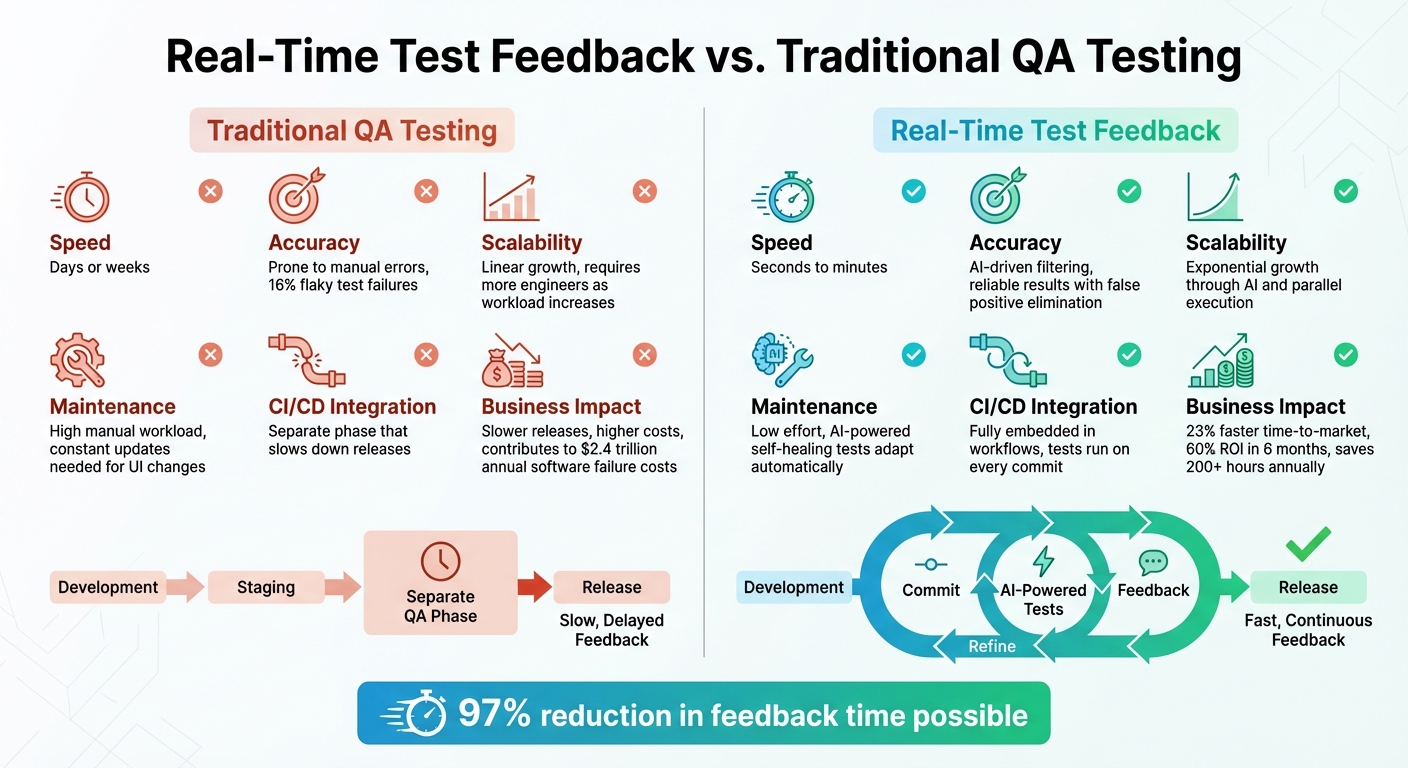
Real-Time Test Feedback vs Traditional QA Testing Comparison
A Tester's Guide to CI/CD: as an Automated Quality Control System
What is Traditional QA Testing?
Traditional QA testing kicks off only after the coding phase is complete. Instead of testing throughout the development process, teams hold off until they reach the "dev complete" milestone. At this point, the software is handed over to a dedicated QA team or fully-automated QA engineer. These professionals manually verify the system's functionality through code reviews and pre-written test scripts.
This approach leans heavily on human-written scripts created using tools like Selenium or Cypress. QA engineers are responsible for building and maintaining these scripts, often working independently from the development team. Tests are executed in large batches rather than continuously, resulting in feedback cycles that can take days or even weeks. In some cases, a single regression testing cycle can last up to 8 hours.
This segmented workflow means developers focus on building features first, then pass their work to QA for testing. When tests fail, developers often have to revisit code they wrote days or weeks earlier, disrupting their workflow. As software engineer Rouan Wilsenach points out, without proper testing in place, teams risk facing repeated failures. Below, we’ll dive into the main features and challenges of this approach.
Main Features of Traditional QA Testing
Traditional QA testing is known for being time-consuming and labor-intensive. Manual testing requires testers to follow step-by-step procedures for each test case, creating bottlenecks when teams need to integrate code multiple times a day. Even automated tests aren’t immune to issues - scripts often break when a UI element changes, leading to constant updates and a heavy maintenance workload.
In this model, QA operates as a separate team, which can lead to communication gaps. Developers frequently wait for QA to debug problems in code they originally wrote. Due to time constraints, manual testing efforts prioritize high-visibility functions, leaving edge cases - like special characters, expired sessions, or complex user flows - unexamined.
Additionally, varying interpretations of requirements among testers can result in inconsistent outcomes and make it harder to reproduce bugs. Looking ahead, 80% of enterprises are expected to adopt AI-augmented testing by 2027 to move beyond these manual-heavy processes.
Problems with Traditional QA Testing
While traditional QA testing has its defining features, it also presents significant hurdles. Testing that begins only after development is complete often leaves developers waiting days or weeks for results. Switching back to old code after a delay can take developers 20 minutes or more to regain focus. As applications grow, these delays only worsen.
"Manual regression testing is time-consuming to execute and expensive to perform, which makes it a bottleneck in the process. Software can't be released frequently and developers can't get quick feedback".
Relying on manual testing can increase long-term software testing costs by as much as 35%.
Scalability is another major issue. As applications become more complex, with thousands of interconnected services, it becomes impossible for human testers to cover every potential user interaction. Traditional test suites, which can take anywhere from 5 to 30 minutes to run, slow down development and often provide low coverage despite the significant effort involved.
There’s also the problem of "flaky tests", where tests fail unpredictably without any changes to the code. This inconsistency erodes trust in the automated test suite. In fact, 57% of organizations report that the absence of a solid test automation strategy is a major obstacle to improving their testing processes. Finally, discovering performance, security, or reliability issues late in the QA phase can lead to costly design changes that are difficult to implement.
What is Real-Time Test Feedback?
The need for faster and more integrated testing is reshaping how quality assurance fits into the development process, and real-time test feedback is at the center of this shift. This approach automates testing by running checks on every code commit, delivering results instantly within the CI/CD pipeline. By embedding validation directly into development, it ensures each update is verified before moving to production through continuous testing.
The aim? Provide feedback in less than 10 minutes. According to DORA research, this timeframe is crucial for keeping developers focused and productive. Some systems have even slashed feedback times by as much as 97%.
AI plays a big role here, automating test writing, triage, and even self-healing. These systems can generate tests using frameworks like Playwright, based on application testing plans, and produce human-readable code. They also sort through test failures, distinguishing actual bugs from environmental issues, and can fix broken builds without requiring constant human oversight.
Developers get results right where they work, whether through Slack notifications or GitHub pull requests. This instant feedback eliminates delays caused by traditional bug-reporting processes. By integrating directly into the workflow, these systems close the communication gaps that often slow down quality assurance.
"Fast feedback is the foundation of software delivery at scale. Long build and test cycles break developer focus, turning simple changes into momentum-killing pauses."
Main Features of Real-Time Test Feedback
At its core, real-time test feedback revolves around continuous testing. Every code change automatically triggers relevant tests, creating a constant loop that replaces the slower, batch-style testing approach.
One standout feature is intelligent test selection. Instead of running the entire test suite, AI analyzes code changes and dependency graphs to identify and execute only the affected tests. Early adopters have reported cutting feedback times by up to 90%, with some systems skipping over 90% of the full test suite by zeroing in on the tests that matter.
Automated bug detection and triage also streamline the process. AI agents classify test failures to identify genuine bugs while filtering out noise from environmental issues. This ensures developers can trust the feedback they receive, without wasting time on false alarms.
Self-healing capabilities tackle one of the biggest challenges in traditional QA: test maintenance. For example, if a UI element changes, AI-powered tests can adapt automatically, reducing the need for manual updates. Tools like CircleCI’s "Chunk" agent can even repair flaky tests and handle CI/CD maintenance tasks that might otherwise bog down teams.
Finally, integration with tools like Slack and GitHub ensures that feedback reaches developers instantly. By embedding testing into their natural workflow, these systems make testing a seamless part of development rather than a separate step. This integration not only speeds up testing but also boosts the overall efficiency of CI/CD pipelines.
How Real-Time Feedback Improves CI/CD Pipelines
Real-time feedback eliminates the bottlenecks that often plague development teams. Traditional test cycles that take 30 minutes or more can disrupt developers’ focus, requiring significant time to regain momentum. Delivering results in minutes - or even seconds - keeps developers in the zone and allows them to address issues while the code is still fresh in their minds.
Instant feedback also translates to significant time savings. Engineers using AI-driven testing platforms have reported saving over 200 hours annually by cutting out repetitive manual testing tasks. Ben Horne, Director of Engineering at FORM, highlights this efficiency:
"Smarter Testing has helped our team meaningfully shorten the cycle time between development, QA, and release. By automatically prioritizing the tests that matter most to our current work, we're able to move faster without sacrificing stability or coverage."
Continuous testing accelerates release cycles by providing immediate results, enabling teams to ship multiple updates per day with confidence. This speed is essential in agile environments, where quick responses to user feedback and market demands are key.
Real-time feedback also shifts responsibility for quality directly to developers. Instead of relying solely on a QA team, developers receive immediate notifications about issues in their code, allowing them to fix problems as they arise. This approach not only speeds up bug resolution but also reduces the complexity and cost of addressing issues later in the process.
Real-Time Test Feedback vs. Traditional QA Testing
Let’s take a closer look at how real-time test feedback stacks up against traditional QA testing. The differences are striking, especially when it comes to speed, accuracy, scalability, and overall business impact.
Traditional QA often slows down the development process. Testing happens only after development is complete, creating delays that can stretch from hours to days. This forces developers to wait for results, often disrupting their workflow. On the other hand, real-time testing is integrated into the development cycle itself, running automatically on every commit and delivering feedback in just seconds or minutes.
When it comes to accuracy, traditional QA methods can fall short. They’re prone to manual errors and flaky tests, which account for roughly 16% of failures and can erode trust in the system. Real-time feedback, powered by AI, is far more reliable. It effectively filters out environmental issues and pinpoints actual bugs, providing dependable results.
Scalability is another area where real-time feedback shines. Traditional QA requires more engineers as the test suite grows, leading to a linear increase in resources. In contrast, real-time testing leverages AI agents and parallel execution to handle growing workloads without adding extra headcount. This efficiency has allowed teams to save over 200 hours annually by automating repetitive manual testing tasks.
These differences are especially important for teams adopting CI/CD workflows. Real-time feedback integrates seamlessly into the pipeline, ensuring that tests run automatically on every commit or pull request. This level of integration helps accelerate development and reduces bottlenecks, unlike traditional QA, which often operates as a separate phase that slows down shipping.
Comparison Table: Key Differences
| Metric | Traditional QA Testing | Real-Time Test Feedback |
|---|---|---|
| Speed | Days or weeks; feedback after development | Seconds to minutes; runs during development |
| Accuracy | Prone to manual errors; 16% flaky test failures | AI filters out false positives; reliable results |
| Maintenance | High; manual updates for UI changes | Low; AI adjusts automatically to UI changes |
| Scalability | Linear; more engineers needed as workload grows | Exponential; AI handles increased volume efficiently |
| CI/CD Integration | Separate phase; slows down releases | Fully integrated; tests run on every commit |
| Business Impact | Slower releases, higher costs | 23% faster time-to-market, 60% ROI in six months |
The numbers tell the story. Software failures cost businesses a staggering $2.4 trillion annually in downtime and remediation. Teams that embrace real-time testing consistently report faster release cycles and reduced costs, with a 60% ROI in just six months. For example, in 2025, Ben Horne's team at FORM adopted real-time testing and dramatically shortened their cycle time between development, QA, and release by automatically prioritizing the most relevant tests for their work. This kind of efficiency isn’t just a nice-to-have - it’s a game-changer for modern software development.
sbb-itb-7ae2cb2
Benefits of Real-Time Test Feedback
Real-time test feedback eliminates the typical waiting game by providing results in seconds. This quick turnaround allows developers to fix bugs while they’re still immersed in the context, potentially saving up to 20 minutes of productivity for every interruption.
Faster Results and Improved Accuracy
Instant feedback transforms how teams handle testing, offering major gains in speed, precision, and efficiency.
For instance, real-time systems can shrink feedback cycles significantly, turning a 10-minute test suite into a lightning-fast 10-second run. How? Through intelligent test selection. These systems analyze code changes and run only the tests impacted by a specific commit. Thanks to AI-driven selection, over 90% of redundant tests can be skipped entirely.
But speed alone isn’t enough. Accuracy is just as critical. Real-time platforms use AI to triage test failures, distinguishing genuine bugs from flaky tests or environmental noise. This AI-generated analysis is further reviewed by human experts to ensure its dependability. In 2025, Matt Hooper, Engineering Manager at Yurts, highlighted this impact:
"Ranger helps our team move faster with the confidence that we aren't breaking things. They help us create and maintain tests that give us a clear signal when there is an issue that needs our attention".
Reduced Maintenance Work
Traditional QA often demands constant manual updates when the user interface evolves. Real-time feedback systems, however, leverage AI-powered self-healing tests, which automatically adapt to interface changes without requiring manual intervention. This automation can save engineers more than 200 hours annually, freeing them from repetitive maintenance tasks. Instead, teams can concentrate on building new features. Brandon Goren, a Software Engineer at Clay, shared in 2025:
"Ranger has an innovative approach to testing that allows our team to get the benefits of E2E testing with a fraction of the effort they usually require".
This streamlined process doesn’t just save time - it also makes scaling easier for teams.
Built for Growing Teams
Traditional QA grows at a linear pace, meaning more QA engineers are needed as the test suite expands. Real-time systems, on the other hand, scale exponentially. They achieve this through parallel execution and intelligent automation, ensuring that even as teams grow, quality remains intact. Within a CI/CD pipeline, this level of automation eliminates bottlenecks. Martin Camacho, Co-Founder of Suno, explained:
"They make it easy to keep quality high while maintaining high engineering velocity. We are always adding new features, and Ranger has them covered instantly".
The platform also automates browser environments and test infrastructure setup, allowing teams to increase test volume without adding manual effort or extra staff.
How to Implement Real-Time Test Feedback with Ranger
Switching to real-time test feedback doesn’t mean you need to completely revamp your workflow. Ranger makes it simple by blending AI automation with human expertise to deliver accurate testing results with minimal effort. It integrates smoothly with your current tools, so teams of all sizes can get started quickly. Let’s dive into the features that make this possible.
Ranger's Features for Real-Time Testing
Ranger’s system combines the power of AI with human oversight to streamline testing. At its core, an AI web agent navigates your site using a testing plan you provide. It then generates Playwright test code automatically. Before these tests are finalized, they’re reviewed by human QA experts to ensure they’re clear and reliable.
The platform also takes care of the testing infrastructure for you. It spins up browsers to run tests against your staging and preview environments, eliminating the need for your team to manage these environments. If a test fails, the AI agent conducts an initial analysis. From there, a team of "QA Rangers" steps in to verify if the failure points to a genuine bug before notifying your team.
Integration is another standout feature. Ranger connects directly to GitHub, automatically running your test suite whenever code changes are made. Results are displayed on pull requests, so developers can see them instantly. Additionally, Ranger’s Slack integration sends real-time notifications to specific channels, making it easy to loop in stakeholders for quick action. The web agent consistently delivers results that meet industry performance benchmarks.
Steps to Add Ranger to Your CI/CD Pipeline
Ready to integrate Ranger? Here’s how to get started:
- Connect to GitHub: Link Ranger to your GitHub repository to automatically trigger tests with every code update. This allows developers to see QA results directly in their workflow, reducing interruptions and keeping productivity high.
- Set Up Slack Alerts: Configure Slack notifications to receive immediate updates when tests fail. You can tag specific team members or channels to ensure the right people are alerted without delay.
- Target Preview Environments: Direct Ranger to run tests on staging or preview deployments to catch issues early, well before they reach production.
- Focus on Key User Flows: During the initial setup, prioritize testing your most critical user flows. Ranger’s team will maintain and update these test flows as you roll out new features, saving you from manual updates. Whether you’re migrating existing Playwright tests or starting fresh, Ranger adapts to your needs. Pricing is based on annual contracts and tailored to the size of your test suite.
Conclusion: Choosing the Right QA Approach
Traditional QA testing often slows things down, delivering feedback days - or even weeks - after code is written. This delay not only disrupts workflows but also makes fixing bugs far more expensive. In contrast, real-time test feedback, integrated directly into CI/CD pipelines, provides results in minutes. Developers can address issues immediately, while the code is still fresh in their minds.
The gap widens further when it comes to maintenance. Traditional automated scripts require constant manual updates as your UI evolves. On the other hand, modern real-time systems leverage AI-driven self-healing, adapting automatically to changes. This shift eliminates tedious manual work, freeing up engineers to focus on more critical tasks. Tools like Ranger combine AI and human oversight to deliver precise bug alerts, avoiding the false positives that plague fully automated solutions.
This streamlined maintenance not only speeds up the process but also enhances trust in the reliability of testing. As mentioned earlier, real-time feedback offers an unbeatable combination of speed and dependability. Research from DORA highlights that fast, automated testing improves software stability, reduces developer burnout, and eases deployment challenges. Matt Hooper, Engineering Manager at Yurts, sums it up perfectly:
"Ranger helps our team move faster with the confidence that we aren't breaking things. They help us create and maintain tests that give us a clear signal when there is an issue that needs our attention".
FAQs
How does real-time test feedback enhance developer productivity compared to traditional QA methods?
Real-time test feedback gives developers the ability to spot and fix bugs as they arise during development. This eliminates the usual delays tied to manual regression testing or waiting for post-development QA cycles. The result? Teams save time, cut down on manual work, and can concentrate on shipping high-quality code more quickly.
When integrated into CI/CD pipelines, real-time feedback catches issues early in the process. This prevents expensive rework, speeds up iterations, and keeps things moving smoothly. It’s a win-win: developers stay productive, features roll out faster, and the overall quality of the software gets a boost.
How does AI improve the accuracy and maintenance of real-time test feedback?
AI has revolutionized how real-time test feedback is handled by streamlining the process of identifying potential failures. By analyzing code changes, execution logs, and UI snapshots, it predicts where issues are most likely to arise. On top of that, it can automatically create or update test cases to focus on these high-risk areas, enabling teams to catch bugs the moment they appear - no more waiting through lengthy debugging cycles.
Another game-changer is AI-powered self-healing scripts. These scripts adapt to changes in the application, like updates to UI elements or APIs. They can automatically adjust selectors, data bindings, and assertions, cutting down on manual test maintenance and avoiding those frustrating brittle test failures.
What makes this system even more dependable is the combination of AI and human oversight. While AI handles the heavy lifting, humans step in to validate recommendations, filter out false positives, and review detailed insights for each failure. This collaboration ensures accurate, real-time feedback in CI/CD pipelines, empowering teams to roll out high-quality features faster and with greater confidence.
How is real-time test feedback more scalable than traditional QA testing?
Real-time test feedback scales effortlessly by tapping into the power of automation within CI/CD pipelines. With this approach, tests run automatically and in parallel across multiple builds and code changes. The result? Faster feedback without piling on extra manual work.
In contrast to traditional QA testing, which often involves step-by-step processes and hands-on involvement, real-time feedback keeps up with the speed of your development. As your team pushes out features more quickly, automated testing ensures steady coverage and precision, allowing you to uphold quality while conserving both time and resources.
Related Blog Posts
Stop babysitting your coding agents. Use Ranger
%201%20(1).svg)
More signals, less noise, faster launches
Let Ranger be your guide to sustainable QA testing.

.png)