%201.svg)
How Legacy QA Slows CI/CD Pipelines

Legacy QA methods are slowing down CI/CD pipelines, causing delays, inefficiencies, and higher costs. Here's why: outdated manual testing processes, fragile test scripts, and siloed QA teams create bottlenecks and increase risks. Modernizing QA can significantly improve speed and reliability.
Key Issues with Legacy QA:
- Manual Testing: Engineers lose over 200 hours per year on repetitive testing tasks, delaying deployments.
- Fragile Test Scripts: Hard-coded values and brittle locators frequently break, diverting developers from building features.
- Scalability Problems: Legacy tools like on-premises Jenkins struggle to handle the demands of modern, containerized environments.
- Late Bug Detection: Bugs found in production lead to costly fixes and damage user trust.
- Isolated QA Teams: Poor collaboration slows feedback loops and disconnects QA from development.
Solutions for Faster CI/CD:
- Automate QA: Replace manual testing with automated tools like Selenium to save time and reduce errors.
- Test Earlier: Shift-left testing catches issues during development, reducing late-stage surprises.
- Run Tests in Parallel: Use tools like Docker and Kubernetes to execute tests simultaneously, cutting run times.
- Integrate QA with CI/CD: Tools like Ranger streamline testing into GitHub and Slack, ensuring real-time feedback and efficient workflows.
Why It Matters:
Modernizing QA isn't optional. Data from 2024–2025 shows automated testing reduces critical deployment failures by 42% in just six months. Tools like Ranger combine AI-driven test creation with human oversight, saving teams over 200 hours annually and ensuring faster, smoother releases.
Take Action Now: Review your QA processes, automate repetitive tasks, and integrate testing into your CI/CD pipeline to eliminate bottlenecks and improve productivity.
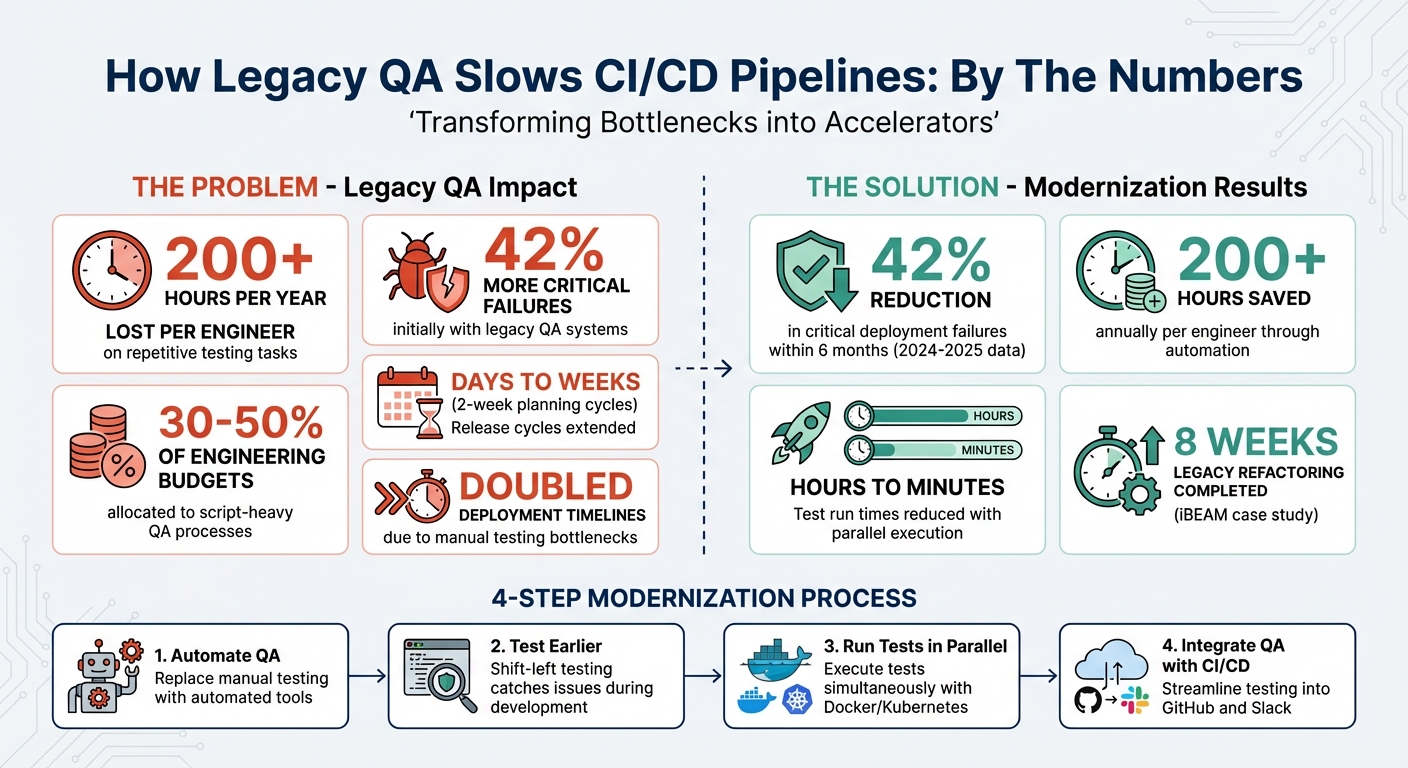
Impact of Legacy QA on CI/CD Pipelines: Key Statistics and Solutions
How to scale automated testing beyond CI/CD pipelines
Main Problems with Legacy QA Methods
Legacy QA methods come with a host of challenges that can seriously hinder the performance of CI/CD pipelines. Let’s break down the key issues.
Manual Testing Slows Everything Down
Manual QA processes eat up valuable engineering time that could be better spent on building features. On average, engineers lose over 200 hours per year to testing tasks alone. This approach creates bottlenecks in CI/CD pipelines, where deployments often grind to a halt, waiting for manual handoffs. In many legacy workflows, a single operations person has to manually trigger scripts in sequence, leaving teams stuck with "painfully slow" feature releases.
Constant Maintenance of Fragile Test Scripts
Test scripts in legacy systems are notoriously fragile. Hard-coded values and brittle locators break frequently, especially with the daily deployments typical of modern development cycles. Every update to the UI or API forces engineers to drop everything and fix these scripts. This not only delays releases but also pulls developers away from building new features.
As one expert has noted: "Shell scripts often render pipelines brittle… the more complex your pipeline, the more brittle it will become". In fact, maintaining these fragile scripts can end up consuming more time than actual feature development, creating significant opportunity costs. Instead of focusing on innovation, engineering teams are stuck patching up scripts that should be working in their favor - not against them.
"Working with Ranger was a big help to our team. It took so much off the plates of our engineers and product people that we saw a huge ROI early on in our partnership with them." - Nate Mihalovich, Founder & CEO, The Lasso
Limited Scalability and Flexibility
Legacy QA methods struggle to keep pace with the demands of agile development and rapid releases. Manual steps, outdated infrastructure, and tools that aren’t cloud-native create major bottlenecks as systems grow in scale - whether that’s more users, data, or workloads. Many of these setups rely on on-premises tools like Jenkins, which don’t integrate well with modern containerized or serverless environments. The result? Performance degrades significantly at scale.
For teams that are "always adding new features", maintaining and evolving tests becomes an overwhelming task. Without continuous end-to-end testing, QA becomes the roadblock that slows down fast-moving teams - defeating the entire purpose of CI/CD pipelines.
These problems underscore the urgent need to modernize QA practices to keep up with today’s fast-paced development environments.
How Legacy QA Impacts CI/CD Performance
Outdated QA practices can significantly hinder CI/CD workflows, leading to longer release cycles, delayed bug detection, and disconnected teams. These inefficiencies not only slow down development but also increase risks, making it harder for teams to deliver high-quality software quickly.
Longer Release Cycles
Legacy QA methods often stretch deployment timelines from days to weeks. Manual testing and step-by-step processes create bottlenecks at every stage - teams are left waiting for approvals, tests run at a sluggish pace due to limited infrastructure, and deployments stall. These delays can double the time it takes to release updates, turning what could be a few days into two-week planning cycles, hampering the ability to respond swiftly to market demands.
Data from modernization efforts between 2024 and 2025 highlights that legacy QA systems initially lead to 42% more critical failures, extending release cycles until automated testing is adopted to mitigate risks. When developers spend more time maintaining test scripts than actually building features, the time-to-market suffers. Features that should be live within days end up taking weeks, with release cycles shifting from daily to weekly - or even bi-weekly - cadences.
These delays also mean that issues are often discovered much later in the process.
Bugs Found Too Late
Without continuous and comprehensive testing, defects often go unnoticed until they reach production environments. This outdated approach results in bugs being discovered by end users, creating costly and time-consuming reactive fixes. Beyond the financial hit, this can damage a company’s reputation - issues that could have been caught earlier instead become public problems.
The ripple effects go further. Engineering teams lose momentum and confidence, worrying that any change might break existing functionality. This uncertainty forces developers to spend excessive time on repetitive testing and bug fixes, diverting focus from building new features. Over time, regressions accumulate, slowing down progress and adding to an ever-growing pile of technical debt.
Isolated QA Teams
Fragmentation within QA teams creates another major obstacle to efficient CI/CD processes. When QA operates in isolation, collaboration suffers, and feedback loops slow down. Test results often fail to integrate seamlessly into development workflows, leaving stakeholders without real-time insights into quality status. This disconnect leaves product and development teams "out of the loop", unaware of QA progress or unresolved issues.
This siloed approach also creates a reliance on specialized QA personnel, further slowing team velocity. Without integrated communication tools like Slack or GitHub, teams waste precious time on handoffs and status updates instead of addressing problems collaboratively. The result? A disjointed process where everyone moves more slowly, undermining the very essence of CI/CD - continuous integration and delivery.
sbb-itb-7ae2cb2
How to Modernize QA for Faster CI/CD
Updating your QA process doesn't have to happen all at once. By gradually transitioning from manual, step-by-step tests to automated, continuous workflows, you can lay the foundation for faster and more efficient CI/CD pipelines.
Start Testing Earlier in Development
Shift-left testing involves moving quality checks to the earliest stages of development instead of waiting until the end. Developers can run unit and API tests right in their IDEs or during the initial phases of CI using tools like JUnit or SonarQube. This approach provides immediate feedback on code changes, making it easier and less expensive to fix issues early.
For legacy systems, starting with characterization tests is a smart move. These tests create a protective layer around undocumented code, allowing teams to refactor confidently without breaking existing functionality.
Automate Your QA Processes
Manual testing slows down deployment. By automating tests, you can cut execution time from hours to minutes while significantly reducing manual effort. Modern tools now include self-healing scripts that adjust automatically to UI changes, solving the problem of fragile legacy tests.
The benefits are clear. Teams that replaced outdated scripts with automated tools like Selenium - integrated into CI/CD platforms like Jenkins or GitLab CI - reported a 42% drop in critical deployment failures within six months. A standout example is iBEAM's Generative AI framework, which automated refactoring, testing, and deployment in just 8 weeks, clearing legacy obstacles. To get started, try a pilot project in high-risk areas using low-code tools, then expand with cloud-based platforms that support parallel execution and scaling.
Run Tests in Parallel
Running tests one at a time creates delays. Once tests are automated, running them in parallel can speed things up dramatically. Parallel execution spreads tests across multiple environments or containers, cutting run times from hours to minutes. Using containerized setups with Docker and Kubernetes, combined with CI/CD tools like GitLab CI or Jenkins, makes this possible. Adding dynamic resource scaling and caching strategies for build artifacts further reduces setup time and ensures the system can handle peak demand. This approach ensures testing keeps up with development, enabling faster and smoother deployments.
How Ranger Improves QA for CI/CD
Ranger tackles the challenges of outdated QA processes by combining AI-driven automation with human oversight. It streamlines test creation, maintenance, and execution, fitting seamlessly into your CI/CD workflow. The result? No more delays or fragile tests that slow your team down.
Smarter Test Creation with AI and Human Expertise
Ranger takes QA to the next level by blending AI automation with human review. Its AI explores your application and generates Playwright tests automatically. Then, human experts step in to ensure these tests are reliable and easy to understand. Unlike systems that rely solely on automation, this approach guarantees dependable results. Plus, as your product evolves, these tests update automatically - saving your engineers from the grind of constant maintenance. According to Ranger, this process frees up more than 200 hours per engineer annually from repetitive testing tasks.
"Ranger has an innovative approach to testing that allows our team to get the benefits of E2E testing with a fraction of the effort they usually require." - Brandon Goren, Software Engineer, Clay
Seamless CI/CD Integration
Ranger integrates directly with tools like GitHub and Slack, embedding itself into your CI/CD pipeline. Tests run automatically as code changes, and results are delivered right inside GitHub pull requests. Slack notifications keep your team in the loop, tagging the right people when action is needed. This eliminates the slow, disjointed QA handoffs common in older workflows, paving the way for faster and more efficient testing cycles.
Continuous End-to-End Testing at Scale
Ranger provides hosted infrastructure to support continuous testing across staging and preview environments. It handles parallel test execution, slashing test run times from hours to just minutes - without the limitations of traditional on-premise tools. When issues arise, Ranger's team steps in to verify real bugs, giving engineers clear and actionable feedback.
"Ranger helps our team move faster with the confidence that we aren't breaking things. They help us create and maintain tests that give us a clear signal when there is an issue that needs our attention." - Matt Hooper, Engineering Manager, Yurts
Conclusion
Traditional QA methods - like manual testing, fragile scripts, and siloed teams - are slowing down CI/CD pipelines and delaying software releases. It's estimated that organizations allocate 30–50% of their engineering budgets to script-heavy QA processes, which ultimately hinder agile workflows. This results in extended release cycles, delayed bug detection, and wasted developer hours.
Key Takeaways
Updating QA processes is no longer optional if teams want to deliver software quickly and reliably. Outdated practices create inefficiencies that consume resources and delay deployments, costing teams valuable time and money. Data from 2024–2025 shows that integrating modern CI/CD practices with automated testing reduced critical deployment failures by 42% within six months. By focusing on early testing, automation, and parallel test execution, teams can eliminate these bottlenecks and regain their agility.
Solutions like Ranger illustrate the potential of AI-driven testing to simplify workflows. Ranger uses AI-powered test creation combined with human oversight, automates test maintenance, and integrates smoothly with CI/CD tools like GitHub and Slack. This approach not only detects bugs faster but also saves engineers over 200 hours annually by reducing repetitive testing tasks. These advancements highlight the urgency of modernizing QA processes.
Next Steps
Now is the time to modernize your QA strategy and eliminate delays. Start by analyzing your pipeline to identify bottlenecks and outdated scripts that require constant upkeep. Consider piloting Ranger’s AI-driven testing alongside your current GitHub and Slack workflows. Begin with phased automation, such as characterization tests, to minimize deployment failures while speeding up releases. Automated testing is essential for maintaining safe CI/CD practices, especially with legacy systems. Explore how Ranger can help streamline your QA efforts, enabling your team to meet the demands of today’s fast-paced development cycles.
FAQs
How does QA automation make CI/CD pipelines faster and more efficient?
Automating QA plays a key role in improving the efficiency of CI/CD pipelines by ensuring continuous and consistent testing throughout development. This approach catches bugs earlier, minimizes the reliance on manual testing, and eliminates delays caused by time-consuming testing cycles.
By simplifying test creation and upkeep, automation allows development teams to prioritize delivering new features more quickly without compromising on quality. It provides dependable results, ultimately saving time and resources over the course of the project.
What challenges can manual testing create for CI/CD pipelines?
Manual testing within CI/CD pipelines often results in slower feedback loops because it takes longer to execute compared to automated testing. This added time can disrupt development and deployment schedules, making it challenging to stick to tight release timelines.
On top of that, manual testing introduces a higher chance of human error and inconsistent test coverage, which can lead to overlooked bugs or unreliable outcomes. These shortcomings can negatively impact software quality and delay the rollout of key updates or features. For teams focused on speed and reliability, manual testing frequently becomes a hurdle in achieving those goals.
What are the benefits of connecting QA with CI/CD tools like GitHub and Slack?
Integrating QA with CI/CD tools like GitHub and Slack can significantly boost your team's efficiency. By automating testing processes and delivering real-time updates, this setup helps catch bugs faster, sends instant notifications, and fosters smoother collaboration among team members.
With streamlined communication and fewer manual tasks, your team can speed up development cycles, concentrate on building high-quality features, and maintain consistent, reliable testing results throughout the process.
Related Blog Posts
Stop babysitting your coding agents. Use Ranger
%201%20(1).svg)
More signals, less noise, faster launches
Let Ranger be your guide to sustainable QA testing.

.png)