%201.svg)
How AI-Powered QA Improves Engineering Velocity

AI-powered QA testing is transforming software development by speeding up processes, reducing costs, and improving product quality. Here's what you need to know:
- Faster Testing: Companies like Microsoft and Google cut testing times by up to 60% using AI.
- Improved Accuracy: AI predicts bugs early, with Google identifying 80% of critical errors pre-release.
- Cost Savings: Automation reduces manual efforts, saving companies hundreds of thousands annually.
- Better Workflows: AI integrates directly with tools like Slack and GitHub, providing real-time test feedback and reducing bottlenecks.
- Balanced Approach: Machines handle repetitive tasks, while humans focus on complex problem-solving.
AI in QA isn't just about speed - it's about smarter workflows. From automated test creation to predictive analytics, it's reshaping how software teams work while maintaining high-quality standards.
Generative AI for Software Testers | Revolutionize Your QA Workflow with AI Tools
How AI in QA Accelerates Software Delivery
AI is transforming quality assurance (QA) from a time-consuming hurdle into a driving force for faster software delivery. By addressing long-standing challenges, AI empowers teams to work more efficiently, from test creation to predicting faults early in the development process.
Automated Test Creation and Maintenance
AI simplifies the creation and upkeep of test scripts by automating these processes. Tools like Playwright can generate detailed test scripts automatically, changing the way teams approach testing. One of the standout features is self-healing scripts, which adapt to changes in the user interface or application logic. This eliminates the tedious task of manually updating scripts every time something changes. However, human expertise remains essential - reviewers ensure that AI-generated scripts are reliable, readable, and aligned with the project’s goals.
"Ranger has an innovative approach to testing that allows our team to get the benefits of E2E testing with a fraction of the effort they usually require."
- Brandon Goren, Software Engineer, Clay
Smart Test Prioritization and Coverage
AI takes testing to the next level by analyzing historical data, code changes, and risk patterns to focus on the areas most likely to contain defects. It also identifies coverage gaps by examining code paths and past failures. Companies like Microsoft have seen impressive results: by integrating AI into Azure DevOps and Visual Studio, they reduced regression testing time by over 60%, cut test script maintenance by 50%, and improved high-risk code detection by 40%. Similarly, Infosys reported a 60% reduction in regression testing cycles and a 45% improvement in defect detection rates for enterprise clients.
Integration with DevOps Workflows
AI-driven QA tools integrate seamlessly into DevOps workflows, embedding quality checks directly into the development process. These systems work with platforms like Slack and GitHub to provide real-time feedback within developers' existing tools. For instance, tests can run automatically whenever code is updated, with results delivered straight to pull requests or chat channels. Additionally, tasks like browser setup and environment configuration are automated, allowing developers to focus on creating new features rather than troubleshooting infrastructure.
"Ranger helps our team move faster with the confidence that we aren't breaking things. They help us create and maintain tests that give us a clear signal when there is an issue that needs our attention."
- Matt Hooper, Engineering Manager, Yurts
Predictive Analytics for Early Bug Detection
AI uses machine learning to predict and prevent late-stage bugs before they become major problems. By analyzing historical defect data and code churn, these systems can forecast which parts of the code are most likely to fail. For example, Google’s AI system has been able to predict 80% of critical errors before release. Over time, these models improve as they learn from each release cycle and defect patterns. By highlighting high-risk areas based on recent changes and complexity, AI helps both automated tools and human testers focus their efforts where they’re needed most. Microsoft reported a 35% boost in testing efficiency thanks to early defect detection in high-risk areas.
Balancing AI Automation with Human Oversight
Despite AI’s ability to handle repetitive tasks and analyze vast amounts of data, human input is still vital. The most effective QA processes combine AI’s speed and precision with human judgment. While AI can generate, execute, and maintain tests, humans are needed to validate results, interpret ambiguous findings, and ensure everything aligns with broader business objectives. This partnership between AI and human expertise not only speeds up software delivery but also ensures that quality remains a top priority.
"We've loved our experience with Ranger. They make it easy to keep quality high while maintaining high engineering velocity. We are always adding new features, and Ranger has them covered in the blink of an eye."
- Martin Camacho, Co-Founder, Suno
Research and Case Studies: AI QA Impact on Engineering Speed
Real-world examples show that incorporating AI into quality assurance (QA) processes can significantly boost engineering speed. Leading tech companies have shared measurable improvements in testing efficiency, defect detection, and release cycles, showcasing how AI is reshaping software development.
Case Studies from Industry Leaders
Google's Smart Test Selection has set a benchmark for AI-driven QA at scale. In 2023, Google introduced this system, which uses machine learning to focus on the most relevant test cases based on code changes and historical data. This approach cut test execution time by 50% without compromising defect detection rates. By delivering near-instant developer feedback, the system eliminated traditional bottlenecks, enabling faster iterations.
Netflix adopted AI in its continuous testing processes, prioritizing critical user paths. This approach reduced testing time by 50%, which was crucial for a platform serving millions of users globally. The ability to quickly validate essential features ensured reliable service during rapid feature rollouts.
IBM improved enterprise testing with AI-generated test datasets, reducing provisioning time by over 70%. These datasets enhanced edge case coverage, leading to better defect detection and more reliable products.
Facebook (now Meta) implemented AI-based visual testing across its apps, including Instagram, WhatsApp, and Messenger. By running visual tests in parallel within CI/CD pipelines, Facebook maintained UI consistency across billions of interactions while meeting its aggressive update schedule.
These examples highlight the tangible benefits AI brings to QA workflows.
Performance Metrics and Results
The impact of AI in QA is backed by compelling performance data. Microsoft, for instance, used AI to focus testing on high-risk areas, achieving a 35% efficiency boost by dynamically assigning risk scores to code changes.
Research by Coherent Solutions revealed several key improvements after adopting AI: a 50% reduction in test-case writing effort, a 60% increase in documentation speed, a 35% improvement in test coverage, and a 25% reduction in test planning time.
The financial advantages are equally striking. Scope3, a climate tech company, doubled its release velocity to 20+ deployments per week and reduced the time to add new test coverage to just 24 hours. They also saved over $300,000 annually by cutting manual testing costs and reducing the need for additional QA staff.
When comparing AI-assisted testing to traditional methods, studies found that AI sped up test case creation by 41%, reduced defect density by 62%, and shortened overall test execution time by 35%. These improvements directly translate to faster product launches and lower operational costs.
Lessons from Successful Implementations
The success of AI-powered QA isn't just theoretical - it’s proven in real-world applications. A key takeaway is the importance of integrating AI into existing workflows. For example, Scope3 embedded AI-driven testing into its CI/CD pipeline, enabling multiple daily production deployments with confidence.
At the same time, human oversight remains critical. Coherent Solutions found that while AI streamlined tasks like documentation and test planning, human expertise was still essential for analyzing requirements, assessing risks, and managing complex edge cases. This hybrid approach ensures automation accelerates processes without sacrificing strategic judgment.
Standardization and knowledge sharing also play a vital role. Companies that developed shared prompt libraries, standardized workflows, and thorough documentation experienced smoother onboarding and more consistent results across teams.
Finally, continuous improvement of AI models is crucial. Companies like Microsoft and Google refined their systems based on real-world feedback, improving their ability to predict defects and prioritize tests over time.
sbb-itb-7ae2cb2
Business Impact: ROI and Faster Time-to-Market
AI-powered QA isn't just about improving testing efficiency - it delivers real financial and operational benefits. Companies adopting these solutions report faster delivery cycles, lower operational costs, and better product quality, all of which contribute to higher customer satisfaction.
Before and After AI QA Adoption Metrics
The transformation AI brings to QA processes is evident when you compare performance metrics before and after its adoption. In 2024, Coherent Solutions implemented an AI-driven QA framework using OpenAI and Claude models across a team of 360 QA engineers in nine countries. The outcomes were impressive: test-case writing efforts dropped by 50%, documentation speed jumped by 60%, and test coverage expanded by 35%.
Microsoft also saw remarkable results after integrating AI test automation into its CI/CD pipelines. Regression testing time was slashed by over 60%, and test script maintenance efforts were halved. Additionally, predictive models boosted defect detection rates by 40%.
Infosys experienced similar success with its AI-Assured Testing framework. Their enterprise clients saw regression testing cycles cut by 60% and defect detection rates improve by 45%, enabling faster releases without sacrificing quality.
| Company | Metric | Improvement | Impact |
|---|---|---|---|
| Coherent Solutions | Test-case writing effort | ↓ 50% | Faster test development |
| Coherent Solutions | Documentation speed | ↑ 60% | Accelerated knowledge sharing |
| Microsoft | Regression testing time | ↓ 60% | Shorter release cycles |
| Infosys | Defect detection rate | ↑ 45% | Higher product quality |
These measurable improvements not only enhance operational efficiency but also lead to substantial cost savings and smarter resource use.
Cost Efficiency and Resource Optimization
AI-powered QA reshapes how testing resources are utilized. By automating repetitive tasks like test case generation, maintenance, and regression testing, teams can focus on more strategic, high-value activities.
A 2025 survey by Ranger found that each engineer saves over 200 hours annually on repetitive testing tasks. Common test maintenance issues are solved by self-healing test scripts, which adapt automatically to software changes, further reducing the need for manual updates and cutting maintenance overhead. This level of automation allows QA teams to scale their efforts across more projects without increasing headcount, maximizing efficiency.
The result? Better allocation of resources, greater productivity, and a direct boost to product reliability.
Better Product Reliability and Customer Satisfaction
AI-driven QA doesn’t just streamline processes - it also enhances product quality. With improved test coverage and early bug detection, software releases are more robust, leading to fewer production crashes and better user experiences. In fact, flagship applications saw a 50% reduction in production crashes after adopting AI-powered QA.
"Working with Ranger was a big help to our team. It took so much off the plates of our engineers and product people that we saw a huge ROI early on in our partnership with them."
- Nate Mihalovich, Founder & CEO, The Lasso
AI’s predictive capabilities take things a step further. For example, Google’s machine learning approach identified 80% of critical errors before delivery, significantly cutting down on post-release issues.
These advancements also boost developer confidence, empowering teams to introduce new features without worrying about quality compromises. This creates a cycle of continuous improvement: better testing leads to higher-quality products, which in turn drives customer satisfaction and reduces support costs. Ultimately, this positions companies for long-term growth and a stronger competitive edge.
Ranger: AI-Powered QA in Action
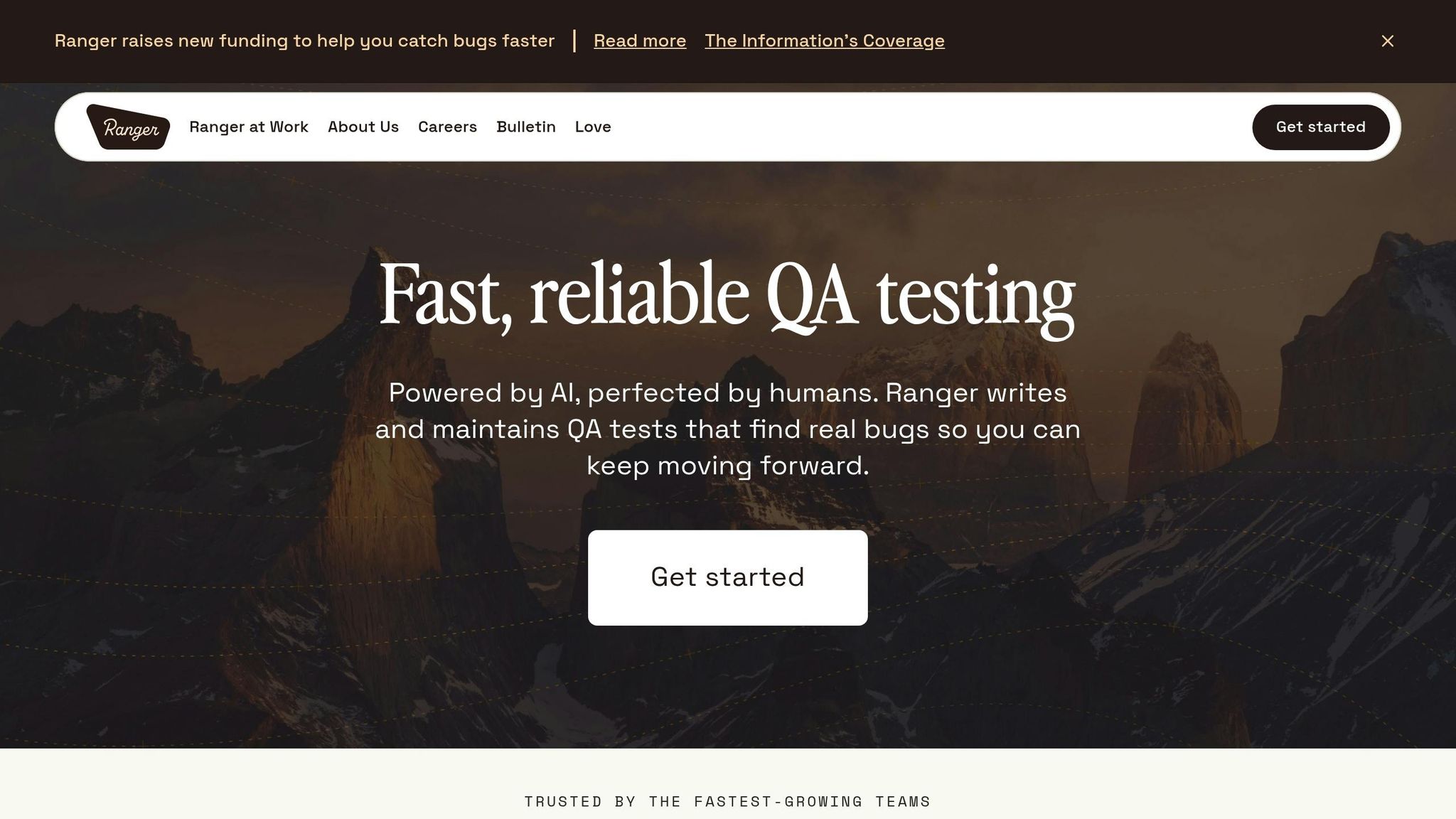
Ranger is a standout example of how AI-powered quality assurance (QA) can revolutionize engineering workflows in practical applications. While the industry has seen impressive advancements in AI-driven QA, Ranger takes it a step further by combining automated testing with human oversight. This blend ensures it adapts effortlessly to the fast-paced demands of modern development. Below, we explore how Ranger brings these benefits to life through cutting-edge automation, seamless tool integration, and real-world success stories.
End-to-End Testing with AI and Human Oversight
Ranger employs a hybrid approach, where AI handles the bulk of test creation and execution, while human QA experts step in to review and validate results. This combination ensures faster, more accurate testing by automating repetitive tasks like regression testing and maintenance, freeing up experts to tackle complex scenarios that need contextual understanding.
The platform's AI web agent auto-generates Playwright code based on testing plans, which QA experts then review to ensure quality and clarity. When tests fail, Ranger automatically triages the results, allowing human reviewers to distinguish between actual bugs and false positives.
Ranger also manages the entire test infrastructure, from hosting to spinning up browsers, ensuring tests run quickly and consistently. As new features are rolled out, the platform adapts existing tests to prevent regressions, maintaining critical workflows with minimal manual input.
Integration with Development Tools
Ranger seamlessly integrates with Slack and GitHub, streamlining communication and feedback during the development process.
- Slack: Teams receive instant notifications about test results directly in Slack. When issues arise, the platform automatically tags the relevant stakeholders, ensuring everyone stays informed and can act quickly.
- GitHub: Ranger runs test suites as code changes are made, sharing results directly within pull requests and commit discussions. By testing against staging and preview environments, the platform helps catch bugs early in the development cycle.
Case Studies and Success Stories
Ranger's impact is best seen through its users' experiences and measurable results. According to a 2025 customer survey, engineers saved over 200 hours annually on repetitive testing tasks, allowing them to focus on building new features.
"Ranger has an innovative approach to testing that allows our team to get the benefits of E2E testing with a fraction of the effort they usually require."
- Brandon Goren, Software Engineer, Clay
"Working with Ranger was a big help to our team. It took so much off the plates of our engineers and product people that we saw a huge ROI early on in our partnership with them."
- Nate Mihalovich, Founder & CEO, The Lasso
Even OpenAI partnered with Ranger to enhance their testing capabilities, praising the platform's ability to capture complex web browsing behaviors.
These examples highlight how Ranger is reshaping QA processes, paving the way for broader business benefits explored in the next section.
Conclusion: Proven Benefits and Future of AI-Powered QA
AI-powered QA is proving to be a game changer, delivering measurable improvements in speed and cost efficiency. For instance, Microsoft managed to cut regression testing time by over 60%, while Google’s Smart Test Selection system slashed test execution time by 50%, all without compromising defect detection rates. These kinds of outcomes mean faster software releases, lower costs, and better-quality products.
The financial benefits are just as compelling. Companies have reported saving hundreds of thousands of dollars annually while speeding up their release cycles. These savings come from reducing manual testing efforts, identifying defects faster, and using resources more efficiently.
A standout example is Ranger’s hybrid model, which combines AI-driven automation with human oversight. This approach strikes the right balance, allowing teams to move quickly while ensuring accuracy and avoiding false positives that could otherwise slow development.
Looking ahead, the future of QA seems to lie in even smarter automation and tighter integration. AI-powered tools are expected to further streamline workflows with features like self-healing tests that adapt to UI changes automatically and predictive analytics that catch bugs earlier in the development process. The vision is an end-to-end integration of AI across the software development lifecycle, from requirements analysis to release management.
For organizations exploring AI-powered QA, a phased and strategic rollout is the way to go. Start with tools that align smoothly with existing DevOps workflows and development platforms, and keep an eye on key metrics like time-to-market, test coverage, and reductions in manual effort to gauge success. Above all, it’s critical to maintain a balance between the efficiency of AI and the irreplaceable judgment of human experts to fully transform QA processes.
Those embracing these advancements aren’t just speeding up - they’re creating better software with more confidence. As AI continues to evolve, the organizations adopting these tools today will be better prepared to take advantage of tomorrow’s breakthroughs.
FAQs
How does AI-powered QA help engineering teams deliver software faster?
AI-driven QA tools speed up software delivery by handling repetitive tasks such as test creation and upkeep. This automation cuts down the time engineers spend on manual testing, ensuring precise and dependable testing outcomes. It also helps teams catch and address genuine bugs earlier in the development process.
With a more efficient QA process, engineering teams can dedicate their energy to developing features, stick to timelines with greater ease, and deliver top-notch products to market more quickly.
Why is human oversight essential in AI-powered QA, and how does it enhance the process?
Human involvement plays a key role in AI-driven QA processes, as it ensures that the tests generated by AI are accurate, dependable, and easy to understand. While AI is great at automating repetitive tasks and spotting potential problems, it’s the human experts who step in to validate results, fine-tune test cases, and tackle complex scenarios that AI might overlook.
By blending AI’s speed and efficiency with human critical thinking and expertise, teams can uncover actual bugs, enhance the quality of tests, and confidently roll out new features more quickly.
How does AI-powered QA help companies save time and improve efficiency?
AI-driven quality assurance (QA) tools have transformed how businesses handle testing, making processes faster and more efficient. Take Ranger, for instance - companies using this tool have reported saving over 200 hours per engineer every year. That’s a huge chunk of time freed up, enabling teams to concentrate on rolling out new features more quickly. This approach doesn’t just cut down on manual labor; it also helps deliver better-quality software in a shorter timeframe.
Related Blog Posts
Stop babysitting your coding agents. Use Ranger
%201%20(1).svg)
More signals, less noise, faster launches
Let Ranger be your guide to sustainable QA testing.

.png)