%201.svg)
How AI Improves Test Data Provisioning for Parallel Testing


AI is reshaping how teams handle test data in parallel testing. Here's the core takeaway: AI automates test data creation, management, and distribution, reducing delays, increasing efficiency, and solving compliance challenges. Traditional methods often fail due to shared database conflicts, manual processes, and legal risks, but AI eliminates these issues by generating synthetic, production-like test data tailored for each test.
Key benefits include:
- Faster testing cycles: Multi-hour tests reduced to 30–45 minutes.
- Lower costs: Storage expenses cut by 50–80%; infrastructure costs reduced by 60–70%.
- Improved reliability: Eliminates data conflicts and flaky tests.
- Compliance-ready: Synthetic data avoids risks tied to real customer information.
AI-driven tools like Ranger integrate with CI/CD pipelines, enabling on-demand data provisioning and scalable testing environments. This shift ensures faster releases, fewer bugs, and streamlined workflows. If you're struggling with test delays or data conflicts, AI-powered solutions are the way forward.

AI-Powered Test Data Provisioning: Key Benefits and Cost Savings
Test Data Provisioning Challenges in Parallel Testing
Traditional methods of provisioning test data often fall short when it comes to meeting the demands of parallel testing.
Data Bottlenecks and Scaling Issues
Scaling parallel testing efforts is often hindered by the availability of reliable test data. A common issue arises with shared databases: when multiple test threads run simultaneously, they can inadvertently modify or delete records that other threads rely on. This leads to unpredictable failures that are difficult to diagnose.
Reza Ansari, an SDET, highlights this challenge:
Tests that depend on shared data, global state, or previous steps become fragile and difficult to scale. They introduce hidden coupling and prevent full parallelization.
This issue creates what Virtuoso QA refers to as a "sequential bottleneck." For example, a suite of 500 tests, each taking just one minute, would require over 8 hours to execute if forced to run sequentially.
The problem is exacerbated by tools like GitHub Copilot, which allow teams to complete tasks up to 55% faster. This increased efficiency drives a significant growth in test scenarios and data permutations. Test suites often expand by 50% to 100% annually, making it critical to isolate data for each parallel thread. Without this isolation, teams face a scenario where 20% of integration test failures stem from data conflicts rather than actual code issues.
| Scale of Testing | Primary Problem | Recommended Strategy |
|---|---|---|
| Under 100 tests | Data existence | Faker factories, manual seed scripts |
| 100–1,000 tests | Test interference / Flaky state | Transaction rollbacks, DB branching, Docker |
| 1,000–10,000 tests | Schema drift / Maintenance cost | Schema-aware generation, automated refresh |
| 10,000+ tests | Data lifecycle / Cleanup debt | Data catalog, codebase-driven generation |
Source: Autonoma AI
These bottlenecks not only slow down testing but also introduce compliance risks that cannot be ignored.
Compliance and Privacy Concerns
Using production data for parallel testing introduces significant legal and security risks. A staggering 80% of an organization's data risk resides in non-production environments, yet these environments receive only 20% of the security focus. Copying production data into test environments often violates GDPR's "purpose limitation" rule, which prohibits using transaction data for testing without explicit consent or proper anonymization.
Parallel testing amplifies this issue since each concurrent environment requires its own data copy. James Walker, Co-Founder of GoMask.ai, warns:
The practice of using real customer PII... in testing creates a scenario where sensitive data is replicated across dozens of insecure endpoints.
These endpoints - developer laptops, test servers, CI/CD pipelines - become potential breach risks. Compounding the problem is GDPR's "right to be forgotten", which requires organizations to delete user data upon request. This can mean tracking and removing data from hundreds of test database copies, backups, and developer machines.
Traditional masking techniques fall short, as bad actors can increasingly re-identify anonymized data using external datasets. Beyond compliance, manual processes further slow down testing cycles.
Manual Processes and Time Delays
Waiting for test data is a major bottleneck, consuming an estimated 20% of the development cycle. These delays cause developers to lose valuable code context, reducing overall productivity and agility.
As Lukas Pradel, a Software Engineer, notes:
Feeding services with consistent test data [is] quite challenging.
This challenge is particularly pronounced in microservices architectures, where each service often has its own database. Manually coordinating data to maintain referential integrity across distributed systems becomes nearly impossible. Inconsistent environments lead to "works on my machine" issues, as it's difficult to ensure all services are using the correct data versions across multiple parallel executors.
Shared staging databases often turn into "museums" filled with outdated artifacts. Without clear ownership of data health, teams resort to troubleshooting via Slack messages like, "Did anyone else touch the database?". On the other hand, efficient automation can slash infrastructure costs by 60% to 70% compared to manual processes that leave resources idle.
Solving these challenges is crucial for unlocking the potential of AI-driven testing solutions discussed in later sections.
sbb-itb-7ae2cb2
How AI Improves Test Data Provisioning
AI is transforming test data management by shifting the process from manual, reactive methods to automated, proactive solutions. It enables the creation of lightweight, version-controlled data that integrates seamlessly into CI/CD pipelines.
AI-Generated Synthetic Data
AI can create realistic datasets that mimic production data while avoiding the use of real customer information. This solves compliance challenges, as synthetic data is inherently compliant with regulations like GDPR, HIPAA, and CCPA. Why? Because it has no direct connection to actual individuals.
"High-fidelity synthetic data looks like production, behaves like production, and stresses your code like production, but it is completely anonymous and safe."
- James Walker, Co-Founder of GoMask.ai
Unlike basic dummy data, AI-generated datasets replicate real-world patterns, correlations, and even edge cases. They maintain referential integrity across multiple database types, whether you're using Postgres, MongoDB, or Snowflake. This ensures consistent integration testing, even in complex microservices environments.
AI also shines when it comes to edge case amplification. While production data often reflects "happy path" scenarios, AI can generate datasets filled with anomalies and borderline values. This pushes error-handling capabilities to their limits, enabling more rigorous testing. Plus, these generation rules can be version-controlled in Git, ensuring debugging is both deterministic and reproducible.
Beyond creating compliant and realistic data, AI simplifies its provisioning across various testing environments.
Automated Data Provisioning for Parallel Environments
Traditional methods of data provisioning can take anywhere from 3 to 5 days. AI-driven automation slashes this time to just minutes by integrating directly with CI/CD pipelines through APIs. For example, when a developer spins up a feature branch, AI automatically generates the corresponding data branch. This eliminates the common "empty database" problem for new features.
"By eliminating the multi-day wait for data, we turn a blocking dependency into an on-demand utility."
- James Walker
With AI, ephemeral database containers can be spun up, populated with synthetic data, tested in parallel, and torn down - all within the lifecycle of a single pull request.
The financial benefits are striking. Inefficient test data management costs enterprises an average of $4.3 million annually. AI-driven automation can reduce these costs significantly by accelerating development cycles up to 10x.
Once the data is provisioned, AI further optimizes its use by focusing on the most critical test scenarios.
Smart Resource Allocation and Test Prioritization
AI uses historical test data and recent code changes to predict and generate the most relevant edge cases before bottlenecks arise. For instance, if integration tests frequently fail due to specific data states - like edge cases in pricing algorithms - AI ensures those scenarios are prioritized for parallel execution.
This approach also makes it safer to share realistic datasets with offshore teams or contractors without exposing sensitive information. Developers can easily access synthetic data on their local machines via tools like VS Code extensions or Docker containers. This enables them to catch bugs earlier in the process, embodying a true "shift-left" testing strategy.
Benefits of AI-Powered Test Data Provisioning
AI-driven test data provisioning reshapes the way teams handle speed, quality, and costs in parallel testing. By tackling issues like manual processes, shared database conflicts, and compliance risks, AI eliminates delays, reduces inefficiencies, and ensures smoother workflows.
Faster Provisioning and Reduced Delays
AI slashes traditional provisioning times down to minutes by automating the entire process and integrating seamlessly with CI/CD pipelines. For example, when a developer submits a pull request, AI instantly generates the necessary synthetic dataset, eliminating bottlenecks.
Parallel test execution further accelerates timelines - what used to take 8 hours can now be completed in just 45 minutes. A striking example: running 2,000 tests in parallel reduced execution time from over 300 hours to just 16 hours. This speed boost is possible because AI ensures referential integrity and maintains statistical accuracy across even the most complex data schemas, preventing test failures due to inconsistent mock data.
"The trade-off between speed and security is a false dichotomy. With AI-driven synthetic data generation, development teams can finally have both: instant velocity and absolute compliance."
- James Walker, Co-Founder, GoMask.ai
While speed is a key advantage, AI also improves the quality of the test data, ensuring better coverage and fewer missed issues.
Better Test Coverage and Accuracy
AI-generated synthetic data doesn’t just accelerate processes - it elevates test quality. Unlike simple dummy data, AI creates datasets that reflect real-world patterns, correlations, and even edge cases. This ensures that tests catch issues that might otherwise go unnoticed until production.
Maintenance becomes far less of a headache, too. Teams using AI-powered platforms report almost no test maintenance issues compared to the constant upkeep required by traditional methods. With self-healing mechanisms, AI adapts automatically to application changes, keeping parallel test suites stable and reliable.
These improvements in coverage and accuracy also lead to major financial benefits.
Lower Costs and Better Resource Use
Inefficiencies in test data management cost enterprises an average of $4.3 million annually. AI addresses this waste by optimizing resource usage and reducing idle capacity. Companies report 60–70% reductions in infrastructure costs when leveraging AI.
AI-driven orchestration can cut compute expenses by as much as 40%. How? By rightsizing resources, scaling predictively, and automating cost-saving measures. Instead of over-provisioning test environments, AI analyzes real-time workloads to adjust resources dynamically. It shuts down underused environments, shifts non-critical tests to lower-cost spot instances, and moves rarely accessed data to cheaper storage options.
| Optimization Strategy | Cost/Resource Impact | Key Benefit |
|---|---|---|
| Rightsizing | 15–30% efficiency improvement | Avoids over-provisioning |
| Predictive Scaling | Prevents waste during downtime | Matches capacity to demand |
| Spot Instances | Reduces hardware expenses | Saves on non-critical tasks |
| Autonomous Actions | 30%+ lower cloud costs | Minimizes manual errors and interventions |
Beyond cutting costs, AI boosts team productivity by 6x, as it takes over routine optimization tasks. This allows teams to focus on delivering new features instead of managing infrastructure.
Up next, see how Ranger harnesses these AI capabilities to provide scalable, integrated test data provisioning.
Ranger's AI-Powered Test Data Provisioning
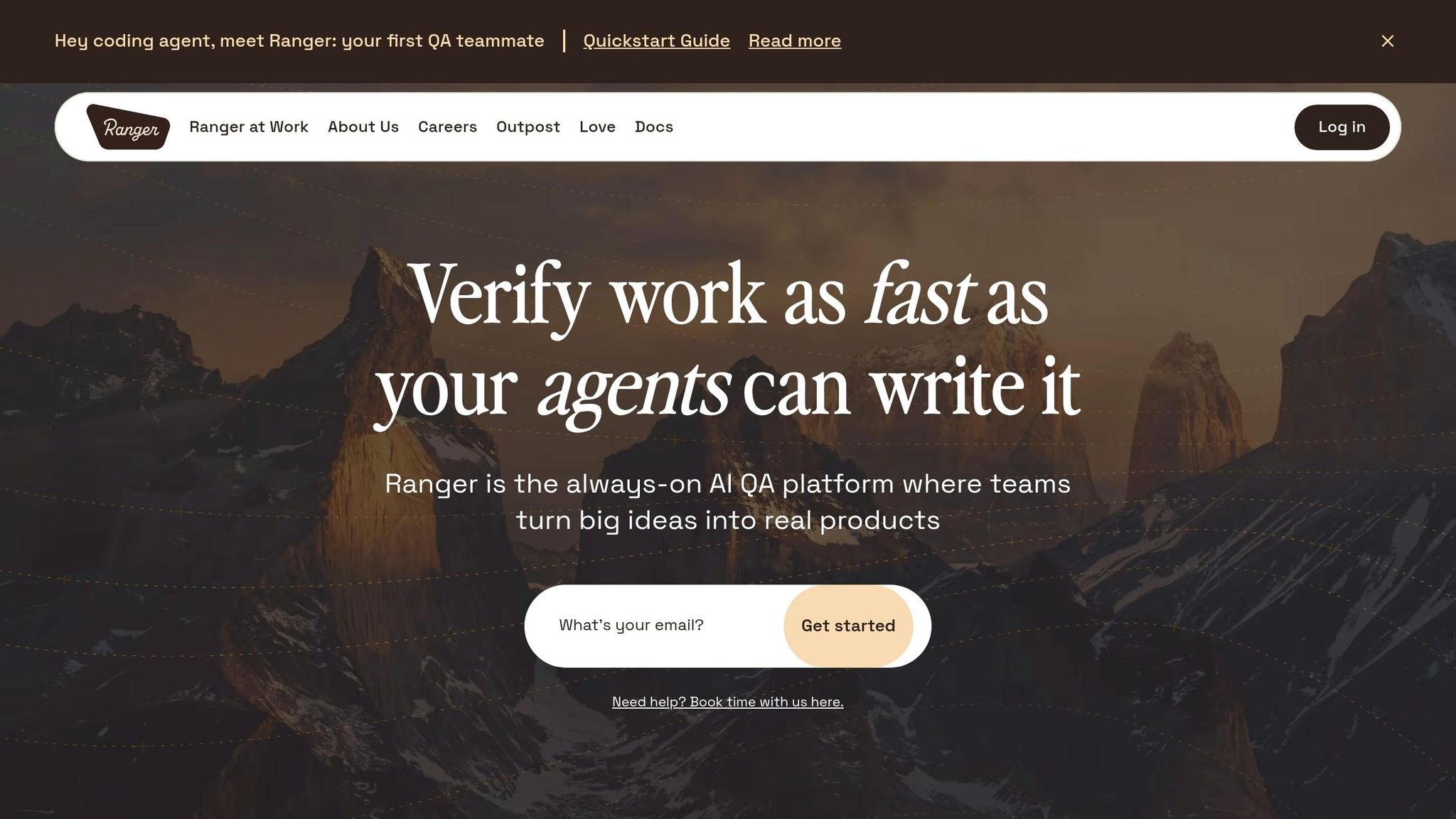
Ranger takes test data provisioning to the next level by combining AI-driven automation with expert human oversight. The platform uses AI agents to navigate websites and automatically generate Playwright tests. These tests are then reviewed by QA experts to ensure they’re both reliable and easy to understand.
Integration with CI/CD Tools
Ranger seamlessly integrates with tools like GitHub and Slack to streamline workflows. When code changes are made, Ranger automatically runs tests and displays the results alongside those changes. This setup enables faster releases, as demonstrated by Jonas Bauer's team at Upside, where same-day releases became possible. Slack integration provides real-time notifications, tagging relevant stakeholders when immediate action is required. Meanwhile, GitHub integration keeps test results visible alongside code changes, eliminating the need to switch between tools and ensuring testing stays in sync with deployment pipelines. This alignment helps reduce delays and keeps the process efficient.
AI with Human Oversight
Ranger combines the power of AI with the precision of human review to deliver high-quality results. Its automated triage system filters out flaky tests and unnecessary noise, allowing engineering teams to focus on critical bugs and high-risk issues. While AI handles the bulk of test creation, QA experts meticulously review the test code to ensure accuracy.
"We love where AI is heading, but we're not ready to trust it to write your tests without human oversight. With our team of QA experts, you can feel confident that Ranger is reliably catching bugs." - Ranger
This dual approach has led to successful collaborations, such as with OpenAI, where Ranger helped create a specialized web browsing harness for their o3-mini research paper.
Scalable Testing Infrastructure
Ranger also addresses the challenge of scaling testing infrastructure. The platform manages the entire process, launching browsers to run consistent tests without requiring preconfigured setups. Its hosted infrastructure scales automatically as development speeds up, removing the need for manual provisioning or maintenance of testing environments.
"Ranger has an innovative approach to testing that allows our team to get the benefits of E2E testing with a fraction of the effort they usually require." - Brandon Goren, Software Engineer, Clay
Unlike static scripts that often break with product updates, Ranger's AI agents adapt test coverage dynamically. This reduces maintenance efforts and ensures that testing keeps up with the fast pace of development.
Conclusion
AI-powered test data provisioning is reshaping how parallel testing workflows operate. The move from shared staging environments to ephemeral, isolated setups marks a significant step forward. As Lukas Pradel aptly explained:
Replicating a production-like environment for testing is technically doable, but in practice... feeding services with consistent test data [is] quite challenging.
AI tackles this head-on by automating test data orchestration and ensuring consistent and predictable states.
This shift not only eliminates data conflicts but also speeds up testing cycles. For instance, by dividing 40 end-to-end tests into four groups, the execution time drops from an hour to just 15 minutes. Combined with AI's ability to remove flaky tests and maintain data integrity across distributed services, development pipelines become far more efficient by enhancing continuous testing with AI.
Ranger builds on these advancements by blending AI automation with human oversight. Its scalable infrastructure and seamless CI/CD integration ensure rapid and reliable testing, offering the best of both automation and reliability.
As development environments grow increasingly complex and release cycles demand faster turnarounds, AI-driven solutions are no longer optional - they’re a necessity. Teams leveraging these tools can release features faster, catch critical bugs earlier, and maintain high standards of quality without compromising on innovation.
FAQs
How does synthetic test data stay realistic without using real customer data?
Synthetic test data mimics the patterns and traits of real-world data, allowing it to stay realistic while safeguarding actual customer information. This approach protects privacy and security while still providing the authenticity required for meaningful and effective testing.
What do I need to make test data fully isolated for parallel runs?
To keep test data fully isolated during parallel runs, it's essential to set up separate, independent datasets or environments for each test shard. Tools powered by AI, such as Ranger, can handle this process automatically, simplifying data provisioning within CI/CD workflows. This approach not only makes parallel testing more efficient but also eliminates the risk of data conflicts.
How do I plug AI test data provisioning into my CI/CD pipeline?
Integrating AI test data provisioning into your CI/CD pipeline can make test data management faster and more efficient. By using AI-driven tools, you can automate tasks like creating, maintaining, and versioning test data. For instance, tools such as Ranger allow you to embed AI-powered workflows directly into platforms like GitHub or Slack, simplifying the process.
You can also configure your CI/CD tools to automatically trigger AI-driven updates. This ensures your test data stays dynamic and reliable, adapting to the needs of each build or test cycle. The result? Smoother parallel testing and a more streamlined workflow.
Related Blog Posts
Stop babysitting your coding agents. Use Ranger
%201%20(1).svg)
More signals, less noise, faster launches
Let Ranger be your guide to sustainable QA testing.

.png)