%201.svg)
ROI of Multi-Cloud QA Testing


Multi-cloud QA testing is transforming software development by improving test coverage, reducing costs, and accelerating product releases. By leveraging multiple cloud providers like AWS, Azure, and Google Cloud, companies can avoid vendor lock-in, enhance resilience, and optimize costs. Here’s why it matters:
- Cost Savings: Companies report up to 93% cost reductions and ROI exceeding 300% within 18 months through automation and cloud-based QA.
- Productivity Gains: AI-driven automation reduces manual work by up to 85%, enabling faster testing and quicker releases.
- Improved Resilience: Multi-cloud setups ensure failover capabilities, minimizing downtime during outages.
- Key Metrics: Focus on defect leakage rate, release velocity, and cloud efficiency to measure success.
While multi-cloud QA offers clear financial and operational advantages, it also introduces challenges like increased management complexity and security risks. However, tools like Ranger simplify workflows, automate test creation, and cut infrastructure costs, making multi-cloud QA more accessible and effective.
Bottom Line: Multi-cloud QA testing isn’t just about cutting costs - it’s about delivering better software faster while minimizing risks. For companies prioritizing speed and quality, this approach offers measurable benefits.
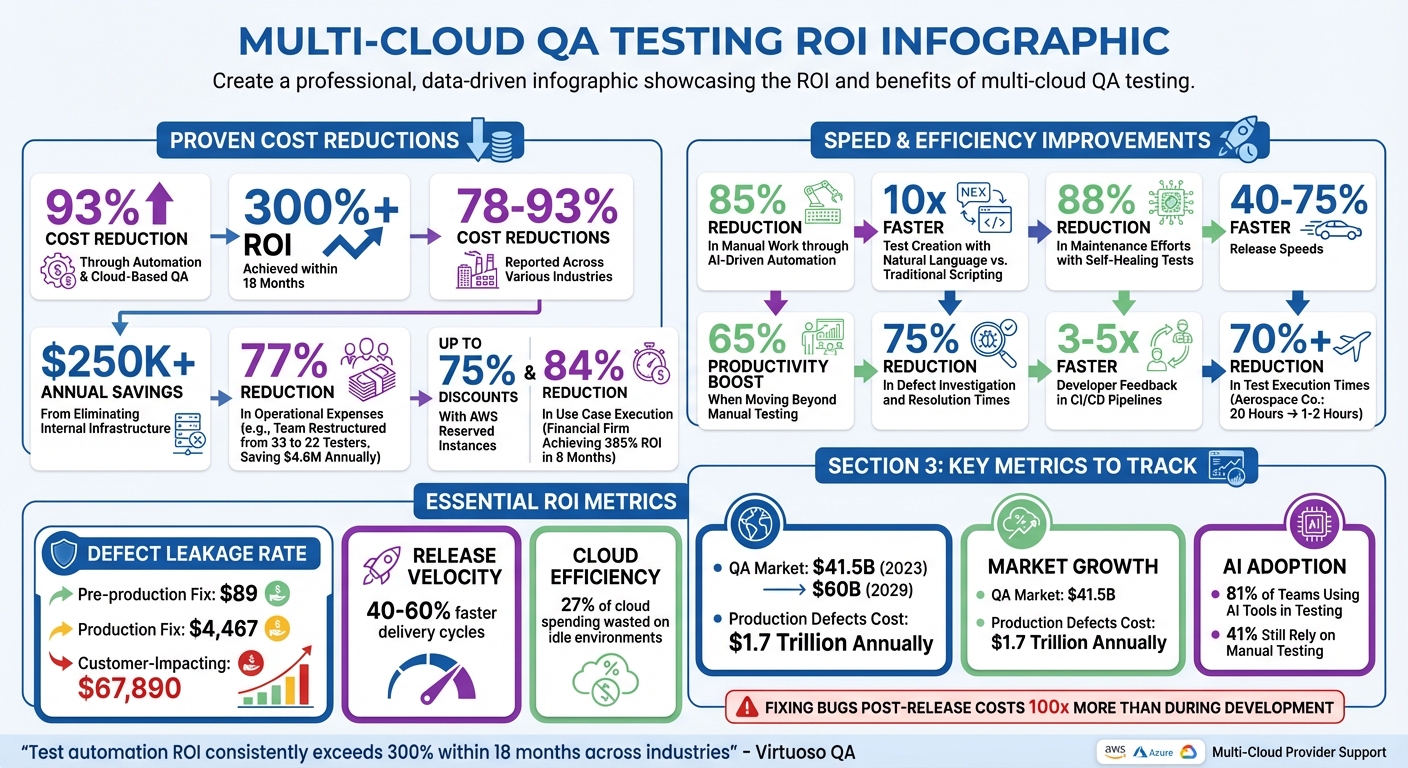
Multi-Cloud QA Testing ROI: Cost Savings and Productivity Metrics
Research Findings on Cost Savings
AI-Driven QA Testing and ROI Projections
AI-powered QA testing is proving to be a game-changer, with projections showing it could double ROI by 2026 [Target Section Description]. Companies leveraging comprehensive automated testing report cost reductions ranging from 78% to 93%, with ROI often surpassing 300% within just 18 months across various industries.
Real-world examples back up these claims. For instance, a multinational financial firm implementing natural language test creation and self-healing automation for its digital banking platform cut use case execution costs by 84% and achieved a 385% ROI in just eight months. Similarly, a large U.S. technology company reduced its daily test execution costs from about $4,000 to roughly $270 after adopting AI-powered test generation.
AI-native platforms offer even faster payback periods - typically 3 to 6 months - compared to the 8 to 15 months required by traditional frameworks like Selenium. Features like self-healing tests also slash maintenance efforts by up to 85%, allowing teams to focus on other priorities. These advancements pave the way for broader cost-saving initiatives, particularly in cloud environments.
Reducing Cloud Overspend
AI-driven efficiencies pair seamlessly with smarter cloud resource management to cut costs even further. Real-time monitoring of cloud usage can reduce overspending by as much as 50% [Target Section Description]. The key lies in aligning compute and storage capacity with actual workload demands, avoiding the pitfalls of over-provisioning for peak usage.
One example comes from a global systems integrator working on U.K. public sector projects. By restructuring its testing team from 33 to 22 functional testers through automation, the company saved approximately $4.6 million annually - a 77% reduction in operational expenses. Cloud-native QA platforms also eliminate the need for internal infrastructure, delivering more than $250,000 in yearly savings compared to traditional setups.
Additional savings can be achieved through strategies like reserved instances, which offer discounts of up to 75% on AWS and 57% on Google Compute Engine compared to on-demand pricing. Automated environment shutdowns help avoid unnecessary costs from unused test instances, while spot instances provide an affordable option for less critical testing workloads.
Market Growth and Investment Trends
The financial benefits of AI-driven testing are mirrored in the rapid growth of the global QA market. Projected to expand from $41.5 billion in 2023 to $60 billion by 2029, this growth reflects increased investment in automation and AI-powered solutions [Target Section Description].
These investments are driven by the high costs of quality failures. Globally, production defects cost enterprises $1.7 trillion each year, with individual critical bugs averaging a $5.6 million impact on businesses. Fixing bugs post-release can cost over 100 times more than addressing them during development. Despite these stakes, 41% of enterprises still rely primarily on manual testing, which drives costs up as application complexity grows. On the flip side, 81% of software development teams have already integrated AI tools into their testing workflows.
"Test automation ROI consistently exceeds 300% within 18 months across industries, making it one of the highest-return technology investments available to modern enterprises."
– Tamara Mostögl, VP Customer Experience and Partner Enablement, Virtuoso QA
Adopting multi-cloud strategies further amplifies these savings by enabling parallel testing across multiple browser and device combinations, achieving speeds up to 10x faster than traditional single-environment approaches. These strategies also eliminate the need for costly capacity planning associated with fixed single-cloud or on-premise setups.
sbb-itb-7ae2cb2
Productivity Gains from Multi-Cloud QA
Reducing Manual Work with AI Test Automation
AI-driven automation is reshaping the way QA processes are handled. With Natural Language Programming, business analysts and product managers can now create tests using plain English, eliminating the need for deep technical expertise. This approach has expanded the pool of test contributors by 300% while reducing the technical knowledge barrier by 85%.
Creating tests with natural language is also incredibly efficient - up to 10 times faster than traditional scripting methods. The result? A significant return on investment (ROI). For instance, a global e-commerce platform with 2.5 million daily active users adopted an AI-driven testing solution to handle their end-to-end purchase workflows. The outcome was impressive: a 644% ROI in the first year, a 67% drop in customer-reported bugs, and a 45% improvement in feature delivery times.
Another game-changer is the introduction of self-healing tests. When user interface (UI) elements are updated - something that happens often in modern development - AI-powered tests automatically adapt to these changes. This reduces maintenance efforts by 88% and achieves a 95% user acceptance rate. Teams that previously allocated 60–70% of their budget to manual test updates can now redirect those resources toward innovation and strategic projects, enhancing overall ROI.
These advancements in automation are a key driver of more efficient CI/CD workflows.
TestOps and CI/CD Integration Benefits
Integrating automated testing into CI/CD pipelines turns quality assurance from a bottleneck into a catalyst for speed. Developers now receive feedback 3–5 times faster than with traditional methods, allowing them to fix bugs during development rather than waiting for manual QA cycles. This is crucial because addressing bugs in production can cost 5–10 times more than fixing them earlier in the process.
Organizations that adopt automated testing see release speeds improve by 40–75%, with delivery cycles accelerating by 40–60%. Take the example of a U.S.-based healthcare technology provider: by integrating continuous testing into their DevOps pipeline across 200+ device-browser combinations, they halved their release cycles while maintaining strict regulatory compliance.
Similarly, an aerospace company streamlined GUI testing for Java-based applications with automation, cutting test execution times by over 70% and saving thousands of engineering hours annually. Manual regression testing, which previously took 20 hours, was reduced to just 1–2 hours.
On the whole, teams report a 65% boost in productivity when they move beyond manual testing bottlenecks. Additionally, defect investigation and resolution times drop by 75% when testing is embedded into CI/CD pipelines. This efficiency paves the way for scalable, parallel testing across multiple cloud environments.
Automating QA Across Multiple Cloud Providers
Automation in a multi-cloud setup offers unparalleled speed and flexibility by enabling parallel test execution across countless browser and device combinations. Distributed testing infrastructure allows teams to run thousands of tests simultaneously, slashing execution times.
This approach also eliminates the need for physical hardware labs. Cloud-native QA platforms dynamically provision virtual machines and devices, scaling resources up or down based on demand. This flexibility not only reduces infrastructure costs but also ensures teams pay only for what they use.
Global distribution further enhances testing capabilities. Teams can simulate user traffic from regions like the U.S., Asia, and Europe simultaneously, validating latency and localized behavior in real time. This is particularly critical for applications with international users, as it helps identify regional performance issues before they affect customers.
ROI Metrics and Benchmarks
Single-Cloud vs. Multi-Cloud QA Comparison
Single-cloud QA setups are susceptible to vendor-wide outages, while multi-cloud strategies offer failover resilience, though they come with added management challenges. Bill Hineline, Field CTO at Chronosphere, highlights this reality:
"No one wants to say it out loud, but major cloud outages do happen. When they do, having 10 zones in one provider means nothing. That's when multicloud earns its keep".
However, multi-cloud complexity can take a toll on productivity, as Christian Khoury, CEO of EasyAudit.ai, points out:
"Flexibility's a myth if your team spends half their time context switching... We saw productivity drop when engineers had to juggle two cloud consoles, two IAM systems, two sets of docs".
| Metric | Single-Cloud QA | Multi-Cloud QA |
|---|---|---|
| Resilience | Vulnerable to provider-wide outages | High; failover across providers |
| Latency | Limited by provider’s regional footprint | Optimized by proximity to end-users |
| Management Complexity | Low; single console and IAM | High; multiple consoles and workflows |
| Vendor Leverage | Low; risk of vendor lock-in | High; better leverage in contract negotiations |
| Cost Optimization | Limited by one provider’s pricing | Optimized by using cost-effective workload pricing |
Multi-cloud QA allows teams to position workloads closer to end-users in various regions, which enhances responsiveness and safeguards revenue. These advantages provide a foundation for assessing QA performance with targeted metrics.
Key Performance Indicators for QA ROI
To gauge QA ROI effectively, it's important to go beyond counting tests and focus on metrics that tie directly to financial outcomes. One crucial metric, the defect leakage rate, measures QA's ability to prevent production defects. Fixing defects early saves significant costs: pre-production fixes average $89, while production fixes soar to $4,467, and customer-impacting defects can cause losses up to $67,890.
A useful formula for quantifying savings is:
Rework Savings = (Production Fix Cost – Development Fix Cost) × Number of Bugs Prevented
| KPI | Calculation Method | Business Impact |
|---|---|---|
| Defect Leakage Rate | (Bugs in Production / Total Bugs) × 100 | Evaluates QA effectiveness in catching defects early |
| ROI Percentage | (Annual Benefits – Annual Costs) / Annual Costs × 100 | Shows financial return on QA investments |
| Rework Savings | (Production Fix Cost – Development Fix Cost) × Bugs Prevented | Highlights savings from early defect detection |
| Release Velocity | Time from code completion to production deployment | Reflects faster time-to-market and competitiveness |
| Cloud Efficiency | (Active Test Time / Total Uptime) × 100 | Measures active test time as a proportion of total uptime |
These KPIs not only track efficiency but also underline the financial gains of adopting a multi-cloud QA strategy. Metrics like cloud efficiency, for example, are particularly relevant. Bill Hineline emphasizes the importance of tracking costs:
"If your FinOps team can't trace a dollar of spend back to a service and a team, you're flying blind".
Regular audits can help eliminate wasteful "zombie infrastructure" - test environments that remain active unnecessarily, leading to ongoing billing.
Drew Firment, Chief Cloud Strategist at Pluralsight, sums up the ultimate goal:
"Multicloud investments need to be measured by meaningful productivity gains and business outcomes. If you're not achieving faster deployments and improved customer value, then you're just racking up cloud bills with a fancier name".
Ultimately, the true ROI of QA isn't just about cutting costs - it’s about accelerating deployments and delivering better customer value. As Virtuoso QA aptly puts it:
"The cost isn't in fixing bugs. It's in the opportunities lost while fixing bugs".
Challenges and Risk Mitigation
### End-to-End Security in Cloud QA Testing
Multi-cloud QA testing comes with its own set of security risks, which, if not addressed, can undermine the return on investment (ROI). The most common risks include data exposure from unmasked production data, insecure network communications, and weak identity and access management (IAM) controls.
Another challenge is the inefficiency of idle test environments - organizations estimate that around 27% of cloud spending is wasted on these unused setups. Beyond financial waste, these dormant environments increase the attack surface, making them attractive targets for breaches. To address these vulnerabilities, teams should prioritize using AI-generated synthetic or anonymized data instead of real customer information and implement automated data purging protocols to immediately delete temporary test data after use.
| Vulnerability | Mitigation Strategy |
|---|---|
| Sensitive Data Leakage | Data masking, anonymization, or synthetic data generation |
| Unauthorized Access | Role-based access control (RBAC) and strict IAM policies |
| Insecure Data Transfer | End-to-end encryption (TLS/SSL) and VPNs |
| Compliance Violations | Regional data pinning and automated compliance scanning |
| Infrastructure Breach | Regular vulnerability assessments and certified vendors |
A shared responsibility model is key in managing security effectively. Cloud providers handle physical infrastructure security, while QA teams focus on protecting test data and managing access controls. To reduce risks further, teams can use network isolation tools, such as VPNs and segmented test environments, to shield production systems. The growing adoption of FinOps teams, now present in 59% of enterprises, highlights the importance of aligning cloud cost management with security priorities.
These strategies lay the groundwork for tackling the compliance challenges associated with multi-cloud environments.
Meeting Regulatory and Compliance Standards
Ensuring compliance in multi-cloud setups adds another layer of complexity. These environments often involve test data crossing regional borders, which can conflict with data residency regulations like GDPR for EU data. Balancing these requirements while maintaining consistent quality assurance (QA) processes across jurisdictions is no small feat. Failing to comply can result in hefty audit costs and legal penalties, further cutting into QA ROI.
Automated compliance testing can help, with studies suggesting it can reduce audit-related costs by up to 30%. A real-world example comes from a U.S. healthcare technology provider that adopted the Perfecto cloud-based test automation platform. By integrating continuous testing into their DevOps pipeline, they achieved a 50% reduction in release cycles while ensuring HIPAA and data integrity compliance across more than 200 device-browser combinations. As JigNect explains:
"In a highly regulated industry like healthcare, automation proved its value not just by boosting speed and cost-efficiency, but also by crucially mitigating risk and ensuring regulatory compliance".
Adopting a shift-left testing approach - which identifies compliance issues earlier in the development process - can significantly cut costs. Fixing a bug in production can be 5 to 10 times more expensive than addressing it during development. Additionally, teams should verify that their cloud testing providers meet certifications such as ISO 27001, SOC 2, and GDPR compliance. Using modular and scalable test scripts ensures consistent adherence to these standards across various environments.
How Ranger Improves Multi-Cloud QA ROI
Automated Test Creation and Maintenance
Ranger’s AI-powered platform takes the heavy lifting out of test creation by automating tasks that often make up 60% of testing costs. Instead of relying on engineers to manually write test scripts, its AI models analyze code changes and user behaviors to automatically generate test cases, drastically reducing setup time. Plus, its self-healing feature ensures tests adapt seamlessly to changes, eliminating the need for constant rewrites. This not only slashes labor costs by around 40% but also achieves test coverage exceeding 90%. Such automation lays the groundwork for streamlined integration with development tools.
Integrations and Hosted Infrastructure
Ranger integrates directly with tools like GitHub and Slack, embedding quality checks into developers’ existing workflows. Automated tests kick off immediately after code is committed, providing instant feedback to catch defects early - when they’re 5 to 10 times cheaper to fix compared to production. On top of that, Ranger’s cloud-based infrastructure eliminates the need for expensive physical testing labs. Its scalable environment can handle peak demands and supports parallel testing across thousands of browser and OS combinations. These features not only save costs but also enhance efficiency, making it easier for teams to maximize their ROI.
Achieving Cost Savings and Productivity Gains
Switching to cloud-based testing solutions often cuts total costs by 60–70% compared to maintaining local infrastructure. Ranger amplifies these savings with its AI-driven optimizations, reducing regression testing cycles by 80% and increasing productivity by 30%. Tasks that once dragged on for weeks are now completed in mere hours. Additionally, Ranger combines AI automation with human oversight to ensure dependable results. Its continuous monitoring and adaptive testing strategies validate performance, latency, and compliance across multi-cloud setups. This holistic approach accelerates release cycles, improves quality, and lowers operational costs, delivering measurable ROI gains.
Automated testing, ROI, and more: Roy Moya
Conclusion
Multi-cloud QA testing has reshaped traditional quality assurance into a strategic tool that balances cost savings, increased productivity, and scalability. By spreading workloads across multiple cloud providers, organizations can cut testing expenses, speed up release cycles, and enhance software quality. This approach also provides leverage in provider negotiations and access to resources like GPUs, which are often in high demand.
For example, an energy grid project that transitioned to a more advanced cloud setup in 2025 saw simulation times plummet from 12 hours to just 2 hours. This shift allowed the team to run three times as many simulations each month. However, Drew Firment, Chief Cloud Strategist at Pluralsight, offers a cautionary perspective:
"If you're not achieving faster deployments and improved customer value, then you're just incurring higher cloud costs".
Achieving success with multi-cloud QA testing hinges on disciplined practices - tracking costs meticulously, automating environment shutdowns, and focusing on the most suitable cloud providers rather than simply increasing their number. These measures help manage complexity and pave the way for tools that simplify workflows.
This is where Ranger's AI-powered platform comes into play. It automates test case generation, seamlessly integrates with existing workflows, and removes the burden of maintaining testing infrastructure. By blending AI-driven automation with human oversight, Ranger enables teams to deliver accurate results across multi-cloud setups - without the usual productivity roadblocks.
The benefits of multi-cloud QA testing are clear: faster deployment times, lowered operational costs, and better software quality. Organizations that adopt disciplined strategies and leverage the right tools are well-equipped to thrive in today’s digital-first world.
FAQs
When is multi-cloud QA worth the added complexity?
Multi-cloud QA can be well worth the effort, especially when it brings greater value, efficiency, and reduced risks. The key benefits? Better coverage, stronger security, and enhanced performance across various cloud environments. By using tools that automate and simplify testing, you can tap into these advantages while keeping the challenges in check.
Which KPIs best prove multi-cloud QA ROI to leadership?
When presenting the return on investment (ROI) of your multi-cloud QA strategy to leadership, it's essential to focus on measurable metrics that clearly demonstrate value. Here are some key performance indicators (KPIs) to consider:
- Test Coverage Percentage: This metric shows how much of your application or system is being tested, ensuring quality across all aspects.
- Time Saved Per Test Cycle: Highlight the efficiency of your QA processes by showcasing how much time is saved during each testing cycle.
- Release and Deployment Frequency: Demonstrates how often your team can push updates or new features, reflecting agility and responsiveness.
- Lead Time for Changes: Measures the time it takes to implement and deliver changes, emphasizing the speed of your development pipeline.
- Change Failure Rate: Tracks the percentage of changes that result in failures, showcasing the reliability of your QA processes.
- Mean Time to Recovery (MTTR): Indicates how quickly your team can recover from failures, underscoring operational resilience.
These KPIs provide a clear picture of cost reductions, productivity improvements, and the overall effectiveness of your QA efforts, making it easier to communicate the value to decision-makers.
How do we keep test data secure and compliant across clouds?
To keep test data safe and compliant across different cloud platforms, it's crucial to use advanced encryption for protecting data both during transfer and while it's stored. Combine this with strict access controls, such as least-privilege OAuth scopes and multi-factor authentication (2FA), to limit who can access sensitive information.
On top of that, continuous monitoring paired with AI-powered tools can help spot unusual activity or potential threats. Automation plays a key role too, ensuring consistent data governance practices and maintaining detailed audit trails. Together, these steps provide strong protection for sensitive data while meeting compliance requirements in multi-cloud setups.
Related Blog Posts
Stop babysitting your coding agents. Use Ranger
%201%20(1).svg)
More signals, less noise, faster launches
Let Ranger be your guide to sustainable QA testing.

.png)