%201.svg)
AI in Shift-Left Testing: Automating QA in DevOps



Shift-left testing moves quality assurance earlier in the development cycle to catch defects sooner and reduce costs. AI supercharges this process by automating test creation, maintenance, and defect detection, helping teams deliver faster and with fewer bugs. Key benefits include:
- 75%-90% faster QA cycles and 60%-80% fewer production defects.
- $2.3M annual savings by addressing issues early.
- AI-generated tests save up to 70% of test creation time.
- Self-healing scripts reduce maintenance efforts by 40%-60%.
- AI tools integrate with CI/CD pipelines for instant feedback on code changes.
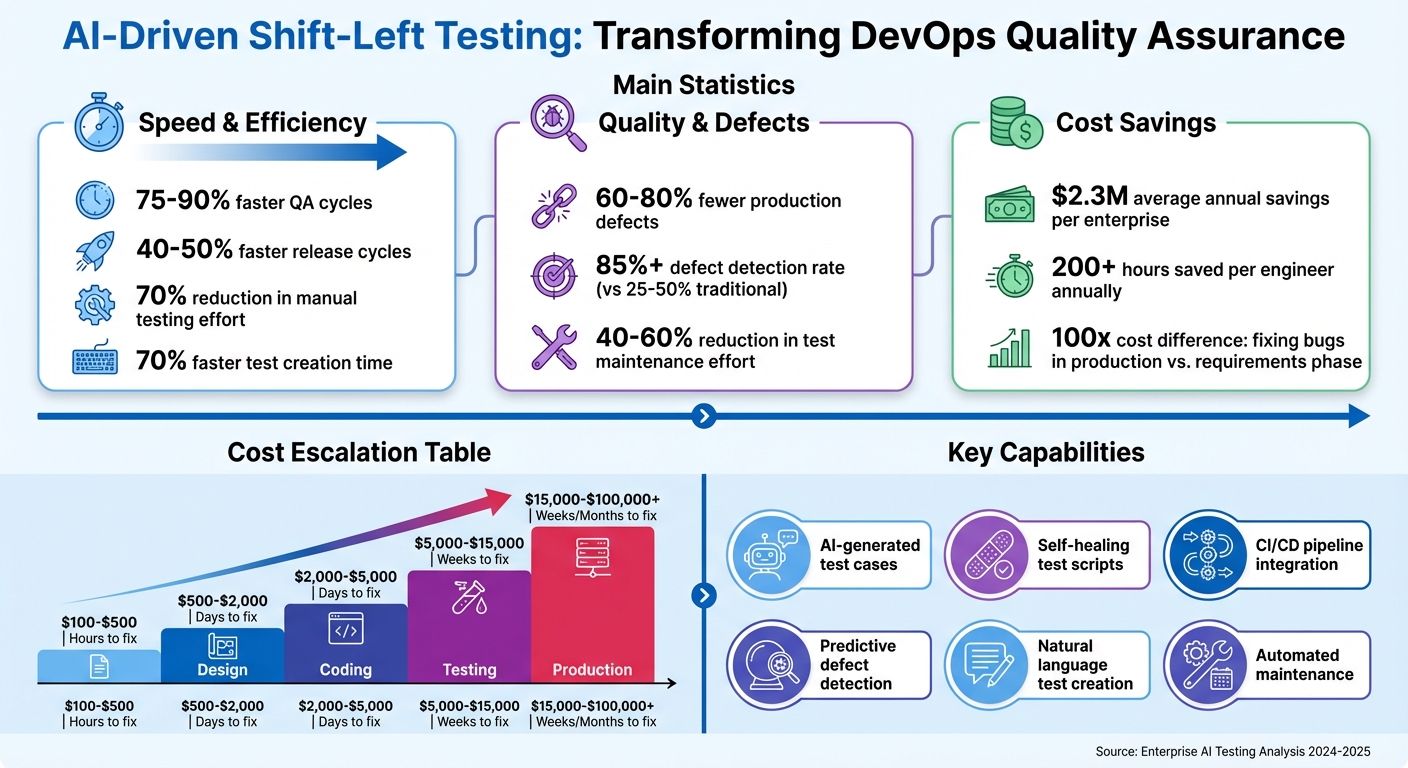
AI-Driven Shift-Left Testing: Key Benefits and Cost Savings
What Is Shift-Left Testing in DevOps
Shift-Left Testing Defined
Shift-left testing involves integrating testing earlier in the software development lifecycle (SDLC), embedding it into stages like requirements gathering, design, and coding instead of leaving it as a final step. First introduced by Larry Smith in 2001, this approach reimagines quality assurance by making it an integral part of development.
Traditionally, testing has been a separate process, with developers working on code for long periods before handing it off to QA teams. This often results in costly rework, delayed releases, and inefficiencies tied to the waterfall model. Shift-left testing flips this script by embedding testing into developers' workflows - such as within CI/CD pipelines - ensuring quality is consistently assessed throughout development.
One of the core principles of this method is the idea of "failing fast." Developers get feedback within minutes of committing code, rather than waiting days or weeks. This immediate feedback allows them to address issues while the context is still fresh, avoiding the need to untangle complex dependencies, debug old changes, or revisit forgotten decisions. Static testing also plays a key role, as it validates requirements and design models before coding begins, catching potential flaws early and saving significant effort.
The benefits are tangible. Companies implementing automated shift-left testing have reported reductions in QA cycle times of 75% to 90%. By addressing quality concerns early, this method helps DevOps teams streamline development and meet their goals more efficiently.
Why DevOps Teams Need Shift-Left Testing
DevOps teams are under constant pressure to deliver features quickly while maintaining high quality. Without shift-left testing, bugs discovered late in the process can disrupt sprint plans and force developers to shift focus from building new features to fixing existing issues. This back-and-forth not only delays releases but also drives up the cost of addressing defects.
The financial impact of catching bugs late in the process is steep. Fixing a bug during the requirements phase might cost $100 to $500, but the same issue found in production could cost anywhere from $15,000 to over $100,000. The table below illustrates how defect costs escalate across development stages:
| Development Stage | Typical Cost per Bug (USD) | Risk Level | Time to Fix |
|---|---|---|---|
| Requirements | $100–$500 | Low | Hours |
| Design | $500–$2,000 | Medium | Days |
| Coding | $2,000–$5,000 | Medium | Days |
| Testing | $5,000–$15,000 | High | Weeks |
| Production | $15,000–$100,000+ | Very High | Weeks/Months |
Shift-left testing helps avoid these costs by turning QA into a proactive process. By integrating testing into CI/CD pipelines, teams get instant feedback, significantly reducing the chances of defects slipping through. This approach not only minimizes defect leakage but also boosts overall productivity. Most importantly, it shifts the responsibility for quality from just QA specialists to the entire DevOps team, fostering a collaborative environment where quality is everyone's priority.
How AI Automates Shift-Left Testing
Automated Test Creation and Maintenance
AI has transformed the shift-left testing approach by automating core testing tasks. For instance, it can analyze requirements and design documents to generate executable test code, cutting test creation time by up to 70%.
One standout feature is the use of natural language processing (NLP), which enables non-technical team members to write plain English test cases. These are then converted into automation scripts, allowing teams to start testing during the requirements phase - when it has the most impact.
Another breakthrough is self-healing test maintenance. Traditional test scripts often break when developers make changes to UI elements or code structures, requiring time-consuming manual fixes. AI tackles this by identifying elements using multiple attributes rather than rigid selectors, updating scripts automatically as applications evolve. This process saves QA teams from spending 40% to 60% of their time on maintenance.
In October 2024, NVIDIA's DriveOS team introduced an AI-powered framework named Hephaestus (HEPH), designed to automate the entire testing lifecycle. HEPH analyzes requirements from Jama, generates executable C/C++ tests, and uses a feedback loop to identify and create missing test cases based on coverage data. Max Bazalii, Principal System Software Engineer at NVIDIA, shared:
"HEPH dramatically accelerates the test creation process. In trials with multiple pilot teams at NVIDIA, teams reported saving up to 10 weeks of development time".
Finding Defects Earlier with AI
AI doesn't just automate test creation - it also helps catch defects earlier in the development process, where fixes are easier and less expensive. By analyzing historical bug data and code repositories, predictive analytics can pinpoint high-risk modules, such as payment systems or authentication features, even before developers commit their code. This targeted testing approach ensures teams focus on areas where issues are most likely to arise.
AI excels at identifying various defect types throughout the development lifecycle. Unit tests powered by AI validate individual functions in milliseconds, catching logic errors before integration. API testing identifies mismatches between services before UI development begins, while automated security scans simulate attacks in sandboxed environments to uncover vulnerabilities during the build phase.
The results are impressive. Companies using AI for shift-left testing report a 60% to 80% reduction in production defects. For example, Virtuoso QA's "Agentic AI" approach helped enterprise clients save an average of $2.3 million annually by addressing defects earlier in the software development lifecycle (SDLC). The system’s self-healing capabilities also ensure test stability, distinguishing between intentional changes and actual regressions.
Reducing Manual Work and Speeding Up QA
AI doesn’t just improve accuracy - it also streamlines QA workflows by eliminating repetitive manual tasks. Automated test execution ensures comprehensive testing on every commit, while AI filters out false positives and reduces alert fatigue.
The impact on development speed is notable. AI-enhanced workflows can accelerate release cycles by 40% to 50%, largely by removing manual testing bottlenecks. Additionally, manual testing efforts drop by 70%, freeing QA teams to focus on more strategic tasks like exploratory testing and user experience validation.
Virtuoso QA’s Agentic AI takes automation a step further. These intelligent systems adapt dynamically to application changes, break high-level testing goals into smaller tasks, and collaborate to ensure thorough test coverage. As Virtuoso QA puts it:
"AI-driven testing tools identify defects, security vulnerabilities, and performance issues during coding and build phases... creating autonomous quality assurance that scales with development velocity".
Multimodal AI: Redefining the Boundaries of Shift-Left Testing
Benefits of AI-Driven Shift-Left Testing
AI's role in automating test creation and maintenance has far-reaching advantages, including expanded test coverage, cost savings, and improved productivity for developers.
Better Test Coverage and Reliability
AI takes test coverage to new levels by generating scenarios that human testers might overlook - think of edge cases like oversized data inputs, Unicode handling, or high-frequency bursts. Instead of relying on manual scripting, AI analyzes functional specifications and code patterns to create comprehensive test cases, ensuring no stone is left unturned.
One standout feature is AI's self-healing capability, which keeps tests reliable even when UI elements or API endpoints change. By identifying elements through multiple attributes instead of rigid selectors, these tests adapt automatically, reducing flaky results. Machine learning models also analyze past defect data to predict high-risk areas in the code, helping teams target their efforts where they’re needed most.
Natural language processing (NLP) further simplifies the process, allowing product managers and business analysts to write tests in plain English. This ensures business requirements are covered accurately from the start, reducing costly fixes later and enabling faster releases.
Lower Costs and Faster Releases
Catching bugs early isn’t just a nice-to-have - it’s a major cost-saver. Fixing a defect in production can cost up to 100 times more than addressing it during development. AI-driven shift-left testing tackles this head-on, with enterprises saving an average of $2.3 million annually by resolving issues earlier in the process.
Automation also speeds up release cycles by 40% to 50%, as AI handles much of the test creation and maintenance work. Traditional test maintenance, which often eats up 40% to 60% of QA resources, is significantly reduced thanks to AI’s self-healing capabilities.
| Benefit Category | Measurable Outcome | Impact on DevOps Teams |
|---|---|---|
| Defect Management | 60-80% fewer production bugs | Reduced technical debt and emergency fixes |
| Speed to Market | 40-50% faster release cycles | Greater agility and competitive edge |
| Resource Efficiency | 70% less manual effort | QA can focus on exploratory testing |
| Cost Control | $2.3M saved annually | Lower late-stage remediation costs |
| Test Coverage | 100% critical flow coverage in 7 days | Higher confidence in deployments |
These gains don’t just cut costs - they also free up resources, enabling teams to focus on strategic priorities.
Increased Developer Productivity
By automating repetitive testing tasks, AI allows developers to concentrate on building features. Automated test generation slashes creation time by up to 70%, while self-healing maintenance eliminates the need for constant script updates.
But the benefits go beyond time savings. AI reduces "alert fatigue" by consolidating alerts into a single actionable notification, rather than bombarding developers with multiple messages. Predictive defect detection adds another layer of efficiency by identifying high-risk code areas before changes are even committed. This proactive approach not only improves quality but also shifts the focus of development teams toward exploratory testing and refining user experiences.
The potential for AI to transform productivity is widely recognized - 86% of executives believe AI agents will make process automation significantly more effective by 2027. Together, these advancements in automation, defect detection, and test maintenance form a strong foundation for a shift-left testing approach that empowers development teams to deliver better software, faster.
sbb-itb-7ae2cb2
Adding AI to Shift-Left DevOps Pipelines
Incorporating AI into DevOps workflows changes how teams approach quality assurance. The idea is to create a pipeline where AI takes care of repetitive testing tasks, freeing up human teams to focus on decisions that require context, judgment, and strategy. This shift ensures QA becomes an integral part of the process from the start.
Bringing QA into the SDLC Early
Quality assurance should kick off during the requirements and design phases. By involving QA teams in early discussions, potential issues can be spotted before any code is written. This proactive approach not only improves testability but also sets clear quality expectations early on.
Here’s why timing matters: fixing a bug during the design phase costs only 1×, but that same bug can cost 15× more if caught just before production and up to 100× more if it makes it to live users. By embedding QA early, teams can align on quality standards that guide developers and AI tools throughout the project.
Connecting AI Tools with CI/CD Pipelines
AI tools integrate seamlessly with CI/CD platforms like Jenkins, GitHub Actions, GitLab, and Azure DevOps. These tools analyze code changes, run targeted tests, and provide feedback in seconds rather than hours. Instead of just automating deployments, these integrations deliver a "quality signal" that benefits the entire pipeline.
FORM, for instance, adopted CircleCI's Smarter Testing in late 2025 under the leadership of Director of Engineering Ben Horne. The results were transformative:
"Smarter Testing has helped our team meaningfully shorten the cycle time between development, QA, and release. By automatically prioritizing the tests that matter most to our current work, we're able to move faster without sacrificing stability or coverage."
Early adopters of similar tools have reported reducing feedback cycles by as much as 90%. This improvement is crucial since even a brief interruption in testing or build processes can cost developers 20 minutes - or more - to refocus.
These integrations also enable continuous learning. For example, AI assistants can use protocols like the Model Context Protocol (MCP) to analyze pipeline and runtime data, learning which code patterns often lead to failures. Features like self-healing mechanisms allow test scripts to update automatically when UI elements change, while parallelization enables simultaneous testing across web, mobile, API, and accessibility environments.
Platforms like Ranger simplify this process by connecting tools like Slack and GitHub directly to testing workflows. They provide instant feedback as code is committed, with automated bug triaging surfacing critical issues immediately. By handling the computational workload and keeping testing efficient, these tools ensure that pipelines remain fast and effective without compromising quality.
Maintaining Human Oversight in AI Testing
Even as AI handles more of the testing workload, human expertise remains indispensable. QA professionals are evolving into quality strategists and "AI supervisors", taking on roles that involve validating AI outputs, managing edge cases, and prioritizing business-critical issues. Machines can handle repetition, but humans provide the judgment and context that AI lacks.
Companies using this balanced approach have seen production defects drop by 50–80% and QA cycle times shrink by 75–90%. To make this transition smooth, QA teams are being trained in AI literacy and coding, enabling them to better manage AI-driven tools.
The goal isn’t to replace humans but to empower them. While AI tackles repetitive tasks, QA teams focus on strategic decisions. Even in highly automated pipelines, a "human-in-the-loop" model ensures accountability and quality at the speed of automation.
How Ranger Enables AI-Powered Shift-Left Testing
Ranger takes the shift-left approach to the next level by integrating AI-powered automation directly into the DevOps pipeline. As an AI QA platform, it combines automation with human expertise to streamline shift-left testing. One of its standout features is a web agent that automatically generates Playwright code, enabling the creation of end-to-end tests that adapt as your product evolves. This functionality sets the stage for the advanced features outlined below.
Ranger's AI Test Automation
Ranger's web agent navigates websites based on predefined testing plans and writes test code automatically. What makes it different from fully automated tools is its hybrid approach: AI generates the initial tests, but QA experts review and refine them. Ranger also integrates with tools like GitHub and Slack, triggering tests whenever code changes occur and providing real-time alerts. A 2025 customer survey revealed that engineering teams using Ranger saved over 200 hours per engineer annually by automating critical test maintenance tasks.
End-to-End Testing with Human Review
This hybrid approach doesn’t just automate test creation - it boosts accuracy. By incorporating human oversight, Ranger reduces false positives. AI handles the initial triage of failures, and QA experts step in to verify and address issues. Brandon Goren, Software Engineer at Clay, highlighted the benefits:
"Ranger has an innovative approach to testing that allows our team to get the benefits of E2E testing with a fraction of the effort they usually require".
Easy Integration and Real-Time Insights
Ranger simplifies browser setup to ensure consistent test execution. Tests run seamlessly against staging and preview environments within the CI/CD pipeline, identifying bugs before they make it to production. In early 2025, OpenAI partnered with Ranger to leverage its capabilities by building a specialized web browsing harness for research validation using their o3‑mini models. Matt Hooper, Engineering Manager at Yurts, emphasized the value of this approach:
"Ranger helps our team move faster with the confidence that we aren't breaking things. They help us create and maintain tests that give us a clear signal when there is an issue that needs our attention".
Measuring AI Impact in Shift-Left Testing
To truly understand how AI is reshaping shift-left testing, it's essential to track specific metrics. These measures not only validate AI's influence on quality and efficiency but also help refine investments over time.
Defect Escape Rate and Test Coverage
Defect escape rate measures the percentage of bugs that make it into production. It’s a critical indicator of how well testing processes catch issues before they impact users. AI-driven tools reduce these escapes by catching defects earlier in the development lifecycle, where they’re quicker and less expensive to fix. Another important metric is test coverage, which shows how much of your application has been tested. AI excels here, automating complex workflows and targeting high-risk areas like payment processing or user authentication. On average, AI-powered platforms can achieve over 90% test coverage.
Additionally, tracking Mean Time to Detect (MTTD) and Mean Time to Resolve (MTTR) offers insights into how quickly defects are identified and fixed. AI significantly lowers both metrics compared to traditional manual reviews.
Cycle Time Reduction
Cycle time - how long it takes to complete development and testing phases - is another key performance metric in any CI/CD pipeline. AI shortens this timeline by automating test generation and deploying self-healing scripts that adapt to code changes without requiring manual updates. Monitoring the success rate of these self-healing scripts provides a clear picture of reduced maintenance efforts. Configuring your CI/CD pipeline to halt deployments when AI-driven tests uncover critical issues ensures bugs don’t progress further, creating a continuous improvement loop.
Cost Savings and ROI
Financial metrics, like cost savings and ROI, are crucial for understanding AI’s value. ROI can be calculated using the formula: ((Total Benefits - Total Costs) / Total Costs) x 100. Benefits include reduced labor costs from less manual testing and the savings from avoiding production bugs. Fixing a defect in production can cost up to five times more than addressing it during testing. Poor software quality cost U.S. companies an estimated $2.41 trillion in 2022 alone.
It’s important to evaluate ROI over time. While initial setup costs for AI can be high, the benefits grow substantially over three to five years. Startups often see positive ROI within 6–10 months, while larger enterprises may take 12–14 months due to more complex integrations.
Conclusion
AI is reshaping shift-left testing, turning it into a proactive, continuous process embedded early in development. Companies adopting AI-driven shift-left testing report impressive results, including lower defect rates, faster cycle times, and a reduction in manual testing effort by up to 70%. These efficiencies also bring financial benefits, with enterprise applications saving an average of $2.3 million annually by resolving defects early.
The key to success lies in striking the right balance between automation and human expertise. AI can create test cases 98% faster than manual methods and maintain scripts autonomously using self-healing features. However, human oversight is indispensable for validating AI outputs, handling complex business logic, and ensuring high-quality test coverage. A great example of this hybrid approach is Ranger, which pairs an AI web agent that generates Playwright test code with QA professionals who review and refine each script.
For teams looking to implement AI-driven shift-left testing, a clear strategy is essential. Start by integrating AI tools into your CI/CD pipelines to enable near-instant feedback on every code commit. Focus on requirements analysis to catch defects early, and foster a quality-first mindset where developers, product owners, and DevOps engineers share responsibility for testing. As Brandon Goren, Software Engineer at Clay, describes it:
"Ranger has an innovative approach to testing that allows our team to get the benefits of E2E testing with a fraction of the effort they usually require".
With AI-powered shift-left testing, teams can achieve defect detection rates exceeding 85%, a significant improvement over the 25–50% range typical of traditional methods. By identifying issues early, organizations can avoid the skyrocketing costs of late-stage fixes while maintaining development speed and delivering high-quality products.
FAQs
How does AI improve shift-left testing in DevOps?
AI is reshaping shift-left testing in DevOps by taking over repetitive tasks like test creation and maintenance, which cuts down on manual work. It introduces self-healing tests that adjust to codebase changes, keeping tests dependable as the code evolves.
On top of that, AI streamlines the process by prioritizing the most critical tests, speeding up root-cause analysis, and improving early defect detection. These features tighten feedback loops, boost test coverage, and help teams identify bugs earlier in development, ultimately saving both time and resources.
How does AI-driven shift-left testing help save costs?
AI-powered shift-left testing helps cut costs by identifying defects earlier in the development process, where fixing them is far cheaper. This method not only reduces reliance on manual testing but also boosts test coverage and speeds up development cycles.
Automation plays a key role here by handling repetitive tasks, freeing up teams to concentrate on higher-priority work. Research shows that defect resolution times can drop by as much as 75%, while test maintenance efforts might shrink by up to 88%. These gains lead to lower costs overall and quicker delivery of better-quality software.
How does AI-driven shift-left testing change the role of QA professionals?
AI-driven shift-left testing is reshaping the responsibilities of QA professionals by moving their focus away from repetitive manual tasks toward more strategic and forward-thinking activities. Instead of spending hours on routine, time-intensive tests, QA teams are now tasked with designing and maintaining automated test cases, analyzing data to catch defects early, and ensuring continuous testing throughout the development lifecycle.
This change positions QA professionals as collaborative contributors in the development process. They can spot potential issues earlier, which helps speed up delivery timelines. By automating tasks like test creation, maintenance, and root cause analysis, AI tools free QA teams to tackle higher-priority work, such as test planning, quality governance, and refining overall processes. As AI becomes more deeply embedded in DevOps workflows, the QA role is evolving into one of oversight and validation - ensuring that automated systems stay accurate and adhere to quality standards.
Related Blog Posts
Stop babysitting your coding agents. Use Ranger
%201%20(1).svg)
More signals, less noise, faster launches
Let Ranger be your guide to sustainable QA testing.

.png)