%201.svg)
How to Anonymize Test Data in Cloud QA


Test environments are often overlooked but pose serious security risks, especially when they house sensitive customer data. Shockingly, 73% of organizations use production data in testing without anonymization, leading to compliance risks under regulations like GDPR and HIPAA. Data breaches involving test environments cost an average of $14.82 million in 2024, with 87% of breaches tied to these environments.
The solution? Anonymization. Effective techniques include:
- Data Masking: Replaces sensitive data with fake but realistic values while preserving database structure.
- Synthetic Data Generation: Creates artificial datasets that mimic real data without privacy risks.
- Pseudonymization: Uses reversible tokens to maintain cross-system consistency.
To secure your cloud QA workflows:
- Automate anonymization in CI/CD pipelines with tools like AWS Lambda or Google Cloud Dataflow.
- Use privacy-by-design principles to embed security early.
- Limit access with IAM roles and encryption key management.
The key is balancing security with usability. Anonymized data must remain functional for testing while meeting compliance standards. By incorporating these methods into your QA processes, you can protect sensitive information without disrupting development.
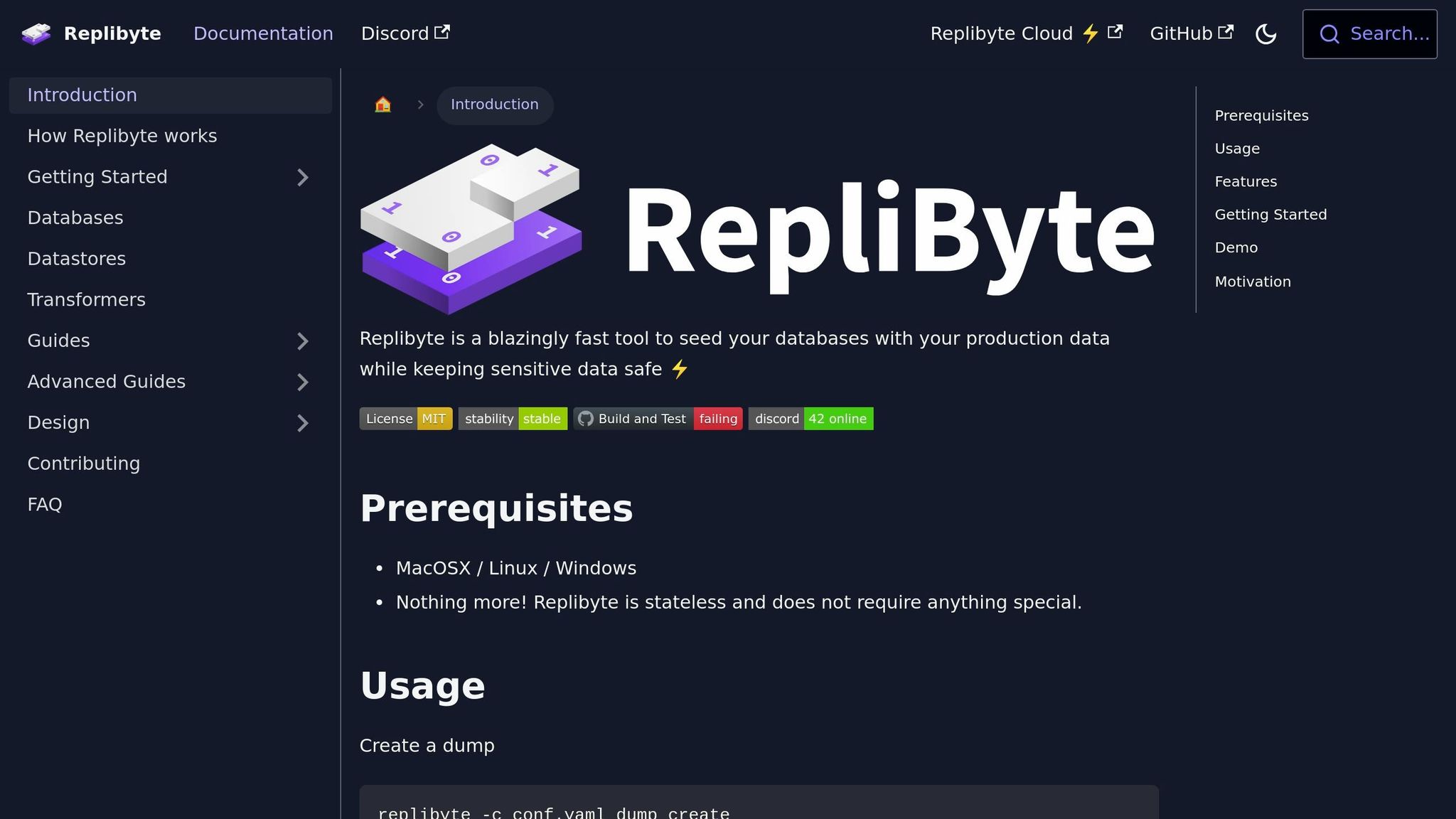
Database Testing with RepliByte | Securely Anonymize Production Data for Testing
sbb-itb-7ae2cb2
Core Techniques for Anonymizing Test Data

Comparison of Data Anonymization Techniques for Cloud QA Testing
When working in cloud QA environments, protecting sensitive data is essential. Three key methods - data masking, synthetic data generation, and pseudonymization - can help ensure data security. The right approach depends on your specific testing needs, compliance requirements, and the level of realism required by your QA team.
Data Masking
Data masking involves replacing sensitive information with plausible fake values, all while preserving the original structure and relationships within the database. For instance, a name like "John Smith" might be consistently replaced with "Eric Jones" across all linked systems. This ensures that referential integrity is maintained, preventing issues with application logic during testing.
A great example of this technique in action comes from Boeing Employee Credit Union (BECU). They used automated masking to process 680 million rows in just 15 hours, enabling developers to access realistic test environments more efficiently. Masking techniques vary and include:
- Substitution: Swapping real values with fictitious ones.
- Shuffling: Reordering values within a column.
- Format-preserving encryption: Keeping the original data's length and format intact.
- Dynamic masking: Transforming data in real time.
Another success story involves a European telecom provider that cut data masking time by 97%, refreshing 60 applications over a weekend - a task that previously took weeks. This efficiency saved more than $7 million in testing labor over three years.
While data masking is effective, using AI for production-like test data creation provides an alternative that eliminates privacy risks altogether.
Synthetic Data Generation
Synthetic data is artificially created to replicate the statistical properties of real data, eliminating the need to use sensitive information. This approach is especially useful for meeting GDPR and CCPA compliance standards, as it removes privacy risks entirely.
One of synthetic data's standout qualities is its flexibility. Unlike masked data, which is tied to historical records, synthetic data allows you to create edge cases that may not exist in your current datasets. For example, you can generate records with special characters in names, international phone numbers, or dates that fall near leap years. Between 62% and 74% of global enterprises now rely on synthetic data for software testing, development, and integration.
This method is particularly valuable for testing new features, conducting large-scale stress tests, or scenarios requiring absolute privacy. However, it’s crucial to ensure that the synthetic dataset mirrors real-world statistical distributions. For instance, if 60% of your users are based in the U.S., your synthetic data should reflect that ratio for accurate testing.
When traceability is necessary, pseudonymization offers a reversible solution.
Pseudonymization
Pseudonymization replaces identifiable information with tokens or aliases, allowing for the data to be reversed if needed. While this reversibility can be helpful for debugging, it also introduces a higher privacy risk if the token vault is compromised.
This method is particularly useful for maintaining consistency across systems. For example, a customer ID can remain the same in your CRM, billing system, and support database, ensuring seamless integration. However, because pseudonymization is reversible, it’s essential to enforce strict access controls for token vaults and encryption keys to minimize privacy risks.
Each technique has its strengths, and the table below provides a quick comparison:
| Aspect | Data Masking | Synthetic Data Generation | Pseudonymization |
|---|---|---|---|
| Data Source | Derived from real production data | Artificially generated from scratch | Real identifiers replaced by tokens |
| Privacy Risk | Low when irreversible | None | Higher if vault compromised |
| Customization | Limited to original data structure | Highly customizable for edge cases | Limited to identifier replacement |
| Best Use Case | Regulatory-compliant testing on live datasets | Stress testing, new features, edge cases | Maintaining cross-system relationships |
Adding Anonymization to Cloud QA Workflows
Incorporating anonymization into your QA processes ensures data protection becomes automatic, reliable, and efficient. The key is to seamlessly integrate these practices into your workflows, making privacy a built-in feature rather than an afterthought.
Automating Anonymization in CI/CD Pipelines
Integrating anonymization into your development pipelines eliminates the manual effort, reducing errors and saving time. Automation ensures that every time data transitions from production to QA, it’s sanitized without human intervention.
You can create serverless anonymization pipelines using tools like Google Cloud Dataflow or AWS Lambda, which automatically scale with workload demands. Orchestrate these workflows with tools like Apache Airflow or Prefect, triggering anonymization tasks whenever new data is ingested.
For real-time redaction, features like S3 Object Lambda can sanitize sensitive data during retrieval, ensuring testers only see anonymized information without altering the source. As Amazon Web Services explains:
By redacting PII, you conceal sensitive data, which can help with security and compliance.
To identify sensitive data before applying anonymization, leverage automated scanning tools like Google Cloud DLP or Amazon Comprehend. These tools can pinpoint fields requiring transformation, with Google Cloud offering over 100 built-in classifiers for detecting PII and PHI. Once flagged, apply techniques like masking, tokenization, or generalization based on privacy needs.
Maintaining referential integrity is critical, especially when working across multiple systems. Consistently replace the same sensitive values with identical surrogates to avoid breaking relationships between datasets. Use de-identification templates to centralize rules and encryption key management, making it easier for QA teams to initiate the process.
Deploy these pipelines with Infrastructure as Code (IaC) tools like Terraform for consistency and repeatability. Incorporate unit and integration tests into your CI/CD pipeline to ensure anonymization doesn’t disrupt data structures or workflows before it reaches QA environments.
Privacy-by-Design Principles
Adopting privacy-by-design means embedding security measures right from the start. Instead of treating data protection as an afterthought, bake it into your test data preparation process. The AWS Well-Architected Framework defines this approach:
Privacy by Design is an approach in system engineering that takes privacy into account throughout the whole engineering process.
Start by profiling production schemas to identify sensitive fields. Apply data minimization at the point of capture, processing only the information necessary for testing. For example, if testing a payment feature, you might only need recent transaction records instead of the entire customer database. Tools like Google SecOps Export API can help extract smaller, targeted samples for testing.
Whenever possible, default to synthetic data for development. If production data is unavoidable, apply pseudonymization as a minimum safeguard. This approach reduces risk, especially since 87% of data breaches involve test environments, with the average cost of such breaches reaching $14.82 million in 2024.
For true anonymization, ensure the process is irreversible to comply with regulations like GDPR. Maintain an audit trail that logs details such as time, date, user ID, and the reason for anonymization. As AWS Solutions Library notes:
Data anonymization is not only about using the technology but also about fostering a culture of trust and appropriate data handling.
Data Minimization and Access Control
Even anonymized data should be carefully managed. Limiting access and minimizing the data in QA environments reduces risks and helps meet compliance requirements.
Develop a data access matrix aligned with your classification catalog. This matrix should define who can access specific types of information in QA environments. Use Identity and Access Management (IAM) to restrict access to de-identification methods and encryption keys to a select group of administrators.
For cryptographic transformations, use separate encryption keys for each data element to minimize exposure if a key is compromised. Store these keys securely with managed services like Cloud KMS, and rotate them regularly. Keep in mind that rotating keys requires re-tokenizing datasets to maintain integrity.
Role-based access control (RBAC) can further refine access. For instance, developers might only see masked customer names, while QA analysts working on compliance tests might access pseudonymized data with cross-system relationships intact. Context-aware anonymization can tailor sanitization based on user roles.
Finally, validate that access controls and anonymization measures are functioning as intended. After anonymization, confirm that workflows, reporting, and analytics still operate correctly with sanitized datasets. Considering that 73% of organizations still use production data in testing with inadequate anonymization, taking these extra precautions ensures better protection while supporting effective QA operations.
Using a QA platform like Ranger can simplify this process by integrating AI-driven automation into your workflows, safeguarding sensitive data throughout the testing cycle.
Maintaining Data Quality During Anonymization
Anonymization is about more than just securing sensitive information - it’s also about ensuring the data remains useful for testing. The tricky part is finding a way to protect sensitive details while keeping the dataset functional for uncovering bugs and validating application behavior. As Alex Hayward, Co-Founder of GoMask.ai, explains:
"Anonymization that breaks applications is worthless. Maintain data utility through referential integrity."
Preserving Data Structure and Relationships
One of the biggest risks with anonymization is breaking connections between related records. For example, if the customer ID in your orders table no longer matches the ID in your users table post-anonymization, tests could fail for reasons unrelated to your application.
To avoid this, deterministic encryption is a reliable approach. It ensures that the same input always produces the same anonymized output. For instance, "CUST-12345" will consistently map to the same masked value across orders, support tickets, and billing records. Techniques like AES-SIV can make this possible. Similarly, format-preserving encryption (FPE) replaces sensitive data with tokens that maintain the original length and format. A 16-digit credit card number, for example, becomes another 16-digit number that still satisfies legacy validation rules.
In distributed systems, maintaining consistency is key. A central token vault with distributed caches can synchronize anonymization mappings across systems like CRM, billing, and support, ensuring accurate lookups.
Balancing Security with Usability
Different testing scenarios demand varying levels of anonymization. For instance, shuffling data works well for analytics dashboards where overall trends matter more than individual records. On the other hand, adding noise - small numerical variations - can preserve aggregate accuracy while obscuring exact values.
It's crucial to identify which fields need protection. Over-anonymizing can break functionality, while under-anonymizing leaves data exposed. Focus on personally identifiable information (PII) like names and social security numbers. For less sensitive fields, such as birth dates, lighter techniques like converting exact dates into age ranges can retain business logic without compromising privacy.
When real data patterns pose a re-identification risk, synthetic data is a safer alternative. Machine-generated records aren't tied to real individuals, eliminating privacy concerns while still providing realistic test scenarios. These strategies help ensure anonymized data remains functional for testing.
Testing Anonymized Data Sets
Even with robust anonymization practices, it’s essential to verify that the data still works as intended. After anonymization, check that your data supports key functions like reporting, search, and complex business logic. Catching issues early can save your QA schedule from unnecessary setbacks.
Define clear benchmarks for success. For example, anonymized data should allow over 95% of test cases to pass, with less than a 10% slowdown in database query performance. Aggregate metrics, such as averages and distributions, should stay within 5% of their original values.
Re-identification risks also need careful attention. Masking alone might not be enough if quasi-identifiers like zip code, birth date, and gender remain intact - these three fields alone can identify up to 87% of the U.S. population. Test your anonymization methods by attempting to re-link records. If you can do it, so can someone else.
| Metric Category | Target Benchmark | Description |
|---|---|---|
| Application Functionality | >95% Pass Rate | Percentage of test cases that pass with anonymized data |
| Query Performance | <10% Degradation | Maximum acceptable increase in database query execution time |
| Statistical Accuracy | <5% Variance | Maximum difference in aggregate metrics between original and anonymized data |
| Re-identification Risk | Below 0.05% | Probability of linking anonymized records back to individuals |
Tools like Ranger can automate these validation checks, helping you ensure that anonymized test data remains both secure and functional throughout your QA process.
Conclusion
Anonymizing test data in cloud QA is all about protecting privacy without compromising the quality of your testing processes. Industry statistics highlight just how critical it is to implement strong anonymization measures.
The challenge lies in balancing security with data usability. To meet GDPR requirements, anonymization must be irreversible while still preserving the relationships between data points that are crucial for effective testing. A smart approach often involves applying tiered risk-based techniques - using stricter methods for sensitive personally identifiable information (PII) and lighter ones for less critical data. Integrating these anonymization practices into CI/CD pipelines ensures that development speed remains unaffected by legacy QA bottlenecks.
Alex Hayward, Co-Founder of GoMask.ai, explains:
The most successful organizations don't just mask data - they architect comprehensive data anonymization strategies that transform testing from a compliance burden into a competitive advantage.
Incorporating anonymization into your cloud QA processes not only secures sensitive information but also boosts efficiency. Ranger simplifies this process by automating PII detection and ensuring consistent anonymization across your cloud QA environments. Its AI-driven test creation, backed by human oversight, ensures anonymized data remains effective for identifying bugs and speeding up releases. Plus, Ranger integrates smoothly with tools like Slack and GitHub, making it easier to maintain security without sacrificing development speed.
Comprehensive strategies - whether through masking, synthetic data, or pseudonymization - are essential for today’s cloud QA workflows. With effective anonymization in place, your team can confidently test, stay compliant, and focus on delivering exceptional software.
FAQs
How do I choose between masking, synthetic data, and pseudonymization?
When deciding, consider your goals for security, compliance, and testing:
- Masking: This method conceals sensitive information within existing datasets. It keeps the structure and realism intact while safeguarding privacy.
- Synthetic data: Generates artificial datasets that imitate real-world data. This approach allows for quicker testing and stronger privacy protections.
- Pseudonymization: Substitutes identifiable data with pseudonyms. It lowers the chances of re-identification while maintaining a connection to the original data to meet compliance requirements.
Your choice should strike the right balance between realism, privacy, and compliance.
How can I automate anonymization in my CI/CD pipeline?
Automating anonymization in your CI/CD pipeline means integrating AI-driven tools that can handle sensitive data efficiently. These tools work in real time to identify sensitive fields, assess their level of sensitivity, and apply masking techniques automatically. By incorporating them into your workflows, you can consistently provide anonymized, compliant datasets during deployment. This approach not only enhances data security but also minimizes the need for manual intervention.
How do I verify anonymized data still works for tests without re-identification risk?
To make anonymized data effective for testing while reducing the risk of re-identification, it's important to evaluate both its usefulness and privacy protections. Start by conducting a re-identification risk assessment using methods such as k-anonymity, l-diversity, or t-closeness. To ensure the data retains value, compare its statistical accuracy against the original dataset. Regularly running attack simulations and performing compliance checks can help confirm that the data stays secure and reliable for testing purposes.
Related Blog Posts
Stop babysitting your coding agents. Use Ranger
%201%20(1).svg)
More signals, less noise, faster launches
Let Ranger be your guide to sustainable QA testing.

.png)