%201.svg)
Ranger vs. QA Wolf


Which testing platform is better for your team?
Both Ranger and QA Wolf automate testing, but they serve different needs. Ranger uses AI to create Playwright tests, refined by QA experts, and focuses on web applications. QA Wolf combines AI and human engineers to handle web and mobile testing, with a goal of 80% coverage in four months.
Key Differences:
- Ranger: AI-driven with expert reviews, tailored pricing, and a focus on web testing.
- QA Wolf: AI + human engineers, supports web and mobile (via Appium), and charges per test.
Quick Comparison:
| Feature | Ranger | QA Wolf |
|---|---|---|
| Test Creation | AI generates Playwright tests | AI + engineers create tests |
| Human Oversight | QA experts review AI tests | Engineers verify & maintain |
| Maintenance | AI adaptive updates, auto-triage | 24/7 manual updates |
| Mobile Testing | No | Yes (via Appium) |
| Pricing | Custom quotes | $40–$44/test/month |
Choose Ranger if you need fast, AI-driven web testing with tailored pricing.
Choose QA Wolf if you require mobile testing and prefer a pay-per-test model.

Ranger vs QA Wolf: Feature and Pricing Comparison
AI-Powered Test Automation: Self-Healing + Visual Testing - Selenium & Playwright
sbb-itb-7ae2cb2
What is Ranger?
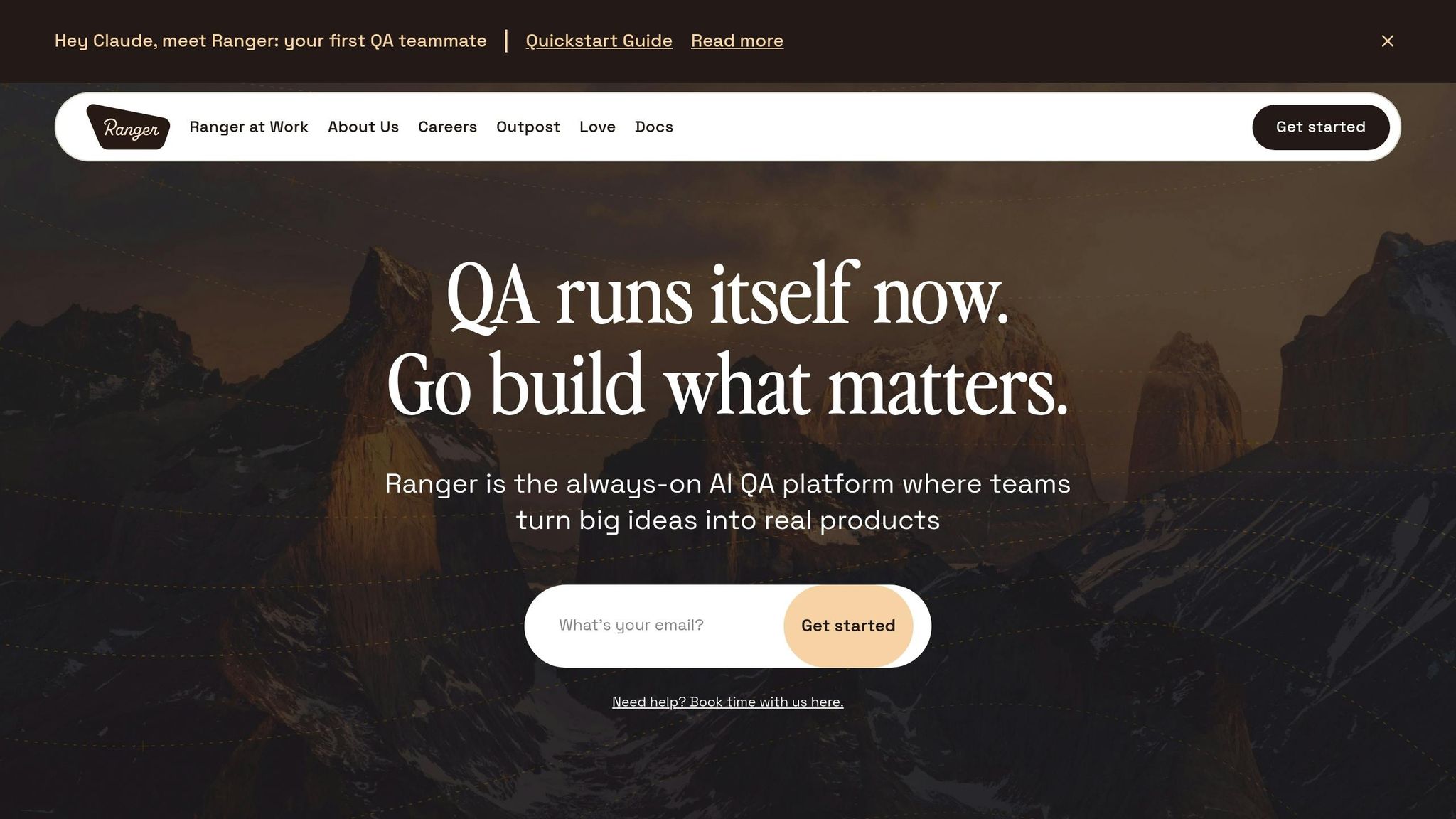
Ranger is an AI-driven QA testing platform that combines automated test generation with expert oversight. It manages test creation and adapts as your product evolves, ensuring your testing process remains reliable and efficient.
The platform automatically updates tests as your user interface changes and consolidates evidence - like screenshots, videos, and traces - into a single dashboard. With integrations for Slack and GitHub, teams can share results and receive real-time alerts seamlessly. Plus, its hosted infrastructure scales browser capacity to match your testing needs.
Ranger's Main Features
Ranger's standout features focus on automated maintenance, smart bug handling, and its Feature Review system. AI-powered web agents explore your application to generate Playwright test code, which QA experts review to ensure stability and quality. Adaptive testing keeps tests up-to-date automatically, while intelligent bug triaging filters out flaky tests, allowing engineers to focus on critical issues. The platform’s hosted infrastructure scales effortlessly to support your team's pace.
The Feature Review system takes it a step further. AI coding agents, like Claude Code, test their work in a real browser before submitting it for human review. Teams can then turn successful feature verifications into permanent end-to-end tests with just one click on the Ranger dashboard.
How Development Teams Benefit
Engineering teams using Ranger often see noticeable productivity boosts and feel more confident in their release cycles.
Jonas Bauer, Co-Founder and Engineering Lead at Upside, shared, "I definitely feel more confident releasing more frequently now than I did before Ranger. Now things are pretty confident on having things go out same day once test flows have run".
Martin Camacho, Co-Founder at Suno, stated, "They make it easy to keep quality high while maintaining high engineering velocity. We are always adding new features, and Ranger has them covered in the blink of an eye".
Matt Hooper, Engineering Manager at Yurts, commented, "Ranger helps our team move faster with the confidence that we aren't breaking things. They help us create and maintain tests that give us a clear signal when there is an issue that needs our attention".
What is QA Wolf?
QA Wolf combines AI-driven automation with human expertise to deliver thorough testing for web and mobile applications. This hybrid platform and service uses AI to generate Playwright code for web and Appium code for mobile apps from natural language prompts, a process they call "Agentic Automated Testing".
QA Wolf's standout feature is its human-in-the-loop approach. AI agents handle test creation and updates, while human QA engineers review and refine them, ensuring precision. This method addresses a common issue in automated testing: flaky tests. By investigating each failure, QA Wolf keeps its flake rate under 1%, distinguishing genuine bugs from environmental glitches.
The platform also boasts impressive speed, promising 80% automated end-to-end test coverage within four months. Tests run on a cloud infrastructure built on Kubernetes, enabling the entire suite to finish in the time it takes the longest single test - usually between 3 and 15 minutes [12, 14].
"I've been doing QA and test automation for 25 years and have never seen anything like QA Wolf."
– Ann Rumney, Staff QA Program Manager
QA Wolf goes beyond just creating tests. It offers continuous maintenance, with engineers updating tests as your product changes, investigating failures, and delivering video walkthroughs of bugs. Plus, since the tests are written in open-source frameworks, you retain full ownership of your code, avoiding vendor lock-in.
Here’s a closer look at QA Wolf’s key features and how they accelerate testing.
QA Wolf's Main Features
QA Wolf uses a multi-agent AI system to streamline test creation and upkeep. Each agent plays a specific role:
- Mapping Agent: Explores your application to understand its features.
- Outliner: Crafts detailed test plans using the "Arrange, Act, Assert" methodology.
- Code Writer: Generates Playwright or Appium code based on extensive test history.
- Verifier: Executes the generated code to ensure it works as intended.
Integration with CI/CD pipelines like GitHub and GitLab allows QA Wolf to run tests automatically with every deployment. Results are sent to tools like Slack and Teams, making collaboration seamless. The platform also offers unlimited test runs and scales automatically to match your testing needs [12, 15].
"We doubled down on QA Wolf and are now 100% bought into their testing approach, to the point where it's part of our definition of done process."
– Elia Karagiannis, Product Platform Engineer
QA Wolf's AI agents are rigorously tested every night against 700 unique UI scenarios, based on 50 million test runs, ensuring consistent reliability.
Fast Test Coverage Approach
QA Wolf’s service model combines AI efficiency with human precision, enabling rapid test coverage. Its AI agents create tests five times faster than traditional methods. For instance, in one demo, QA Wolf generated a Playwright test for Figma's prototyper in just 6 minutes, compared to 30 minutes using conventional recording tools.
The process starts with the Mapping Agent exploring your app to identify its features. The Outliner then develops detailed test plans based on user flows and product tours. Human QA engineers review any failures within 24 hours and update tests as needed. This blend of AI and human input supports QA Wolf’s goal of 80% coverage in four months while maintaining a zero-flake guarantee.
The platform delivers measurable results. Ann Rumney noted that QA Wolf’s parallel infrastructure saved her team over $750,000 annually and reduced QA time by more than 200 hours per release cycle. According to QA Wolf, 92% of customers experience faster release cycles, and 90% eliminate post-release hot fixes. Engineering teams save an average of 9 hours per week per engineer, with some completing QA cycles in as little as 11 minutes [12, 15].
These features highlight QA Wolf’s ability to enhance testing efficiency and reliability, making it a valuable tool for teams aiming to improve engineering velocity and optimize CI/CD pipelines.
Feature Comparison
Here's a breakdown of how these two platforms approach testing, highlighting their distinct methods and capabilities.
Ranger uses AI to automate test generation, with a web agent creating Playwright tests that are then reviewed by QA experts for quality and readability. On the other hand, QA Wolf takes a more hands-on approach, relying on full-time QA engineers to write, run, and maintain tests using open-source Playwright and Appium frameworks.
Both platforms also excel in test maintenance and integrations, though their methods differ. Ranger employs adaptive testing, which automatically updates tests to align with product changes, while using auto-triage to filter out flaky tests. QA Wolf guarantees zero flaky tests by providing 24/7 human maintenance, where engineers investigate every failed test and deliver verified bug reports.
When it comes to integrations, Ranger connects with tools like Slack, GitHub, GitLab, and Vercel, focusing on staging and preview environments. QA Wolf, however, offers broader integration options, including CI/CD pipelines, Jira, and Jenkins, along with GitHub and GitLab. Testing support also differs: Ranger specializes in end-to-end and regression testing for web applications, while QA Wolf extends its capabilities to mobile testing through Appium.
Reliability is another area where their strategies diverge. Ranger prioritizes filtering out noise with auto-triage, ensuring teams can focus on genuine bugs. QA Wolf, meanwhile, relies on human verification to eliminate flaky tests entirely. A notable example of Ranger's capabilities was showcased in February 2025, when OpenAI's o3-mini Research Paper highlighted a collaboration where Ranger developed a web browsing harness that enabled OpenAI’s models to interact with browsers.
Below is a quick comparison of their features:
Feature Comparison Table
| Feature | Ranger | QA Wolf |
|---|---|---|
| AI Test Creation | AI web agent generates Playwright tests | Human engineers write tests in Playwright/Appium |
| Human Oversight | QA experts review AI-generated code | Full-time engineers verify and maintain tests |
| Test Maintenance | Adaptive AI updates with human triage | 24-hour manual maintenance by QA engineers |
| Integrations | Slack, GitHub, GitLab, Vercel | CI/CD pipelines, GitHub, GitLab, Jira, Jenkins |
| Hosted Infrastructure | Provided for staging/preview testing | 100% parallel run infrastructure |
| Supported Testing | End-to-end (E2E) and regression for web | End-to-end (E2E), regression, and mobile |
| Reliability Approach | Signal-over-noise filtering with auto-triage | Human verification ensures zero flakes |
This table offers a concise view of their differences, helping you identify which platform aligns better with your testing needs.
Pricing and Plans
When it comes to pricing, Ranger and QA Wolf take distinct approaches, shaping how teams allocate their automated testing budgets.
QA Wolf adopts a straightforward pay-per-test model, charging a flat monthly fee per test. The cost typically ranges between $40 and $44 per test, per month. This fee includes test creation, 24-hour maintenance, unlimited parallel runs, hosted infrastructure, and human-verified bug reports. Their median annual contract value hovers around $90,000. QA Wolf also suggests a guideline of approximately 30 tests per engineer to maintain sufficient coverage.
Kirk Nathanson of QA Wolf explains: "The main reason we charge by the test is so the cost reflects the real value we provide to our customers, which is the pass/fail results that give you confidence to ship".
On the other hand, Ranger offers a more personalized pricing structure. Their custom annual contracts are based on the size of the test suite, and there’s no publicly available flat-rate pricing. Instead, they require a consultation to provide a tailored quote that aligns with specific testing needs.
Ranger notes: "We base our annual contracts on the size of your test suite. Once we chat about your testing needs, we can customize a quote for you".
This customized approach is ideal for teams that prioritize tailored CI/CD integration and predictable annual budgeting.
For example, a team of 25 developers requiring 625 tests (to achieve 80% coverage) could face in-house costs of up to $1,171,560 annually. QA Wolf highlights that their service is roughly half the cost of employing a single in-house QA resource. These pricing strategies, coupled with potential cost savings, underscore the value automated testing platforms can bring to development teams.
Pricing Comparison Table
| Feature | Ranger | QA Wolf |
|---|---|---|
| Pricing Model | Custom annual contract | $40–$44 per test/month |
| Contract Type | Annual | Monthly or Annual |
| Median Annual Cost | Custom quote required | $90,000 |
| Pricing Basis | Total test suite size | Number of active tests |
| Transparency | Requires consultation | Publicly cited rates |
| Key Inclusions | AI test generation, human review, CI/CD integration, hosted infrastructure | Test creation, 24-hour maintenance, unlimited parallel runs, hosted infrastructure, human-verified bug reports |
| Scaling Approach | Flexible capacity based on suite growth | Scales per test |
| Best For | Teams seeking a tailored, annual pricing model | Teams looking for predictable, per-test scalability |
Strengths and Weaknesses
Ranger: Strengths and Weaknesses
Strengths:
Ranger combines AI automation with expert reviews to deliver dependable, high-quality test results. It integrates seamlessly into development workflows, offering real-time notifications via Slack and sharing results directly through GitHub. This ensures developers stay informed without leaving their existing tools. One standout feature is its ability to automatically triage test failures, filtering out flaky tests so teams can focus on real issues. Additionally, its Feature Review UI allows teams to review screenshots, watch videos, leave feedback, and refine features before deployment.
Ranger's reliability has earned it the confidence of fast-paced, high-growth teams, proving its capability to handle scalable test automation in dynamic development environments.
Weaknesses:
One notable drawback is the lack of transparent pricing. Costs are determined through a custom evaluation based on the size of the test suite, making it harder for teams to predict expenses as they scale. This absence of tiered pricing may deter teams looking for quick, self-service solutions.
QA Wolf: Strengths and Weaknesses
Strengths:
QA Wolf offers a blend of AI-driven automation and human oversight, ensuring rapid test execution without sacrificing accuracy. Its full-stack test coverage supports advanced scenarios, including API setups, database state management, SMS verifications, and multi-user workflows. Tests run in parallel, with automatic re-runs for reliability, and all test code is stored in the user’s repository as standard code - eliminating concerns about vendor lock-in.
Weaknesses:
However, QA Wolf's journey to 80% test coverage can take 3–4 months, which might feel slow for teams with fast-evolving products. Scalability can also be a challenge, particularly for teams with complex, unique manual workflows that don’t easily align with Playwright or Appium scripts. Additionally, its onboarding process spans several weeks, potentially delaying initial deployment for teams needing immediate results.
Use Cases and Performance
Engineering Velocity Gains
Ranger streamlines workflows by saving over 200 developer hours annually per engineer. It achieves this by automating tasks that typically require manual upkeep and fragile scripting, delivering speed without sacrificing quality. This approach blends AI-powered test generation with expert reviews, ensuring tests are both reliable and quickly deployable.
In February 2026, Innovate Inc. made a significant leap in efficiency by reducing their weekly manual vs. automated testing for regression from 40 hours to just 4 hours - an impressive 87% reduction - while also identifying 40% more bugs before deployment.
Brandon Goren, Software Engineer at Clay, shared: "Ranger has an innovative approach to testing that allows our team to get the benefits of E2E testing with a fraction of the effort they usually require."
For teams focused on fast delivery, Ranger's always-on system offers a clear edge. Unlike QA Wolf, which takes 3–4 months to achieve 80% test coverage, Ranger provides immediate time savings. Both platforms excel not only in speeding up test creation but also in enabling seamless scalability within CI/CD pipelines.
Scalability for CI/CD Pipelines
Scaling with growing test suites often introduces challenges, but Ranger addresses this by dynamically spinning up browsers to handle increasing testing needs. It manages all infrastructure setup automatically, ensuring flexibility without bottlenecks.
Matt Hooper, Engineering Manager at Yurts, remarked: "Ranger helps our team move faster with the confidence that we aren't breaking things. They help us create and maintain tests that give us a clear signal when there is an issue that needs our attention."
QA Wolf, on the other hand, generates standard Playwright and Appium code that integrates seamlessly into existing CI/CD pipelines. By leveraging full parallelism, it minimizes bottlenecks and shortens cycle times. Both tools also tackle flaky tests effectively - Ranger uses AI agents to triage failures, while QA Wolf combines AI-driven retries with dedicated human teams to maintain test stability.
These examples highlight how advanced test automation tools like Ranger and QA Wolf empower development teams to deliver faster, more reliable releases while effortlessly scaling alongside their growing needs.
Which Tool Should You Choose?
The right tool depends on your team's specific testing priorities. For web-based startups looking to streamline testing and eliminate manual bottlenecks, Ranger offers a compelling solution. Its "cyborg" model combines AI-generated Playwright tests with human QA reviews, delivering the speed of automation while maintaining high-quality standards.
Spencer Schoeben, Founding Engineer at Delphi, shared his experience: "We knew we needed to do more testing and internally we would always just make up excuses for why we couldn't do it. So hiring Ranger to do it for us was essential."
On the other hand, QA Wolf is ideal for teams that need comprehensive, deterministic testing across web, mobile, and APIs. If your workflows include SMS verification, database state management, or native iOS and Android apps, QA Wolf's Appium support and dedicated iOS device farm offer hardware-level testing beyond browser-based emulation. The platform ensures 80% coverage of critical workflows and generates Playwright or Appium code that integrates directly into your repository.
Each platform is tailored to distinct testing requirements. If you're looking for a managed service that acts as an extension of your QA team, offering human-verified reliability and immediate results, Ranger is the way to go. However, if you need self-contained, reusable test code for complex, multi-platform workflows, QA Wolf is the better choice. Think about your platform's scope (web-only vs. web + mobile), your team's speed goals, and whether you prefer a managed service or full code ownership when deciding which tool fits your needs.
FAQs
How long does it take to get useful coverage with Ranger vs. QA Wolf?
Ranger hits over 80% test coverage in just 1-2 weeks, thanks to its AI-powered automation. On the other hand, QA Wolf takes a much longer route - typically 3-4 months - due to its manual, script-heavy approach. This speed advantage makes Ranger a better fit for teams looking to validate and deploy quickly, as it streamlines early testing phases and provides fast, actionable insights.
Who owns the test code, and can we run it in our own CI/CD pipeline?
Ranger doesn’t clearly specify ownership of the test code it generates. That said, the platform is built to support automation and integration, making it suitable for teams to incorporate the generated test scripts into their CI/CD pipelines. For precise details on ownership and compatibility, it’s best to consult Ranger’s documentation or reach out to their support team.
How do they reduce flaky tests and handle failed runs?
Ranger tackles the challenge of flaky tests and failed runs by automatically sorting through failures to emphasize real bugs and critical issues. It identifies and addresses flaky tests proactively, ensuring test suites remain stable and dependable. By cutting down on false positives and inconsistent results, Ranger helps teams concentrate on actual problems, boosting the overall reliability of their testing processes.
Related Blog Posts
Stop babysitting your coding agents. Use Ranger
%201%20(1).svg)
More signals, less noise, faster launches
Let Ranger be your guide to sustainable QA testing.

.png)