%201.svg)
Ranger vs. Meticulous


When it comes to AI-driven QA tools, Ranger and Meticulous approach testing automation differently. Both aim to save engineering time and improve engineering velocity, but their methods and features cater to distinct needs.
- Ranger blends AI with human QA reviews to generate reliable Playwright tests. It focuses on end-to-end testing in CI/CD, integrates with tools like Slack and GitHub, and filters out flaky tests. Best for teams needing functional testing with human oversight.
- Meticulous uses a fully autonomous system that records user interactions to generate visual regression tests. It’s ideal for frontend teams prioritizing UI testing with minimal manual setup.
Quick Comparison
| Feature | Ranger | Meticulous |
|---|---|---|
| Test Creation | AI-generated Playwright tests + QA review | Session recording and replay |
| Primary Use Case | End-to-end functional testing | Visual regression testing |
| Human Oversight | QA experts verify tests | Fully autonomous |
| Integrations | Slack, GitHub, CI/CD | GitHub, GitLab, Vercel |
| Pricing | Custom based on test suite size | Tiered by company size (~$2,086/year) |
Key takeaway: Choose Ranger for functional testing with human-reviewed results. Opt for Meticulous if you need lightweight UI regression testing for frontend workflows.

Ranger vs Meticulous AI QA Testing Tools Comparison
How QA Teams Scale Test Automation with AI
Ranger Overview
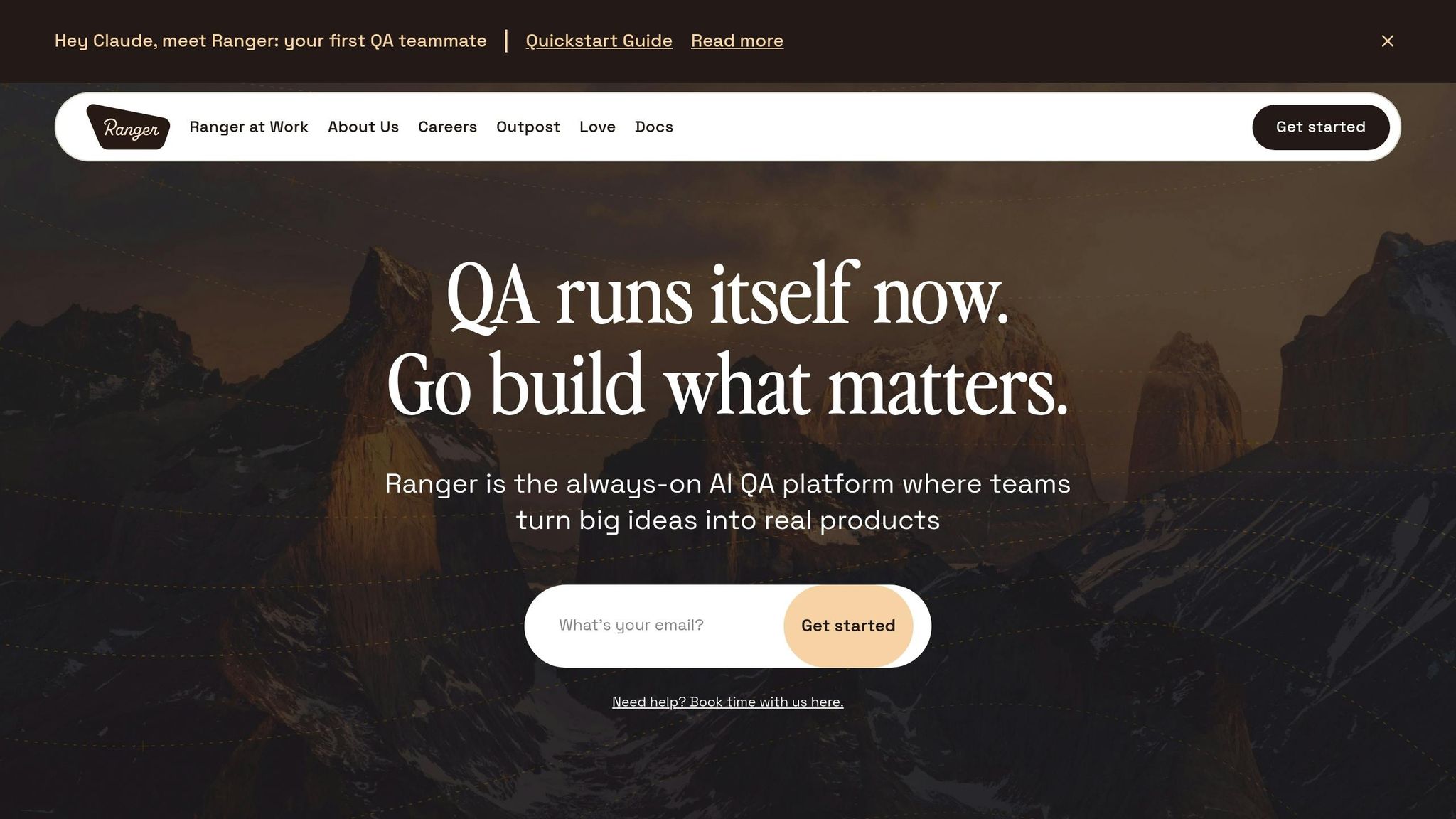
Ranger tackles the challenges of manual QA head-on, offering a faster path to QA process optimization while maintaining strong test coverage. It’s an AI-powered QA testing tool that employs a "cyborg" approach - AI agents create the initial Playwright test code, which QA experts then refine. This ensures the tests are accurate, easy to maintain, and aligned with actual user behavior. The result? Clean, readable tests that evolve alongside your product, eliminating the hassle of constant manual updates.
Ranger doesn’t stop there. It oversees the entire testing lifecycle, from launching browsers to running tests on staging and preview environments. When failures occur, the platform automatically categorizes them, pinpointing genuine bugs while filtering out flaky tests. This means engineering teams only get alerted about critical, high-risk issues, allowing them to focus on what matters most.
Ranger's Main Features and Benefits
Ranger’s adaptive AI-powered testing leverages web agents to explore sites and generate tests that stay up-to-date as your features change. The platform also includes a Feature Review UI, where teams can review screenshots and videos of test sessions, provide detailed feedback on visual elements, and share collaborative links for design and bug discussions.
Integration is effortless. Ranger connects with Slack for instant notifications and GitHub to embed test results directly into pull requests. It even supports autonomous workflows, where AI coding agents create sub-agents to verify their work and post results automatically. Notably, OpenAI partnered with Ranger to develop a web browsing harness for testing advanced models like o3-mini.
"Ranger has an innovative approach to testing that allows our team to get the benefits of E2E testing with a fraction of the effort they usually require", shared Brandon Goren, Software Engineer at Clay.
How Ranger Helps Development Teams
Ranger’s features deliver measurable benefits for development teams. On average, it saves over 200 hours of development time per engineer annually - time that would otherwise be spent on manual testing. For teams deploying code multiple times daily, this efficiency leads to faster feature rollouts and fewer bugs in production. The platform ensures high test coverage without requiring constant manual intervention, freeing engineers to focus on building new features.
Martin Camacho, Co-Founder at Suno, noted: "They make it easy to keep quality high while maintaining high engineering velocity. We are always adding new features, and Ranger has them covered in the blink of an eye".
This speed and reliability are game-changers for fast-paced teams. By handling QA dev-ops, Ranger eliminates testing bottlenecks, ensuring teams only deal with meaningful issues while keeping their momentum intact.
Meticulous Overview
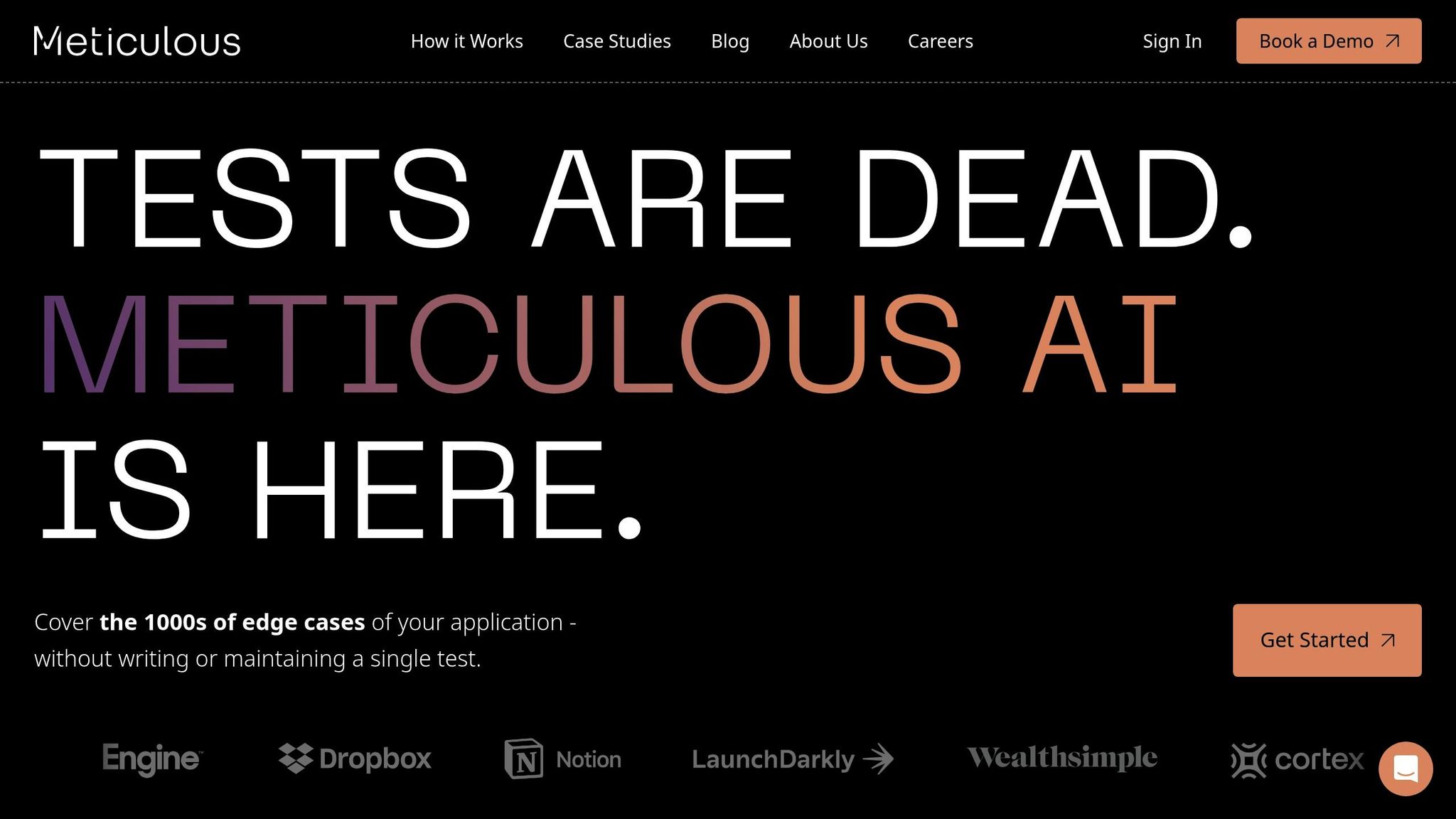
Meticulous approaches QA automation differently, using a JavaScript snippet to capture user interactions and create automated visual tests. Once installed on local, staging, or production environments, this snippet records every click, scroll, and interaction. An AI engine then generates a test suite automatically, removing the need for the upfront coding typically required by traditional testing tools.
One key feature is its deterministic scheduling engine, which is built on Chromium architecture. This ensures consistent test execution, eliminating flaky tests. Additionally, Meticulous mocks backend responses by recording XHR, Fetch, and WebSocket data, allowing tests to run without side effects or requiring special accounts.
Meticulous' Main Features
Meticulous takes visual snapshots after each user event and compares them during pull requests to identify logical, behavioral, and visual changes. It integrates seamlessly with GitHub, GitLab, and Vercel, posting visual diffs directly on pull requests. This lets teams review the impact of code changes before merging. The platform can also run thousands of tests simultaneously across a compute cluster, delivering results in under two minutes.
The test suite evolves automatically as your application changes. It adds new tests for features and edge cases while removing outdated ones, offering virtually zero maintenance. On average, organizations using Meticulous catch 10–20 bugs per week and save developers about 4 hours weekly that would otherwise be spent on manual testing.
"Meticulous is unlike anything else, developers love it and it is now an essential guardrail of our software development process."
- Erdem A., Head of Developer Experience, Notion
These capabilities help teams maintain strong regression coverage even in fast-paced development cycles.
Common Use Cases for Meticulous
Meticulous is ideal for frontend teams working in high-velocity environments where frequent code deployments demand reliable regression coverage without the overhead of manual vs automated testing strategies. It supports frameworks like React, Next.js (versions 12–14), Vue, Angular, Svelte, and Vite. Many teams use it during the pull request process to catch regressions before code goes live.
In 2024, Engine - a travel management platform valued at $2.1 billion - switched from its struggling Cypress testing stack to Meticulous. Principal Engineer Colin Hanna led a team of over 300 engineers to integrate the tool in under an hour. The platform helped catch 50 bugs per month and saved over 250 engineering hours monthly. During a major migration from React 17 to versions 18 and 19, Meticulous enabled the team to review 264 tickets for visual and behavioral regressions individually, speeding up redesigns by a factor of 10 compared to previous methods.
"What makes Meticulous different from other testing tools for me is the amount of effort we're putting in for the value. We're getting a lot of feedback points across our application for no investment."
- Colin Hanna
Feature Comparison
Side-by-Side Feature Analysis
Both platforms leverage AI for QA testing, but their strategies are quite distinct. Ranger uses an AI-Human Hybrid model where AI generates Playwright tests, and QA specialists review them for accuracy. Meticulous, on the other hand, relies on a fully autonomous system that records and replays real user sessions. These differences influence how tests are created, maintained, and how bugs are identified.
| Feature | Ranger | Meticulous |
|---|---|---|
| Core Methodology | AI-Human Hybrid (AI writes, humans verify) | AI-Native Autonomous (Session replay) |
| Test Creation | Generates Playwright tests from site navigation | Records and replays real user sessions |
| Human Oversight | QA experts review code | Fully autonomous |
| Bug Triaging | Automatic triage with expert verification | Automatic detection of UI regressions |
| Test Maintenance | Adaptive "self-healing" reviewed by experts | Automatic updates based on session changes |
| Integration Options | Real-time Slack signals, GitHub, CI/CD, Staging/Preview | GitHub, GitLab, Vercel |
| Hosted Infrastructure | Fully hosted browser infrastructure | Proprietary autonomous runtime |
| Primary Use Case | End-to-end functional testing for fast-shipping teams | Catching UI regressions via user behavior analysis |
Ranger produces human-readable Playwright code, allowing developers to review and refine it as needed. Tests are run against staging and preview environments, with full infrastructure management to ensure reliability before deployment. Meticulous, in contrast, prioritizes visual snapshots and behavioral comparisons within pull requests.
What Sets Ranger Apart
Ranger's standout feature is its "cyborg" model, blending AI-generated tests with human oversight. This ensures the tests are not only reliable but also easy to understand and modify. Unlike fully autonomous systems, Ranger’s QA experts review every test, minimizing brittleness and increasing trust in the results.
Its automatic triaging system adds another layer of efficiency by filtering out flaky tests and irrelevant noise. This means engineering teams only get alerts for real bugs and critical issues, reducing distractions and improving productivity.
"Ranger helps our team move faster with the confidence that we aren't breaking things. They help us create and maintain tests, ensuring clear alerts for genuine issues."
- Matt Hooper, Engineering Manager at Yurts
sbb-itb-7ae2cb2
Performance and Scalability Comparison
Performance Metrics Comparison
When testing at scale, execution speed and reliability are key priorities. Ranger addresses these by using hosted infrastructure that automatically spins up browsers, ensuring smooth and consistent performance across test suites of any size. Its parallel verification system, powered by "sub-agents", allows multiple tasks to run simultaneously, maintaining efficiency and reliability.
Ranger also employs an automatic triaging system that filters out flaky tests before they reach your team, saving time and reducing false positives. By combining AI-generated tests with reviews from human QA experts, the platform delivers a higher level of reliability across various testing scenarios.
| Metric | Ranger | Meticulous |
|---|---|---|
| Test Reliability | High (AI generation + Human QA review) | Variable (AI-only; lacks human oversight) |
| Execution Speed | High (parallel sub-agents for verification) | Slower if limited to a single agent |
| Bug Triage | Automated triage; filters out noise | Often handled by end-users |
| Infrastructure | Fully hosted and managed | Varies depending on the tool |
| Test Maintenance | Adapts automatically as products evolve | Requires manual updates |
This efficient design makes Ranger particularly well-suited for large-scale, high-demand testing environments.
Scalability in High-Demand Environments
Ranger's architecture is built to handle growing demands seamlessly. Its adaptive design ensures that the system scales automatically with your shipping frequency, providing the capacity your team needs as it grows. For example, in early 2025, OpenAI relied on Ranger to test their models' capabilities ahead of the o1 and o3-mini launches, demonstrating the platform's ability to manage critical, large-scale testing.
Martin Camacho, Co-Founder of Suno, highlighted how Ranger supports rapid scaling without compromising quality:
"We are always adding new features, and Ranger has them covered in the blink of an eye".
Similarly, Jonas Bauer from Upside shared how Ranger enabled same-day releases:
"I definitely feel more confident releasing more frequently now than I did before Ranger. Now things are pretty confident on having things go out same day once test flows have run".
Ranger's "closed-loop" system, which allows background agents to verify their own work, provides what users describe as significant leverage for engineering teams. This adaptive and scalable approach ensures that Ranger evolves alongside your development needs, making it a reliable choice for teams aiming to keep up with rapid changes and high shipping demands.
Integration and Use Cases
Integration with Development Tools
Ranger works effortlessly with key development tools like Slack, GitHub, and GitLab, bringing real-time test feedback and detailed failure insights straight into your workflow. When a test fails, QA specialists step in to review the results and share detailed reports directly within GitHub pull requests or Slack channels. The platform also generates easy-to-read Playwright code, making it a natural fit for CI/CD pipelines. As teams roll out new features, Ranger adapts its core testing flows, ensuring everything stays in sync. These integrations allow engineering teams to fully leverage Ranger's scalable setup.
Meticulous, on the other hand, uses a lightweight JavaScript snippet that integrates into development, staging, or preview environments. This snippet records user sessions and automatically flags visual regression issues on GitHub pull requests when the PR is created. However, it lacks direct support for Slack and doesn’t extend beyond its snippet-based setup for broader CI/CD workflows.
When to Use Ranger or Meticulous
Deciding between these tools comes down to your team's size and specific needs. Ranger is a great fit for mid-to-large engineering teams working in fast-paced environments where reliability and seamless tool integration are critical. Companies like OpenAI and Suno use Ranger to handle complex projects without slowing down their deployment cycles. With its deep connections to GitHub, Slack, and GitLab, along with its human-augmented AI capabilities, Ranger is ideal for teams that prioritize both quality and speed.
Meticulous, by contrast, is better suited for smaller to mid-sized teams focused on frontend development and managing web apps with frequent UI updates. Its JavaScript snippet simplifies visual end-to-end testing for user flows and edge cases in staging or preview environments. This makes it appealing for teams that want low-maintenance visual regression testing. However, for projects involving complex, multi-platform scenarios that might need human intervention, Meticulous may fall short.
Pricing and Deployment Comparison
Pricing and Deployment Comparison Table
Ranger stands out by potentially saving over 200 developer hours per engineer annually, and its pricing model is tailored to meet the needs of fast-moving teams. Ranger offers custom annual contracts based on the size of your test suite, while Meticulous uses a tiered pricing structure determined by company headcount. Meticulous customers typically pay around $2,086 per year on average, though this amount varies depending on employee brackets (0–50, 50–150, or 150–250 staff). Ranger requires a consultation to provide a quote that matches your specific testing requirements.
| Feature | Ranger | Meticulous |
|---|---|---|
| Pricing Basis | Test suite size (custom) | Company headcount (tiered) |
| Average Annual Cost | Custom quote required | ~$2,086/year |
| Deployment | Fully hosted infrastructure; managed QA pipeline | SaaS; user traffic replay platform |
| Support Type | AI agents + human QA expert review | Automated platform |
| Training Options | Documentation, webinars, live online, in-person | Documentation |
| Infrastructure Management | Ranger handles all browser setup and environments | Self-service SaaS |
Ranger's fully hosted infrastructure takes care of browser setup and environment management, cutting down on manual effort and maintenance costs. In contrast, Meticulous operates as a SaaS platform that replays user traffic to detect UI bugs. These pricing structures highlight Ranger's focus on aligning costs with actual testing needs.
Ranger's Custom Plans
Ranger's pricing model is designed to deliver a clear return on investment by reducing hidden testing expenses. By basing contracts on the size of your test suite, rather than the number of employees, Ranger ensures its costs reflect your actual testing workload. The platform automates test creation, maintenance, and infrastructure management, saving significant time - over 200 developer hours per engineer annually. Additionally, human QA experts review every AI-generated test before it reaches your team, ensuring the tests are clear, dependable, and ready for production.
"We base our annual contracts on the size of your test suite. Once we chat about your testing needs, we can customize a quote for you."
Ranger also offers flexible deployment options, including cloud, on-premises, and compatibility with major operating systems. With 24/7 live support, phone assistance, and training options like documentation, webinars, and in-person sessions, Ranger positions itself as more than just a testing tool - it becomes a true partner in your QA process.
Strengths, Limitations, and Recommendation
Strengths and Limitations of Each Tool
Ranger takes a hybrid approach, combining AI with human expertise to create reliable, easy-to-understand tests. Every AI-generated test is reviewed by QA experts to eliminate flaky results and ensure that only real bugs are flagged. This "cyborg" model effectively addresses the reliability gap that AI alone can't yet bridge for production-ready tests. It’s a strong solution for tackling common QA challenges.
That said, Ranger’s pricing is based on custom annual contracts tied to the size of your test suite. It’s also primarily designed for web-based products, which might mean it’s not the best fit for testing native mobile or desktop applications.
Meticulous, on the other hand, automatically generates tests by observing user interactions. While this sounds efficient, it lacks the ability to fully understand new features on its own, which could lead to missed bugs during initial releases. Its session-based approach might also fail to detect backend issues like unsent emails or complex redirects. Additionally, its visual diffing feature could mistakenly flag intentional UI changes as errors, adding unnecessary noise.
Why Ranger is the Better Choice
When it comes to performance and integration, Ranger clearly stands out. Its focus on delivering "signal over noise" ensures your team only deals with genuine issues. While Meticulous relies on human oversight to verify critical user flows, Ranger’s QA experts take care of the triage for you. This means your team can focus on solving real problems instead of sifting through false positives. Brandon Goren, a Software Engineer at Clay, shared that Ranger provides end-to-end testing with much less effort than traditional methods.
Ranger’s collaboration with OpenAI in January 2025 further highlights its technical capabilities. By creating a web browsing harness for the o3-mini and o1 research, Ranger showcases its ability to push boundaries. It also generates standard Playwright tests, which reduces the risk of vendor lock-in - a common issue with session-based methods that produce proprietary artifacts. With the potential to save over 200 developer hours per engineer each year, Ranger offers the reliability and scalability that modern engineering teams need to ship features faster and with greater confidence. This approach not only enhances testing efficiency but also bolsters quality in fast-paced development environments.
FAQs
How long does it take to get Ranger running on my app?
Setting up Ranger on your app is designed to be a smooth and efficient process, thanks to its setup tools and quickstart guides. While the exact time required depends on how complex your system is and your specific integration needs, the process is structured to be as straightforward as possible. For detailed, step-by-step guidance tailored to your setup, check out the onboarding resources provided.
Can I edit the Playwright tests Ranger generates?
Ranger has the ability to review and fine-tune AI-generated test scripts. However, it’s unclear if users can manually edit the tests created by the platform. To get a definitive answer, check the platform's documentation or reach out to their support team.
What’s the best way to keep Ranger tests stable as our UI changes?
To ensure Ranger tests remain reliable as your UI evolves, leverage its AI-powered test maintenance tools. These tools automatically update test scripts, adjust to code changes, and cut down on false positives. By reducing the need for manual intervention, they help keep your testing process efficient and dependable, even as your application scales and changes.
Related Blog Posts
Stop babysitting your coding agents. Use Ranger
%201%20(1).svg)
More signals, less noise, faster launches
Let Ranger be your guide to sustainable QA testing.

.png)