%201.svg)
Building Scalable Test Frameworks for Microservices


Microservices make software more flexible but also harder to test. Testing them comes with unique challenges in scaling test automation like managing network issues, handling dependencies, and avoiding delays caused by shared environments. Without proper frameworks, testing becomes slow, error-prone, and costly.
Here’s how to tackle these issues effectively:
- Modular Testing: Create separate pipelines for each service with reusable components to reduce maintenance time.
- Dependency Isolation: Use tools like Testcontainers and WireMock to simulate or isolate external services, preventing flaky tests.
- Contract Testing: Validate API agreements between services to avoid breaking changes without needing full setups.
- CI/CD Integration: Automate testing in pipelines with ephemeral environments to speed up feedback and reduce bottlenecks.
- Balanced Test Types: Follow a 70-20-8-2 pyramid (unit, integration, contract, and end-to-end tests) for efficient error detection.
Organizations using these strategies deploy faster, recover from failures quicker, and save significant costs. For example, teams have cut test delays, reduced incidents, and boosted deployment frequency from biweekly to 25 times daily. Investing in scalable testing frameworks ensures your microservices stay reliable as they grow.
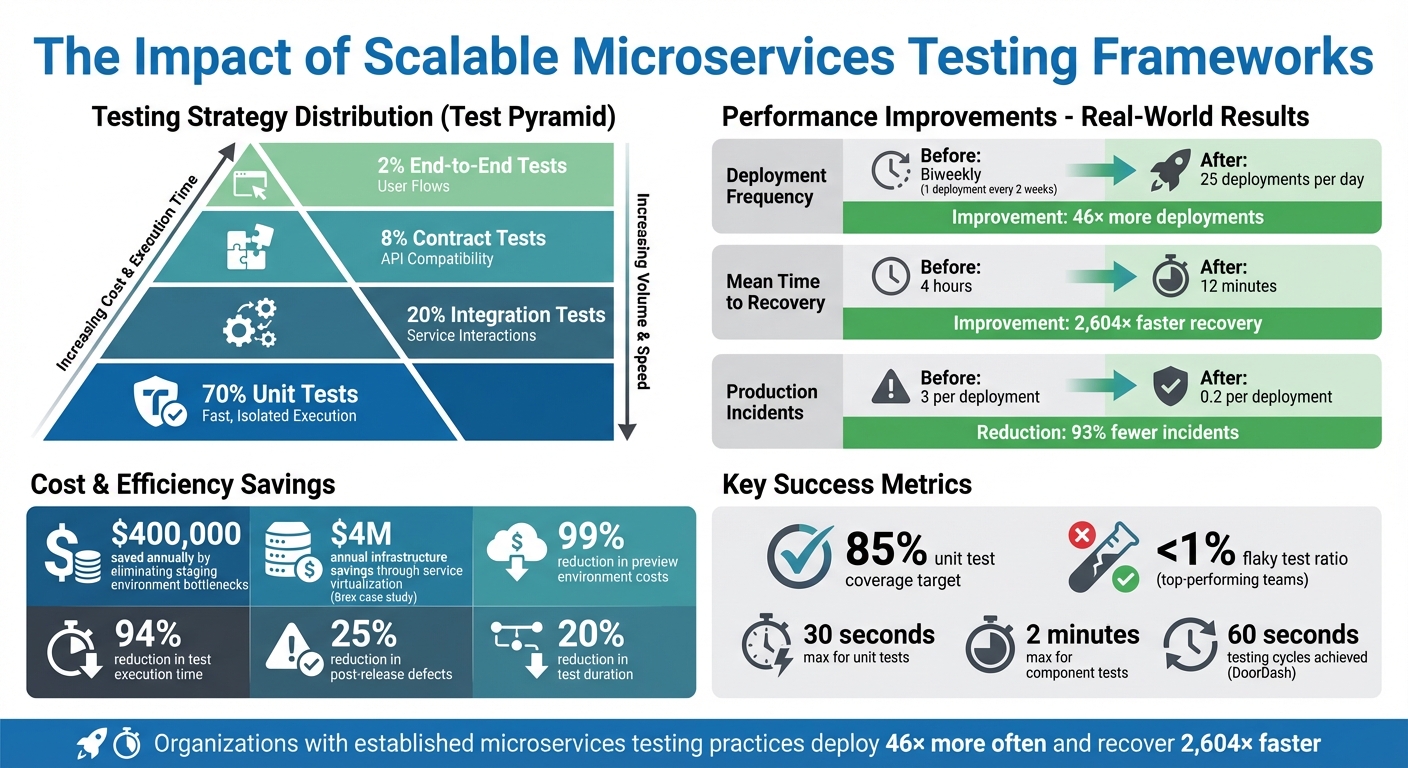
Microservices Testing Framework Impact: Deployment Frequency, Recovery Time, and Cost Savings
Comprehensive testing strategies for modern microservice architectures - Adelina Simion
sbb-itb-7ae2cb2
Design Principles for Scalable Test Frameworks
Building scalable testing frameworks for microservices revolves around three key principles: modularity, isolation, and smooth integration with CI/CD pipelines.
Modularity and Reusability
A modular design is the foundation. Each microservice should have its own independent CI/CD pipeline for unit, component, and contract tests. Keeping test logic separate from core utilities helps reduce maintenance overhead.
Reusable test components streamline the process and prevent code duplication across your suite. For example, test data factories ensure consistency across test layers, eliminating the need for manual setups. Shared utilities for tasks like authentication, cleanup, and polling make updates far easier - you only need to modify a single library instead of hundreds of test files. Leveraging Git-native, YAML-based test definitions ensures tests are easy to review in pull requests and can run seamlessly across both local setups and CI environments.
Here’s a real-world example: A mid-size e-commerce company generating $200M in annual GMV transitioned from a Java monolith to 12 microservices. By achieving 85% unit test coverage, using Testcontainers for component tests, and employing 34 Pact-based consumer-provider contracts, they transformed their deployment process. Deployment frequency jumped from biweekly to 25 times daily, production incidents dropped from 3 per deployment to 0.2, and their mean time to recovery shrank from 4 hours to 12 minutes.
Once modularity is in place, the next step is ensuring dependency isolation for better test reliability.
Isolation Through Mocking and Stubbing
Service virtualization is key to isolating dependencies that are costly, slow, or difficult to replicate locally. This includes SaaS integrations, payment processors, or machine learning services. Tools like WireMock or MockServer simulate realistic responses, eliminating the need for actual network calls and speeding up tests. However, mocks can consume up to 40% of testing time. A more dependable option is infrastructure isolation using Testcontainers. With this approach, you can spin up real, temporary instances of databases (e.g., PostgreSQL), caches (e.g., Redis), or message brokers (e.g., Kafka) for each test run. This prevents flaky tests caused by shared data while keeping tests fast and predictable. Top-performing teams aim for a flaky test ratio of less than 1%.
Consumer-driven contract (CDC) testing further enhances scalability. In CDC testing, consumers publish their expectations, which providers must validate during CI. This avoids breaking changes without requiring a full environment setup, making it an essential practice as your architecture grows.
With dependencies isolated, the final step is embedding these tests into your CI/CD pipelines.
Integration with CI/CD Pipelines
Incorporating automated testing into CI/CD pipelines ensures continuous feedback for developers. When each microservice has its own pipeline, any change triggers contract and integration tests, verifying compatibility with dependent services before deployment. This approach has been shown to significantly boost deployment frequency and recovery speed.
Ephemeral test environments are a must for scalability. CI/CD pipelines should be designed to spin up isolated Kubernetes namespaces or Docker Compose stacks for each pull request. This eliminates the delays caused by shared staging environments. For instance, one organization estimated they were losing $400,000 annually due to engineers waiting for access to staging environments.
To further streamline deployment, implement a "can-i-deploy" gate using a contract broker like Pact Broker. This automatically checks if the service version is compatible with all its consumers before allowing production deployment. Additionally, set execution time limits for tests: unit tests should complete within 30 seconds, and component tests within 2 minutes.
Test Types for Microservices Validation
When it comes to validating microservices, choosing the right mix of test types is key to building systems that are both scalable and reliable. A well-structured testing approach often follows a 70-20-8-2 pyramid: 70% unit tests, 20% integration tests, 8% contract tests, and 2% end-to-end (E2E) tests. This structure ensures quick feedback while catching issues at the right levels, aligning perfectly with the modular and isolated design principles of microservices.
Unit and Integration Testing
Unit tests focus on validating individual components, often with the help of mocks. These tests are incredibly fast - usually running in milliseconds - and help developers quickly identify where the business logic is failing. This speed and precision make it possible to run hundreds of unit tests locally before pushing any changes.
Integration tests, on the other hand, check how a service interacts with its immediate dependencies, such as databases, message brokers, or caches. Unlike unit tests, integration tests rely on real infrastructure, often using tools like Testcontainers to detect configuration and SQL-related errors. By doing so, they help eliminate discrepancies caused by different environments.
Contract Testing
Contract testing ensures that APIs between services work as expected by validating the agreements (or "contracts") between service providers and consumers. The beauty of this approach is that it doesn’t require both services to run simultaneously. Instead, each side tests against a stored contract, allowing teams to work independently and streamline their deployment pipelines.
The benefits of contract testing are striking. For example, teams using this method have reported a 1,400% increase in deployment frequency - from once a week to 15 times per week - while slashing test execution times by 94%. Tools like Pact Broker can enforce these contracts with a "can-i-deploy" gate, preventing deployments if any contract violations are detected. This targeted validation approach paves the way for more focused end-to-end testing of critical workflows.
End-to-End Testing
End-to-end tests validate entire user flows but tend to be resource-intensive and prone to failure. That’s why they should be reserved for the top 5–10 most critical business flows, such as user registration or checkout processes. In microservices, these flows often involve multiple components - for example, crossing four network boundaries, interacting with two message queues, and querying three databases. Unsurprisingly, E2E tests can fail up to 30% of the time due to environment-related issues.
To mitigate these challenges, consider running lightweight "smoke" E2E tests on pull requests and reserving the full suite for main branch merges. Using ephemeral environments can further reduce flakiness. Service virtualization is another useful tactic - it allows you to replace unreliable third-party dependencies (like payment gateways) with simulated versions. Finally, attaching unique trace IDs to requests and leveraging distributed tracing tools like Jaeger can help pinpoint the exact service causing a failure.
Building and Automating Modular Test Frameworks
Creating a scalable test framework is crucial for managing the complexities of microservices. With organizations using microservices spending 40–60% more time on testing than those with monolithic applications, engineering efficiency must be built in from the start.
Creating Reusable Test Components
The idea of modularity can simplify test maintenance significantly. A well-structured framework typically has three layers:
- Test Layer: Focuses on scenarios and assertions. Using a test case generator can help standardize these scenarios.
- Business Layer: Handles common workflows like user login or checkout processes.
- Core Utilities Layer: Manages essentials like driver setup, logging, and API helper functions.
This separation ensures that updates - like interface changes - only need adjustments in the Business Layer, not in every single test.
"The true measure of a scalable framework is not how fast it runs today, but how little it breaks tomorrow." - Our Code World
Shared testing libraries are another way to reduce repetitive code and maintain consistency. These libraries can include pre-configured API clients, Kafka consumers, and JSON utilities. For Java-based environments, custom annotations like @EnableTestContainers can automate infrastructure setups, ensuring clean and consistent test environments every time.
These reusable components are the backbone of a framework that can adapt to dynamic external dependencies, which leads us to service virtualization and data management.
Service Virtualization and Data Management
Service virtualization is an effective way to manage external dependencies that can slow down testing. For instance, Brex saved $4M annually on infrastructure and reduced costs for developer preview environments by 99% in 2023 by switching to request-level isolation and virtualization instead of duplicating full infrastructure stacks. Similarly, DoorDash achieved testing cycles as short as 60 seconds by using isolated sandboxes and service virtualization, speeding up feedback loops tenfold.
Tools like WireMock and MockServer are perfect for simulating external systems, such as payment gateways or third-party services that are unsafe to call directly during CI. These mocks can be configured directly in test scripts using an admin API, avoiding reliance on static files. To handle parallel test runs, unique identifiers like RUN_IDs can be used in template stubs, ensuring no interference between tests.
Establishing Governance for Test Architecture
Governance plays a critical role in maintaining consistency and clarity in testing, especially with evolving microservices. Without it, the complexity of microservices can spiral out of control. Governance policies can standardize service communication, define boundaries, and manage relationships between databases and microservices. Test code should be treated with the same care as production code - optimized for readability and maintainability, not just functionality.
Externalizing test data (e.g., JSON, CSV) and environment-specific configurations (like URLs and credentials) from the test logic allows the same test suite to run seamlessly across QA, staging, and production-like environments. To avoid issues with data pollution or conflicts during parallel test runs, use unique identifiers for each test execution. Packaging tests as containers and deploying them in Kubernetes alongside the application - often referred to as Tests as a Service - provides direct access to internal endpoints and integrates naturally with observability tools like Prometheus and Grafana.
Using Ranger for Scalable Microservices QA

Creating scalable test frameworks for microservices can be a complex and time-intensive process. Ranger simplifies this by automating key testing tasks while still involving human expertise for critical verifications. It integrates effortlessly with existing CI/CD workflows, making it a powerful tool for maintaining quality in evolving microservices environments.
AI-Powered Test Creation and Maintenance
Ranger eliminates the need for manual scripting by using AI to generate modular test designs. This approach not only saves time but also ensures that tests can be reused across different services. It minimizes the risk of widespread failures caused by minor updates to APIs or user interfaces.
Another major advantage is its ability to address test flakiness - those annoying and unpredictable test results that can drain engineering resources. By leveraging AI to detect and resolve flaky patterns, Ranger helps teams focus on delivering features rather than debugging false positives. This reduces the overall maintenance burden.
Human Oversight for Reliable Results
Automation is great, but it’s not foolproof. That’s where Ranger’s human oversight comes in. The platform employs specialized QA agents to verify work through automated loops, ensuring that validations are accurate and thorough.
Instead of relying on a single agent to manage both development and testing, Ranger uses multiple QA agents to handle scenarios in parallel. This method ensures faster and more reliable results. Human-reviewed test code also plays a critical role in catching edge cases - especially in distributed systems where interactions between services can lead to unexpected outcomes.
Integration and Real-Time Feedback
Ranger integrates directly with tools like Slack and GitHub, providing real-time feedback during the CI/CD process. Teams are notified immediately when tests fail, and the platform automatically triages bugs, assigning them to the appropriate engineers.
This integration makes testing a natural part of the development workflow. What’s more, the infrastructure scales automatically as new microservices are added. By building on modular and automated testing principles, Ranger ensures a consistent and efficient QA process that grows with your system.
Conclusion
Creating scalable test frameworks for microservices isn't just a nice-to-have - it's essential for staying competitive. As your architecture expands from a handful of services to dozens (or even more), the complexity of testing increases exponentially. Companies with well-established microservices testing practices manage to deploy 46 times more often and recover from incidents 2,604 times faster than those without such systems in place. The ability to scale your testing framework often determines whether your team thrives or struggles under growing demands.
Rather than duplicating entire environments or relying on excessive mocks - which can account for 40% of testing time - prioritize strategies like modular design, contract testing, and sandbox environments. These approaches have a proven track record. For example, some teams have slashed infrastructure costs by 99% while scaling their testing efforts and boosting deployment frequency from biweekly releases to 25 deployments per day.
The benefits of these improvements go beyond speed - they also drive measurable gains in efficiency and cost savings. Streamlined testing strategies can reduce test durations by 20%, lower post-release defects by 25%, and save a 200-person engineering team about $400,000 per month in productivity. The choices you make today in building your test framework will determine whether your team can deliver features efficiently or get stuck troubleshooting flaky tests and waiting on staging environments.
FAQs
How do I start modularizing tests across many microservices?
To break down testing for microservices effectively, adopt a layered approach: unit tests, integration tests, contract tests, and end-to-end tests.
- Unit tests focus on individual components in isolation, using mocks for external dependencies. They’re your first line of defense for catching bugs early.
- Integration tests ensure that services interact correctly with one another, verifying how they work together.
- Contract tests validate that service interfaces meet agreed-upon expectations, reducing the risk of breaking changes.
- End-to-end tests check the entire system's functionality but should be used sparingly to avoid excessive complexity and maintenance overhead.
This structured strategy helps pinpoint issues quickly, keeps tests manageable, and supports growth as your microservices architecture evolves.
When should I use mocks vs Testcontainers for dependencies?
When writing unit tests, using mocks is a great way to simulate external dependencies like databases or APIs. This method allows you to focus exclusively on testing your internal logic without the overhead of real services, making tests run faster and in isolation.
For integration testing, consider using Testcontainers. These allow you to interact with real dependencies in an environment that mimics production. By dynamically spinning up actual service containers, Testcontainers provide a more accurate representation of how your system will behave under real-world conditions, giving you greater confidence in its reliability.
How can contract tests prevent breaking changes in CI/CD?
Contract tests play a key role in maintaining stability during CI/CD processes. They ensure that service agreements, or "contracts", remain intact before deployment. By verifying that updates don’t disrupt expected interactions between services, contract tests minimize the chances of integration failures. This helps maintain reliability and ensures smoother deployments across interconnected systems.
Related Blog Posts
Stop babysitting your coding agents. Use Ranger
%201%20(1).svg)
More signals, less noise, faster launches
Let Ranger be your guide to sustainable QA testing.

.png)