%201.svg)
How AI Improves Performance Monitoring in QA Testing

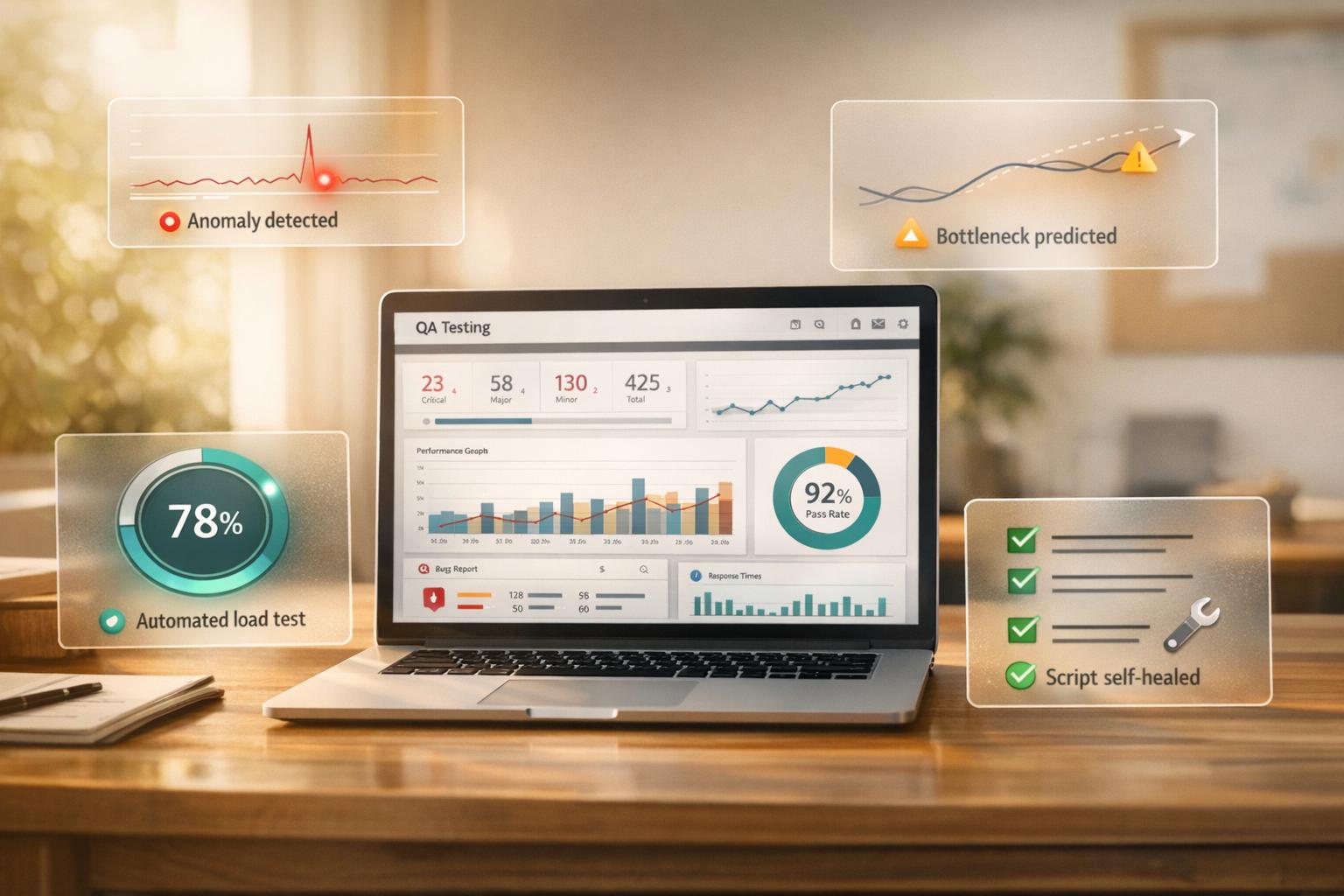
AI is transforming QA testing by automating performance monitoring, saving time, and improving accuracy. Here's what you need to know:
- Real-Time Issue Detection: AI analyzes metrics, logs, and traces together, identifying subtle problems traditional methods might miss. For example, it can flag latency spikes even when resource usage appears normal.
- Predictive Analytics: AI forecasts potential bottlenecks by studying historical data, helping teams fix issues before they escalate.
- Automated Stress Testing: AI simulates heavy traffic and resolves performance dips by scaling resources or restarting systems automatically.
- Self-Healing Tests: AI updates test scripts automatically when software changes, reducing maintenance efforts and keeping tests reliable.
- Integration with CI/CD: AI tools streamline workflows by selecting relevant tests, speeding up feedback loops, and ensuring faster releases.
For example, companies using AI-powered tools report up to a 50% reduction in testing time, with test coverage increasing from 34% to 91% in less than a year. By cutting costs and boosting efficiency, AI enables QA teams to focus on improving software quality, ensuring faster and more reliable releases.
Performance Testing with AI
Integrating these tools into your pipeline is a key part of how AI enhances continuous testing within modern DevOps environments.
sbb-itb-7ae2cb2
How AI Improves Performance Monitoring in QA Testing
AI is reshaping performance monitoring by replacing rigid, rule-based systems with intelligent frameworks that adapt to real-world conditions. Instead of relying on fixed thresholds, AI uses dynamic baselines that adjust to factors like traffic patterns, seasonal trends, and natural metric variations. This approach helps uncover issues that traditional methods often miss. By enabling real-time detection, predictive insights, and automated stress testing, AI brings a proactive edge to quality assurance.
Real-Time Anomaly Detection
AI excels at spotting anomalies by analyzing multiple data streams - such as metrics, traces, and logs - together. This combined approach catches subtle issues that isolated alerts would never flag. For example, if latency spikes while resource usage remains steady, AI identifies it as an anomaly. Traditional systems might overlook such discrepancies, leading to missed critical failures.
The cost of undetected anomalies can be enormous. Equifax, for instance, faced $1.4 billion in losses due to a single anomaly that went unnoticed in their production system.
Bajrang Suthar, Senior AI Engineer at Middleware, highlights this challenge: "In production AI systems, the most dangerous failures are silent ones, models that technically work but no longer behave as expected. Observability closes that gap by revealing what traditional monitoring cannot".
AI leverages advanced techniques like clustering algorithms and neural networks to uncover complex, non-linear relationships in data - patterns that human analysts would struggle to detect manually.
Predictive Analytics for Bottleneck Identification
AI doesn't just address problems after they happen - it anticipates them. Machine learning models analyze historical data to forecast potential system issues. For example, tracking token utilization percentages can reveal downstream latency or cost inefficiencies before they escalate. A PSI score exceeding 0.25, for instance, signals an urgent need for action.
AI also identifies operational challenges like GPU memory fragmentation - when memory remains allocated but underutilized - and detects schema violations or input data shifts before they lead to larger problems. Unlike traditional tools that fail to predict such scenarios, AI continuously learns and adapts, enabling near-real-time detection. This reduces the impact window for users compared to older, batch-based methods. By identifying bottlenecks early, AI can simulate and mitigate extreme conditions before they spiral out of control.
Automated Load and Stress Simulation
AI takes load testing to the next level by automating the process and initiating immediate fixes when performance dips as part of automated performance testing. For instance, it can restart pods or scale resources to counteract sustained degradation. This represents a shift from reactive troubleshooting to proactive system defense. With AI-driven systems, performance issues are often resolved autonomously, ensuring users are less likely to experience disruptions.
Using Ranger for Scalable AI-Driven QA Testing

Ranger combines the precision of AI automation with the reliability of human oversight to streamline performance monitoring in QA testing. Its AI web agent navigates your site and automatically generates Playwright tests, eliminating the need for manual scripting and reducing ongoing maintenance. While the AI produces the initial test code, human QA experts step in to review it, ensuring clarity and dependability. This hybrid approach enables real-time performance tracking and reliable validation.
AI-Powered Test Creation and Real-Time Performance Signals
Ranger tackles the challenges of monitoring dynamic systems by adapting its test creation as your product evolves. It filters out unnecessary noise and unreliable tests, highlighting only critical issues and real bugs for engineering teams to address. Performance signals are sent directly to stakeholders via Slack, while test results are synced with GitHub for seamless integration.
"Ranger helps our team move faster with the confidence that we aren't breaking things. They help us create and maintain tests that give us a clear signal when there is an issue that needs our attention", says Matt Hooper, Engineering Manager at Yurts.
The platform is designed to validate essential workflows continuously and scale effortlessly as your product grows. From managing browser launches for consistent staging tests to reducing the internal workload, Ranger handles the heavy lifting for test infrastructure.
Human Oversight for Reliable Testing Results
Although AI generates the tests, human expertise ensures they meet quality standards. Considering that only 27% of organizations review all AI-generated outputs, Ranger’s human-in-the-loop model stands out. QA experts verify the code for accuracy and readability, addressing concerns about relying solely on AI-generated scripts.
"Ranger has an innovative approach to testing that allows our team to get the benefits of E2E testing with a fraction of the effort they usually require", confirms Brandon Goren, Software Engineer at Clay.
Best Practices for AI-Driven Performance Monitoring
Leveraging AI for real-time insights and automated testing can take performance monitoring in end-to-end testing to the next level. Let’s look at how to make the most of these capabilities.
Integrating AI with CI/CD Pipelines
AI can streamline testing by selecting the most relevant tests based on recent code changes. This not only speeds up feedback loops but also trims down test execution times. Additionally, AI tracks application performance in real time, flagging issues during critical usage periods - when even minor slowdowns could lead to frustrated users and business losses. By analyzing historical bug data, AI pinpoints weak spots in software, allowing teams to direct their efforts toward areas that need the most attention.
To get started, prioritize AI tools that integrate smoothly with your current systems. For example, tools that connect with platforms like Slack or GitHub ensure performance updates are shared without disrupting workflows. To gauge the effectiveness of these integrations, monitor metrics such as the number of bugs identified and fixed, test execution times, and reductions in time-to-market.
While AI speeds up testing, self-healing tests take things a step further by maintaining high performance standards even during fast-paced development cycles.
Using AI for Self-Healing Tests
Self-healing tests are a game-changer. These automated scripts adapt to changes in software functionality - like updates to a UI or API - without requiring manual adjustments. This adaptability ensures tests remain effective, even as your software evolves.
By continuously monitoring code changes and updates, self-healing tests free up QA engineers to tackle more impactful tasks. AI doesn’t stop there - it studies past defects and usage trends to predict areas needing attention, tweaking test scripts accordingly. This means developers can spend less time managing tests and more time writing code.
For self-healing to work effectively, the AI needs to learn from historical data and evolve alongside your software. The more tests you run, the richer the data becomes, enabling even better optimization over time. This approach can achieve 80% test coverage - a level that’s tough to reach with traditional methods - while requiring minimal manual upkeep.
Measuring the Impact of AI on QA Performance

Manual vs Traditional vs AI-Native Testing: ROI and Performance Comparison
Key Metrics for Efficiency and Cost Savings
To understand how AI-powered monitoring benefits your QA process, focus on measurable metrics. Start with detection speed - how quickly AI identifies issues compared to manual methods. Then look at accuracy by tracking how often the system flags real issues versus false positives. Another key factor is scalability - can your framework handle more workload without needing additional personnel? Finally, evaluate cost savings by analyzing reductions in manual effort and maintenance expenses.
The financial impact of defects is no small matter: fixing issues in pre-production costs about $89, while production fixes can soar to $4,467. Customer-facing defects? Those average a staggering $67,890 each. AI-driven monitoring helps teams catch problems earlier, avoiding these hefty downstream costs. Beyond saving money, this early detection also gives teams a competitive edge, enabling faster feature releases.
"AI automation multiplies gains in test coverage, release speed, and team productivity." - Omkar Dhanawade, Quash
To calculate ROI, compare the total cost of implementing and running AI against the value gained from avoiding defects, minimizing delays, and speeding up releases. Dive into operational metrics like confidence thresholds, human overrides, and retry rates to assess AI's effectiveness. Measuring how much time developers save per sprint and gathering feedback during retrospectives can also help quantify productivity improvements.
These metrics provide a clear framework for comparing AI-enhanced testing with traditional methods.
Comparison: Manual vs. AI-Enhanced Monitoring
When you break down the numbers, the differences between manual vs. automated testing and AI-enhanced methods are hard to ignore. The economic contrast is especially striking. AI-native testing boasts an annual ROI of 1,160%, compared to 56% for traditional automation and a negative ROI of -0.5% for manual testing. Why? Manual testing often costs more than the issues it prevents, while traditional automation demands significant maintenance resources.
| Metric | Manual Testing | Traditional Automation | AI-Native Testing |
|---|---|---|---|
| Annual ROI | -0.5% | 56% | 1,160% |
| Release Velocity | Frequent delays (47%) | Moderate | 85% faster |
| Maintenance Effort | N/A | 60% of total effort | 5% of total effort |
| Defect Prevention | Limited | Moderate | 95% accuracy |
| Annual Maintenance Cost | N/A | ~$676,000 | ~$7,800 |
AI-native testing slashes maintenance overhead by 95%, allowing QA teams to shift their focus from debugging scripts to tackling strategic quality initiatives. Companies leveraging AI ship features 85% faster, and the ROI becomes even more compelling in specific industries. For example, e-commerce businesses recover revenue at a rate 1,200% higher than their AI costs, while financial services achieve a risk mitigation value that exceeds costs by an astounding 4,700%.
Conclusion
AI is reshaping performance monitoring in QA testing, offering tools that can detect anomalies in real time, predict bottlenecks before they escalate, and simulate load testing at scale without requiring manual effort.
The numbers speak for themselves: AI-driven QA can reduce testing time by up to 50%, speeding up time-to-market significantly. Furthermore, 43% of companies leveraging AI report major boosts in QA team productivity. These advancements mark a shift from traditional reactive testing to a more predictive approach.
This predictive approach brings real, measurable benefits. AI-powered tools can create self-healing tests that adjust automatically to software changes, provide continuous monitoring for immediate feedback, and integrate seamlessly with CI/CD pipelines to deliver real-time insights. The result? QA evolves from being a bottleneck to becoming an enabler, with test coverage reaching levels of 80% or more - far surpassing what traditional methods can achieve.
Take Ranger as an example. This platform showcases how the speed of AI, combined with human expertise, improves testing reliability. Ranger automates test creation and maintenance while allowing QA professionals to review test code for accuracy. This ensures teams focus on addressing real issues instead of chasing flaky test results.
"I definitely feel more confident releasing more frequently now than I did before Ranger. Now things are pretty confident on having things go out same day once test flows have run".
- Jonas Bauer, Co-Founder and Engineering Lead at Upside
To maximize the benefits of AI in QA, integrate AI-driven monitoring and test data management into your CI/CD pipeline, keep an eye on critical metrics like bug detection rates and time-to-market, and implement self-healing tests to cut down on maintenance work. The payoff is clear - not just in cost savings but in the ability to release features faster without compromising quality. By adopting these AI capabilities, QA transitions into a true value driver, giving teams the confidence to deliver high-quality software with every release.
FAQs
What data does AI need to spot performance anomalies?
AI taps into a variety of data sources to spot performance anomalies. These include logs, network traffic, screenshots, code changes, defect logs, test results, and historical testing data. By analyzing these inputs, AI can uncover patterns and deviations, which enhances both the precision and speed of performance monitoring.
How do I measure ROI from AI monitoring in QA?
To assess ROI from AI in QA, focus on metrics such as test coverage, time saved per test cycle, defect detection rates, and release frequency. The formula to calculate ROI is straightforward:
ROI (%) = (Savings – Costs) / Costs × 100
Savings come from reduced manual work, quicker testing cycles, and fewer bugs in production. On the other hand, costs include expenses for implementing and maintaining AI systems. Tools like Ranger can also help pinpoint bottlenecks and enhance defect detection, further contributing to measurable ROI improvements.
How does Ranger keep AI-generated tests reliable?
Ranger boosts the reliability of AI-generated tests by integrating human oversight during key stages of the process. This approach helps verify AI outcomes, minimize biases, and ensure accuracy and fairness are upheld throughout the testing phase.
Related Blog Posts
Stop babysitting your coding agents. Use Ranger
%201%20(1).svg)
More signals, less noise, faster launches
Let Ranger be your guide to sustainable QA testing.

.png)