%201.svg)
Top Challenges in Test Dependency Management



Test dependency management ensures that tests run smoothly without interfering with each other, but when it fails, it leads to flaky tests, slow testing processes, and missed bugs. Here's what you need to know:
- Cascading Failures: Shared states or improper cleanup can cause one test to break others, making debugging harder and wasting time.
- Performance Issues: Dependencies often force tests to run sequentially, slowing CI/CD pipelines and delaying deployments.
- Coverage Gaps: Hidden or undocumented dependencies can leave critical bugs undetected, especially when mocks or stubs are outdated.
Solutions:
- Mocks and Stubs: Isolate tests from external factors like APIs or databases.
- Dependency Mapping: Visualize and prioritize dependencies to identify and address risks.
- CI/CD Automation: Use tools like WireMock or Testcontainers to manage dependencies and catch issues early.
- AI Tools: Automate updates, detect breaking changes, and maintain test reliability with AI-powered platforms.
By addressing these issues, teams can improve test reliability, reduce debugging time, and speed up delivery pipelines.

Test Dependency Management: Key Statistics and Impact Metrics
Common Test Dependency Challenges
Cascading Test Failures
When one test changes shared resources without cleaning up, it can create a ripple effect that impacts unrelated tests. For example, tests that modify global variables, databases, or caches without resetting them leave the shared state in disarray. This issue worsens when tests depend on a specific execution order - something the code doesn't enforce. As a result, the failure often surfaces far from the actual problem, forcing developers to sift through multiple tests to locate the root cause.
"Because cascading defects affect multiple areas, pinpointing the original source often requires thorough investigation." – testRigor
The consequences go beyond just debugging headaches. Flaky tests - those that fail unpredictably - make up around 16% of all test failures in large codebases. Developers reportedly spend 5 to 10 hours per week dealing with these issues. Over time, this frustration leads teams to ignore test results or repeatedly rerun pipelines, hoping to see a "green" build. This not only wastes time but also diminishes confidence in the test suite, creating a vicious cycle of inefficiency and mistrust.
Performance Bottlenecks in Testing
Dependencies can also slow down testing by forcing sequential execution, which limits the ability to run tests in parallel. This is especially problematic in microservices architectures, where slow dependencies can exhaust system resources. For instance, aggressive retry policies might triple the number of requests, causing "retry storms" that overwhelm threads and crash services.
"Flaky tests are the silent killers of developer productivity. A test that passes on your machine but fails randomly in CI erodes trust in the entire test suite." – Pramod Dutta, Founder, QASkills.sh
These bottlenecks lead to longer merge queues and delayed deployments. When automated tests become unreliable, teams often fall back on manual vs automated testing trade-offs - a slower and less scalable alternative that drags out release schedules when speed is most critical.
Coverage Gaps and Hidden Bugs
Dependency issues can also leave gaps in test coverage, creating opportunities for bugs to slip through. For example, tests that rely on leftover database states, files, or memory from earlier tests often make undocumented assumptions. Without clear documentation, refactoring becomes risky, as changes in one test can unexpectedly break others.
Stale mocks and stubs add another layer of complexity. While service virtualization helps manage dependencies, outdated mocks may no longer reflect actual services. Tests might pass against these outdated contracts, only for the system to fail in production. Additionally, teams often focus on "happy path" scenarios, neglecting edge cases like rate limits (HTTP 429), expired authentication (HTTP 403), or high latency. For instance, a geocoding API returning 429 errors could disrupt operations if such scenarios aren't tested.
"Undocumented dependencies are the most dangerous because they have no resilience mechanisms. Dependency mapping and testing surfaces these hidden connections." – Total Shift Left Team
When flaky tests undermine trust, developers may start skipping tests or ignoring failures altogether, increasing the risk of real regressions going unnoticed until they hit production.
sbb-itb-7ae2cb2
Solutions for Test Dependency Problems
Using Mocks and Stubs to Break Dependencies
Mocks and stubs are invaluable for isolating your tests from external factors like network outages, rate limits, or server downtime. They act as stand-ins for real databases, APIs, or third-party services, ensuring your tests aren't derailed by issues outside your control. Here's the distinction: stubs provide predefined responses to control the data entering your test (state-based testing), while mocks check if specific methods were called correctly (behavior-based testing).
When mocking, focus on patching the usage rather than the definition. For example, in Python/Pytest, using autospec=True ensures mock objects match the original function's signature, preventing false positives caused by invalid arguments that would fail in production. For complex systems like databases, consider using "fakes" - lightweight, in-memory implementations such as SQLite - over intricate mock setups. This keeps tests straightforward and easy to follow.
"Similar to how stunt doubles do dangerous work in movies, we use test doubles to replace troublemakers and make tests easier to write."
- Jani Hartikainen
A key principle: only mock what you own. Avoid mocking third-party libraries directly; instead, create wrappers or adapters around them and mock those interfaces. For UI tests, replace hardcoded delays with condition-based waits (like waitForResponse or expect().toBeVisible()) to handle asynchronous behavior more reliably.
Mapping and Prioritizing Dependencies
Once you’ve introduced test doubles, the next step is to map out and prioritize dependencies. This helps identify where to focus your efforts.
Visual tools like network diagrams or dependency matrices can highlight the critical path. Differentiate between "Hard Logic" (mandatory sequences, such as backend services being ready before frontend tests) and "Soft Logic" (optional sequences based on best practices). Use color coding to separate internal dependencies (within your team) from external ones (third-party APIs or vendors).
Create a centralized inventory of dependencies, noting prerequisites, ownership, impact, and risk levels. During requirement analysis, map both upstream systems (those influencing your tests) and downstream systems (those your tests affect). Prioritize your efforts based on risk, ensuring critical tests that unblock other features run first. Apply the "Eliminate, Mitigate, Manage" framework: remove unnecessary dependencies, reduce their impact through mocks or workarounds, and assign clear ownership with regular reviews.
"The goal of any Agile organization isn't to completely eliminate all dependencies, but to... create better systems for dependency management that mitigate the disruption they cause."
- Brook Appelbaum, Director of Product Marketing, Planview
Once dependencies are mapped and prioritized, integrating these checks into your CI/CD pipeline ensures they’re addressed before reaching production.
Automating Dependency Management in CI/CD
By incorporating dependency testing into your CI/CD pipeline, you can catch issues like compatibility problems, outdated libraries, and security vulnerabilities early. Lockfiles (e.g., package-lock.json) and containers (e.g., Docker) help maintain consistent dependency versions and environments.
Be cautious with smart retries: repeated retries often point to deeper dependency issues. Use a quarantine strategy for flaky tests by tagging them to run in a separate, non-blocking pipeline, ensuring they don’t hold up the main merge queue. Randomizing test order with tools like pytest-randomly can uncover hidden dependencies where one test relies on the state left by another.
Several tools can simplify dependency management:
- WireMock: Virtualizes API dependencies.
- Toxiproxy: Simulates network failures.
- Testcontainers: Provides disposable infrastructure for realistic integration testing.
Automated dependency mapping, using distributed tracing, can uncover undocumented dependencies that pose risks. Adding static analysis to your pipeline can further identify outdated libraries and security vulnerabilities, keeping your dependencies secure and up to date.
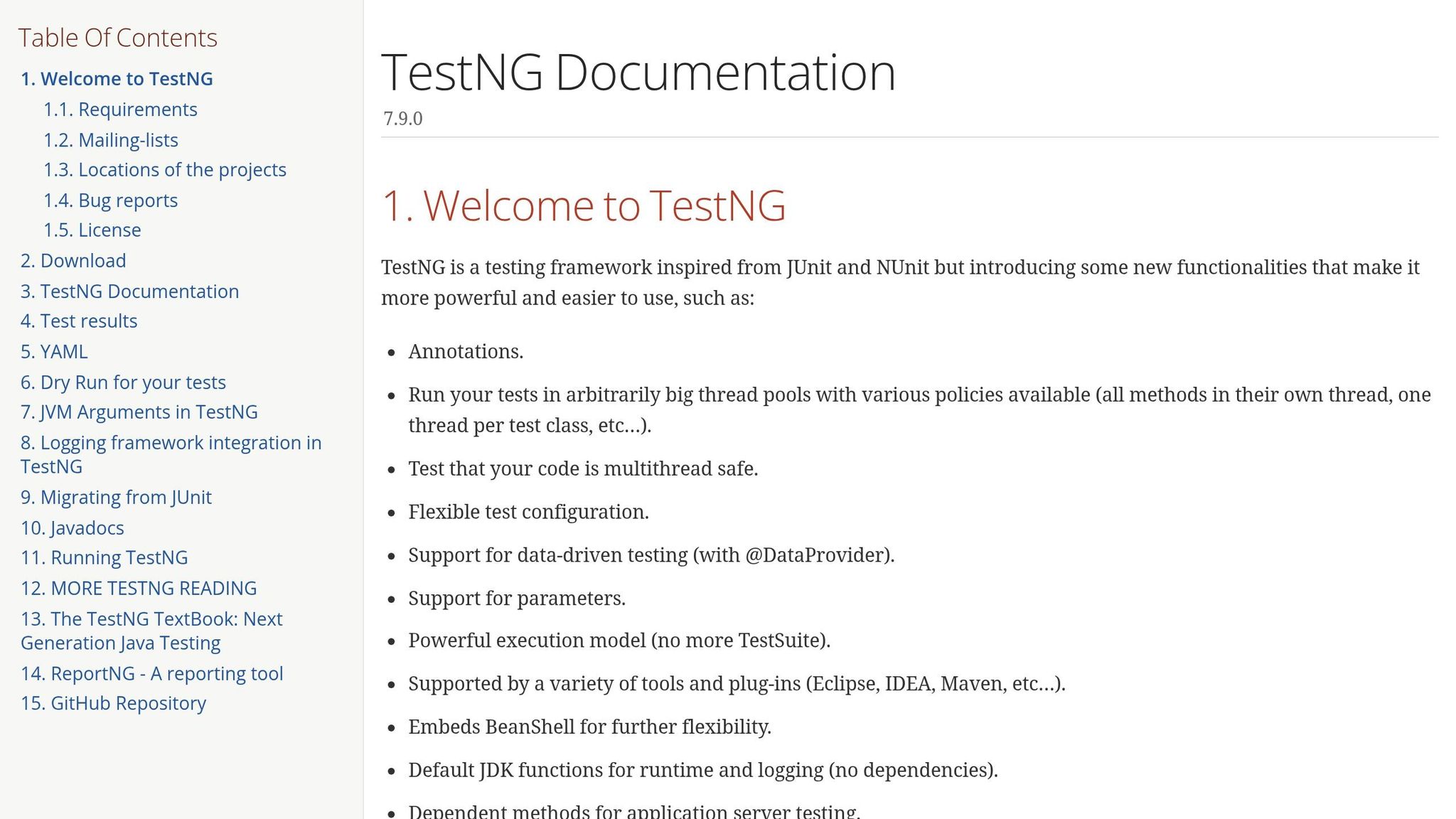
TestNG Tutorial #20 - How to Manage Dependency Between Test Cases
Using AI-Powered Tools for Dependency Management
AI-powered tools are taking automated dependency management to the next level, making testing workflows more efficient and responsive.
AI-Powered Test Creation and Maintenance
AI testing platforms simplify dependency updates while maintaining reliability, often through AI test maintenance alerts. Instead of manually updating test scripts whenever dependencies change, these tools monitor dependency lists in real time. They track security advisories, deprecations, and new releases, while also evaluating updates for compatibility with existing frameworks and predicting potential performance issues.
When a dependency update causes a build to fail, AI steps in to analyze the problem. It can refactor code to address breaking changes, such as altered function parameters, and even create pull requests for major version updates. Ranger's AI-powered platform takes this further by combining automated test creation with human oversight, ensuring that issues related to dependencies are resolved before they impact production.
Self-healing features reduce the hassle of maintenance. If UI elements shift or element IDs change due to dependency updates, AI platforms adjust tests automatically, cutting down on manual work. Additionally, when a dependency update affects an untested area, AI can generate new test cases to validate the change. According to DigitalOcean's 2026 Currents research report, 54% of businesses are actively exploring AI for code generation or refactoring, making it a leading use case for AI-driven solutions.
Integration with Existing Workflows
AI-driven dependency management integrates smoothly into existing CI/CD pipelines. These tools connect directly to platforms like GitHub and GitLab, automatically running checks on every commit or pull request to catch issues before code merges. Ranger integrates with tools like Slack and GitHub, providing real-time updates and automated bug triaging within the team's workspace.
For an efficient workflow, configure your CI pipeline to trigger the AI agent only when a dependency update fails its initial validation tests. AI can also generate code suggestions as merge requests, leaving critical architectural decisions to human reviewers. This approach automates repetitive tasks like version updates while ensuring humans handle complex refactoring. By blending automation with manual oversight, teams can maintain reliability without sacrificing control.
Human Oversight for Reliable Results
While AI excels at automating dependency management, human oversight is crucial to handle edge cases and avoid over-reliance on automated outputs. Flaky tests and hidden bugs still require a human touch. Research from Harvard Business School highlights this balance: entrepreneurs who selectively applied AI advice saw profits rise by 10% to 15%, while those who blindly followed AI suggestions experienced an 8% drop.
"Human expertise and creativity still matter, as do fundamental skills like communication and critical thinking." – Steven Melendez, Author, HBS
Ranger's platform ensures AI-driven fixes are validated by human reviewers. This "human-in-the-loop" approach guards against automation bias - the tendency to trust AI outputs even when evidence suggests otherwise. Teams should design workflows where AI-generated fixes undergo manual review, especially for updates affecting critical paths. AI tools can also provide uncertainty metrics, signaling when human intervention is most needed. This collaboration between AI and human expertise ensures dependable results while maintaining accountability.
Conclusion
Managing test dependencies isn’t just a technical hurdle - it’s a cornerstone of reliable quality assurance. Ignoring dependency issues can lead to cascading test failures, sluggish performance, and elusive bugs that might sneak into production. In fact, cascade failures are behind most severe outages in distributed systems. By addressing dependencies effectively, companies can achieve defect detection rates as high as 98%.
To tackle this challenge, adopt proven methods and embrace automation. Start by mapping your dependency graph, using mocks and stubs to isolate tests, virtualizing services to simulate failures, and randomizing test execution to uncover hidden issues. These techniques can turn unreliable test suites into dependable quality safeguards.
"Automation applied to an efficient operation will magnify the efficiency." – Bill Gates, Founder of Microsoft
AI-powered tools are also transforming dependency management. Platforms like Ranger bring together AI-driven test creation and human oversight to catch and resolve dependency issues before they affect end users. These tools can automate routine updates and reduce the burden of tracking dependencies.
The benefits of investing in strong dependency management are clear. Teams that rework dependencies into explicit contracts have reported up to a 22% reduction in build times, while controlled use of mocks can cut debugging efforts by nearly 40%. Start with small steps: automate routine updates, virtualize external APIs in your CI/CD pipeline, and implement database rollbacks for better test isolation. Over time, these incremental changes can transform dependency management into a smooth, efficient process. This not only improves testing reliability but also speeds up your delivery pipeline.
FAQs
How can I quickly find which dependency is causing flaky tests?
To spot a flaky test dependency, take a structured approach to analyzing test behavior and isolating components. Begin by examining the test environment and checking for dependencies on external services or shared states. Employ techniques like mocking and setting up/tearing down data independently to ensure tests run in isolation. Also, investigate issues related to test order or timing - such as race conditions - by running tests in different sequences to identify where failures occur.
What’s the best way to run tests in parallel when dependencies force sequencing?
To manage dependencies when running tests in parallel, the first step is to pinpoint and separate tests, ensuring they can run independently. If certain dependencies can't be avoided, use structured approaches like test plans or configuration files to define preconditions and handle cleanup tasks. Tools such as Ranger can help automate these steps, making the process more consistent. Additionally, effective resource management - like isolating test data - is crucial for preventing conflicts and keeping the testing process efficient.
When should I use mocks, stubs, fakes, or real services in tests?
The choice boils down to what you're testing and how much control or realism you need. Use mocks when you need to confirm that specific interactions occur. Opt for stubs when you require predefined responses to test behavior under certain conditions. Turn to fakes as lightweight substitutes for real services when simplicity is key. Save real services for integration or end-to-end tests where validating the system's actual behavior is crucial, but steer clear of them in unit tests - they can introduce unnecessary complexity and instability.
Related Blog Posts
Stop babysitting your coding agents. Use Ranger
%201%20(1).svg)
More signals, less noise, faster launches
Let Ranger be your guide to sustainable QA testing.

.png)