%201.svg)
Optimizing Workflows with AI Bug Triage

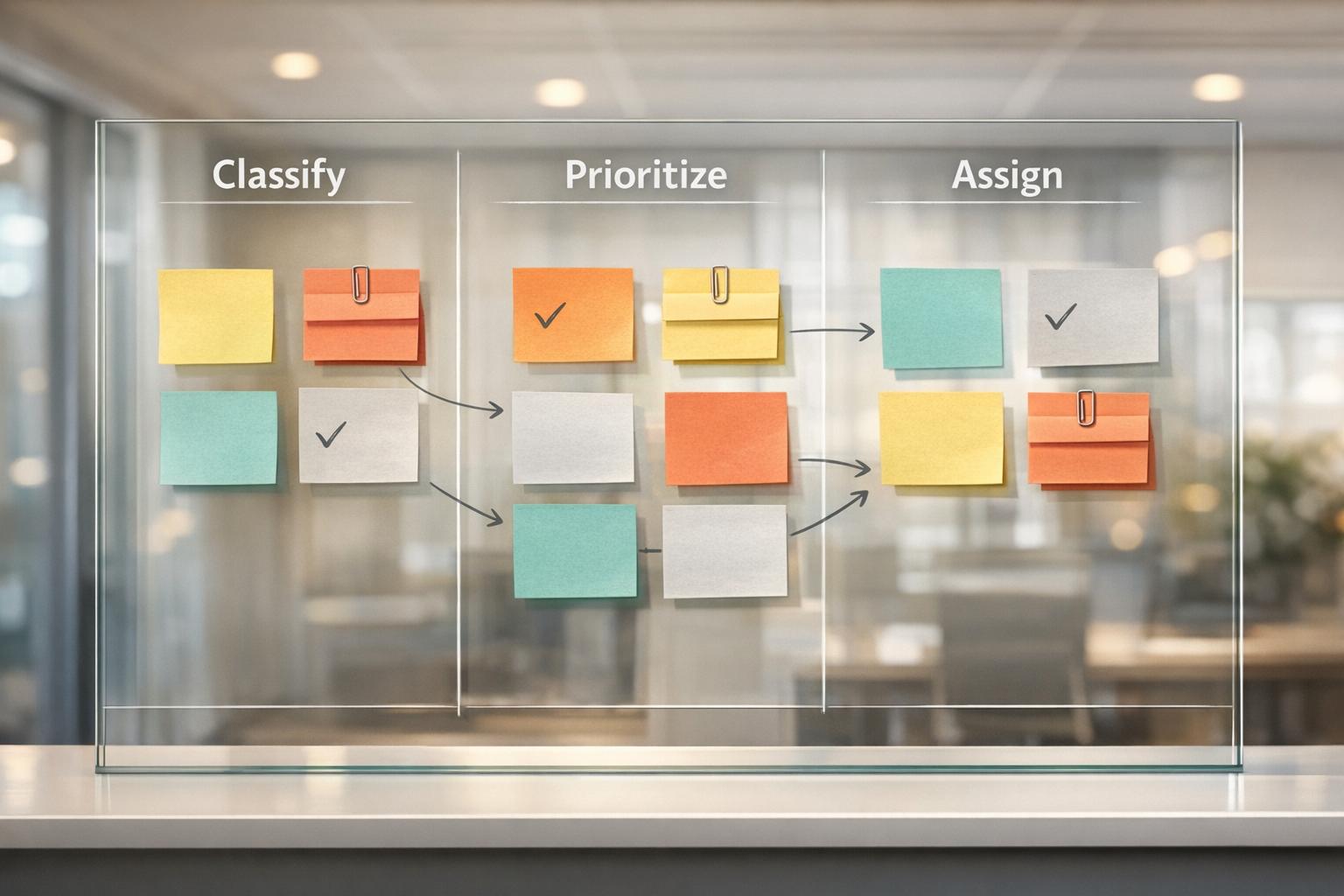
Managing bug reports manually wastes time and resources. AI-powered bug triage solves this by automating bug classification, prioritization, and assignment. Here's why it matters:
- Time Savings: Manual triage takes over 8 hours daily. AI reduces this to 30 minutes, cutting triage time by up to 94%.
- Improved Accuracy: Human classification accuracy is 60–70%, while AI achieves 85–90%, reducing errors by 80%.
- Faster Resolution: AI reduces response times from 4 hours to just 30 seconds and speeds up bug resolution by 21%.
- Duplicate Detection: AI identifies up to 80% of duplicate reports, saving developers from redundant tasks.
- Scalability: AI handles high volumes of bug reports efficiently, freeing engineers to focus on development.
Common Problems with Manual Bug Triage
Too Many Bug Reports to Handle
For high-traffic products, bug reports can quickly overwhelm teams. On average, sorting through these reports takes over 8 hours daily, leading to an ever-growing backlog. This backlog often buries critical issues under a pile of low-priority noise.
As software becomes more complex, the problem only gets worse. Manual triage eats up 30–40% of QA resources, forcing skilled engineers to spend their time on administrative tasks instead of solving actual problems. The process doesn't scale well - more users mean more reports, and the time required to manage them increases linearly, often surpassing what teams can handle.
Mistakes and Inconsistent Decisions
Human error plays a major role in manual bug triage, with classification accuracy hovering between 60% and 70% and a misclassification rate of around 15%. Engineers often assign different severities to the same issue, which can result in critical bugs being overlooked while less important ones are addressed first.
This inconsistency is often referred to as "bug tossing" - a situation where bugs are repeatedly reassigned due to incorrect initial categorization. For example, before Ericsson implemented their automated "Trouble Report Routing" (TRR) system in 2019, their TR Coordinators spent hours each day manually analyzing and routing reports. This tedious process not only delayed assignments but also led to errors in routing across their complex telecommunications systems.
"Manual bug assignment is labor-intensive and error-prone, resulting in 'bug tossing' and potentially slower bug resolution." - Markus Borg, Researcher and Author, Ericsson Case Study
Lower Team Productivity and Longer Resolution Times
Manual triage significantly impacts team productivity. Each interruption costs 23 minutes of recovery time, and duplicate bug reports consume over 15% of developer time. These context-switching penalties add up quickly, with inefficient bug management wasting nearly 25% of engineering time each week.
The result? Slower bug resolution, missed SLAs, and frustrated developers stuck in repetitive administrative tasks instead of focusing on creating new features. These challenges highlight the pressing need for automated solutions to streamline the process and improve engineering velocity by freeing up valuable resources.
| Metric | Manual Triage Impact |
|---|---|
| Classification Accuracy | 60–70% |
| QA Resource Drain | 30–40% of total resources |
| Weekly Time Waste | ~25% of engineering time |
| Context Switching Cost | 23-minute recovery per interruption |
| Duplicate Investigation | >15% of developer time |
sbb-itb-7ae2cb2
The AI trick that cut AWS's issue triage time by 90% and caught regressions in 2 minutes
How AI Improves Bug Triage Workflows
Manual vs AI-Powered Bug Triage: Performance Comparison
AI is reshaping bug triage by automating tasks like analyzing, classifying, and routing bug reports in just seconds. This eliminates hours of manual work for engineers. It processes bug reports by cleaning and extracting key details, such as error messages and stack traces, and then converts them into semantic vectors. These steps form the backbone of automation in classification, assignment, and real-time analysis.
Automatic Bug Classification and Prioritization
Today's AI systems rely on tools like classifiers, neural networks, and large language models to categorize bugs effectively. These tools analyze various signals, such as the bug's impact, emotional tone, and historical patterns, to assign priority levels - like P1, Critical, or Major - without needing manual intervention. For instance, in February 2019, Mozilla introduced "BugBug", an XGBoost-based tool for triaging Firefox bug reports. BugBug, operating at a 60% confidence threshold, achieved over 80% precision in component assignment. After processing its first 350 bugs, the median time for a developer to take action dropped to just 2 days, compared to the previous manual average of about a week.
To maintain reliability, AI systems only act automatically when predictions exceed a confidence threshold, often set at 85% or higher. Bug reports with lower confidence levels are flagged for human review. Additionally, these systems use techniques like sentence embeddings and similarity searches to detect duplicate reports.
Smart Bug Assignment
Once a bug is classified, AI assigns it to the most qualified developer or team by analyzing historical expertise and matching it to the issue's specific components. This process goes beyond simple keyword matching, employing a method called "interaction-based ranking", which identifies developers who have resolved similar issues in the past. For example, in April 2019, Ericsson deployed "TRR" (Trouble Report Routing) for its 4G and 5G systems. TRR automatically assigned 30% of incoming bug reports with 75% accuracy, reducing resolution times for auto-routed bugs by 21% and cutting down the workload for senior engineers.
Real-Time Analysis and Machine Learning
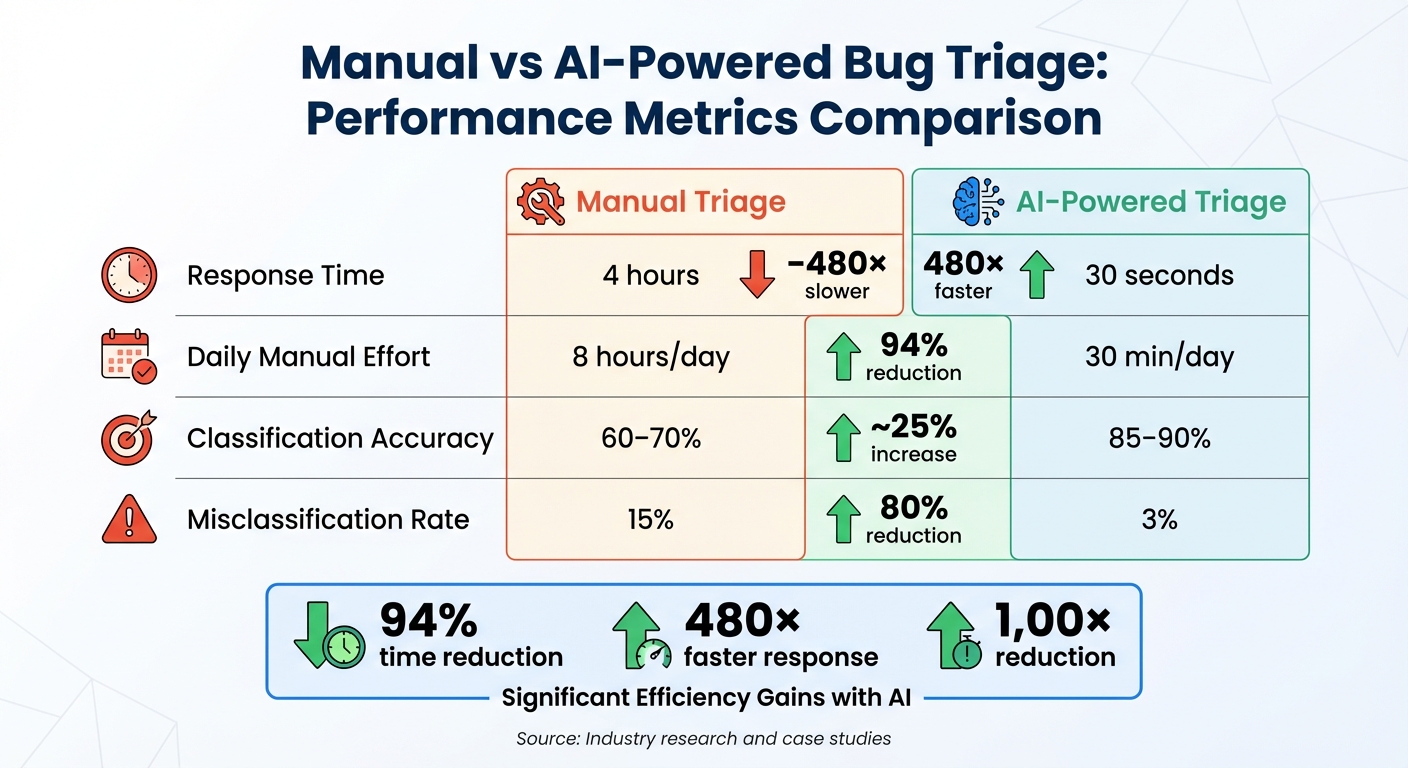
AI systems use Natural Language Processing (NLP) to extract vital information from bug reports as they come in - details like error messages, stack traces, reproduction steps, and even the reporter's sentiment. Each resolved bug report feeds back into the system, continuously improving its performance. This real-time processing dramatically improves response times, cutting them from an average of 4 hours to just 30 seconds. Moreover, advancements in transformer models like BERT and CodeBERT have boosted severity classification accuracy to 85–90%, compared to the 60–70% accuracy achieved through manual efforts.
| Metric | Manual Triage | AI-Powered Triage | Improvement |
|---|---|---|---|
| Response Time | 4 hours | 30 seconds | 480× faster |
| Manual Effort | 8 hours/day | 30 min/day | 94% reduction |
| Classification Accuracy | 60–70% | 85–90% | ~25% increase |
| Misclassification Rate | 15% | 3% | 80% reduction |
Platforms like Ranger integrate these AI capabilities with human oversight, enabling teams to identify critical issues faster and streamline their development cycles.
Main Benefits of AI-Powered Bug Triage
AI-driven bug triage transforms the way teams manage issues by improving speed, accuracy, and scalability. These advancements not only cut downtime but also reduce errors, making bug management more efficient and effective.
Faster Bug Resolution
AI dramatically reduces the time it takes to assign bugs to the right person. Instead of waiting for hours while a human triager reviews and routes reports, AI systems analyze incoming issues in milliseconds, extracting key details to route bugs immediately. This shift slashes response times from an average of 4 hours to just 30 seconds.
Beyond routing, AI can handle 30–50% of common queries automatically by providing instant documentation links, keeping these issues out of the engineering backlog altogether. It also detects up to 80% of duplicate reports, saving developers from wasting time on redundant investigations.
The results speak for themselves: auto-routed bug reports are resolved 21% faster than those handled manually, freeing senior engineers from repetitive sorting tasks and saving countless hours.
Better Accuracy and Consistency
AI brings a level of accuracy and consistency to bug triage that surpasses manual efforts. By analyzing thousands of historical bug reports, AI identifies patterns that humans might overlook, reducing misclassifications by up to 80%. Using tools like Natural Language Processing (NLP) and models such as BERT and CodeBERT, AI understands context far beyond simple keyword matching.
Unlike human triagers, who may classify the same issue differently due to fatigue or personal judgment, AI ensures objective and consistent classification across the board. It also excels at duplicate detection, employing techniques like Cosine Similarity to identify similar reports mathematically.
"AI triaging reduces manual effort by 65% and achieves 85-90% severity classification accuracy vs 60-70% for humans." - Yuri Kan, Senior QA Lead
Scalability for Growing Teams
AI-powered triage is a game-changer for scaling teams. While manual triage can take up significant time, AI processes daily tickets in just minutes. For example, sorting that might take 5 minutes per ticket manually can be completed by AI in 30 minutes per day, allowing engineers to concentrate on development work.
AI also minimizes "bug tossing", where issues bounce between teams before reaching the right person. By predicting the correct assignee with up to 86% precision, AI saves 1–2 days of resolution time per bug.
Interruptions caused by manual triage can cost engineers valuable focus. Studies show that regaining a "flow state" after being pulled away takes approximately 23 minutes. AI eliminates these disruptions by handling routine classifications, giving developers more uninterrupted time to code. Tools like Ranger integrate AI with human oversight, enabling teams to scale bug management without increasing manual workload proportionally.
How to Add AI Bug Triage to Your Workflow
Adding AI-powered bug triage to your workflow doesn’t have to be complicated. The process revolves around integrating AI tools with your existing DevOps setup, finding the right balance between automation and human input, and keeping an eye on metrics to ensure everything runs smoothly.
Connecting AI with DevOps Tools
For AI bug triage to work effectively, it needs to integrate seamlessly with the tools your team already uses. Tools like Ranger are designed for this, connecting directly with platforms like GitHub, Slack, and Jira. This setup allows AI to automatically process bug reports, assign them appropriately, and notify the right teams - all without manual effort.
Here’s how it might look: configure webhooks to pull structured bug reports from GitHub, analyze them using AI, generate Jira tickets, and send critical updates to dedicated Slack channels. This can cut triage time down to just 30 seconds. Using GraphQL, you can map AI-assigned tasks to the correct team members with precision. This type of integration not only speeds up the process but also ensures that automation and human oversight work hand in hand.
Combining Automation with Human Review
While automation handles the bulk of the work, human review is essential for more nuanced or complex cases. AI can manage routine tasks, but edge cases often require a human touch. By setting a confidence threshold - say, 85% - you can automate high-confidence cases while sending lower-confidence ones to a human reviewer.
To refine the process, include approval steps where engineers can review AI-suggested ticket descriptions before they’re finalized. Features like a "Retry" action allow engineers to give feedback, improving the AI's future performance. For unique or sensitive cases, use an "opt-out" label like ~"automation:disable" to ensure they’re handled manually. This hybrid approach ensures that AI can classify up to 90% of routine bugs, while the remaining ambiguous cases are escalated to Slack channels for manual handling.
Setting Success Metrics and Tracking Progress
Integrating AI is just the beginning. To truly optimize your workflow, you need to measure its performance. Focus on metrics like Mean Time to Resolution (MTTR), manual triage time, misclassification rates, response times, and user satisfaction.
Teams that implement AI bug triage often see impressive results: manual triage time drops by 94%, accuracy improves to 90–98%, and user satisfaction increases by about 44%. These numbers not only highlight the benefits but also help pinpoint areas where additional training or adjustments might be needed to keep the process running smoothly.
Conclusion
Manual bug triage can consume up to 32% of an engineering team's weekly time, making it a major bottleneck in modern software development. AI-driven workflows offer a way to streamline this process, combining efficiency and scalability while maintaining the necessary human oversight.
The benefits of AI-powered bug triage are striking: manual triage time decreases by 94%, response times shrink to just 30 seconds, and classification accuracy improves to 85–90%. Teams adopting these systems consistently report time savings and increased job satisfaction, as engineers can focus on creating features rather than sorting through tickets.
"The future of bug tracking is not just automation; it's intelligence." – BugFlows
The secret lies in a hybrid approach. AI takes care of repetitive tasks like categorizing bugs, identifying duplicates, and routing issues to the right teams. Meanwhile, engineers can dedicate their expertise to complex or ambiguous cases that require human judgment. This approach allows AI to handle up to 90% of routine bugs, escalating only the edge cases for manual review.
For teams aiming to scale without increasing headcount, AI bug triage is a game-changer. The technology is proven, the integration process is straightforward, and the results - faster response times and greater accuracy - are undeniable. Whether you're managing a growing backlog or trying to reduce the mental load of constant context-switching, AI-powered triage provides the scalability today's software development demands. By incorporating AI into your DevOps tools, teams can reclaim valuable time and stay focused on driving innovation.
Ranger offers AI-powered solutions that seamlessly integrate with your existing development tools, helping your team stay productive and innovative, even as your backlog expands.
FAQs
What data does AI use to triage bugs?
AI leverages bug descriptions, logs, metadata, and the credibility of the reporter to efficiently prioritize and assign bugs. By processing this data, it simplifies the bug triage process, helping development teams save time and make more accurate decisions.
How do we keep humans in control of AI triage?
Humans maintain control over AI triage by using a human-in-the-loop approach. This means they actively review and validate the AI's findings, prioritize bugs based on their impact on the business, and oversee decisions to ensure both accuracy and reliability. This method ensures that AI serves as a tool to assist - rather than replace - human judgment.
How do we measure AI triage ROI?
Measuring the return on investment (ROI) for AI-driven bug triage means looking at key performance metrics. For instance, it can reduce manual effort by 65–94%, speed up resolution times, and boost bug classification accuracy from the manual range of 60–70% to an impressive 85–90%. Other perks include fewer false positives, fewer duplicate reports, and bug resolution that's up to 40% faster. Together, these gains translate into higher productivity, resource savings, and smoother workflows - offering a clear picture of the value AI brings to bug triage.
Related Blog Posts
Stop babysitting your coding agents. Use Ranger
%201%20(1).svg)
More signals, less noise, faster launches
Let Ranger be your guide to sustainable QA testing.

.png)