%201.svg)
Neural Networks in Regression Testing: Case Studies

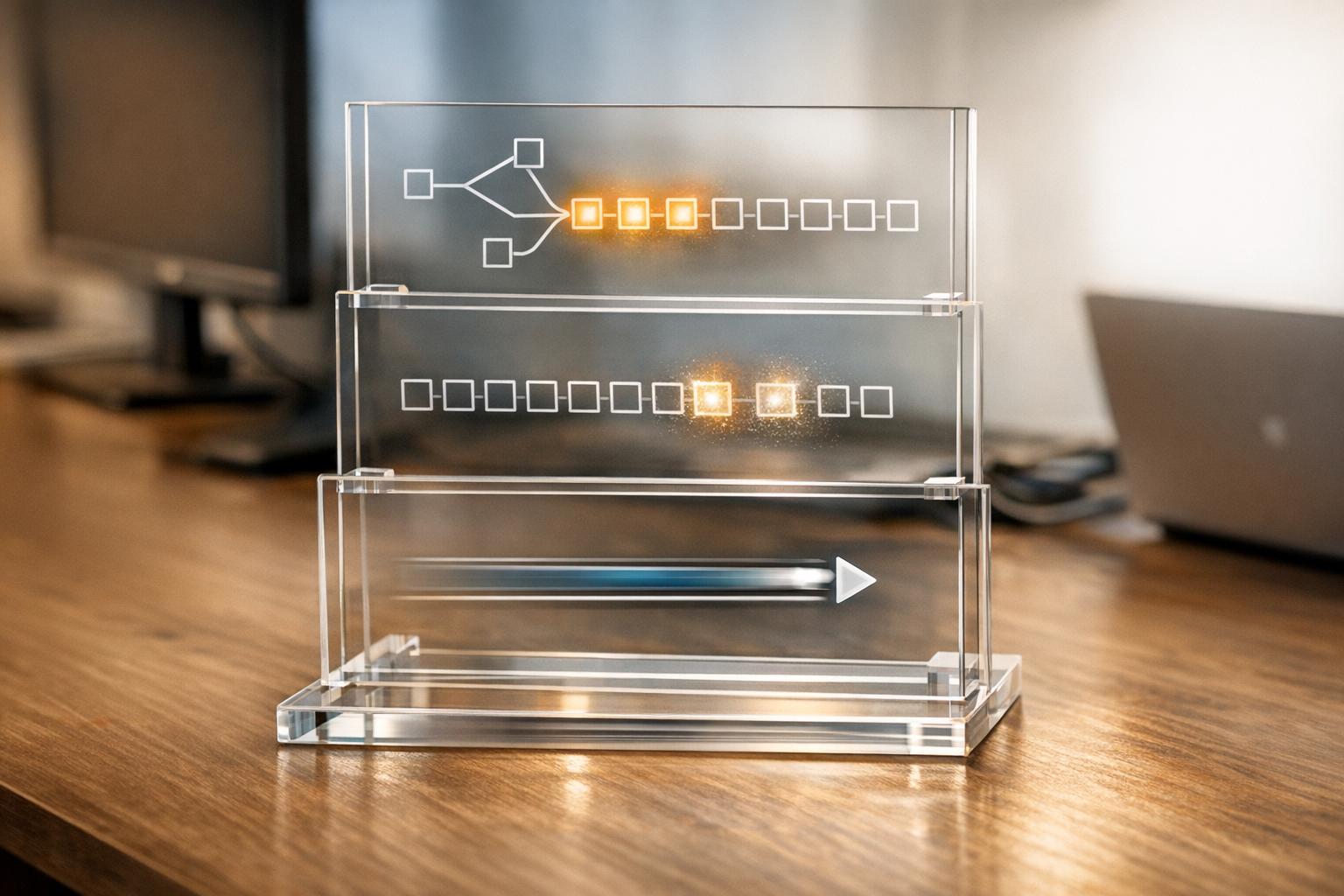
Neural networks are transforming regression testing by helping teams prioritize tests, detect flaky tests, and speed up pipelines. Here's a quick breakdown of how they work and their impact:
- Test Prioritization: Neural networks analyze historical data to predict which tests are most likely to catch bugs, saving time and resources.
- Flaky Test Detection: They identify inconsistent test failures, improving reliability in CI/CD pipelines.
- Faster Testing Pipelines: Tools like Netflix's "Lerner" optimize test execution within tight timeframes.
Key Results:
- Mozilla reduced test tasks by 70% and cut unnecessary runs by 99%.
- A global bank trimmed 30% of its regression tests, saving 25% on costs.
- Slack and GitHub drastically reduced flaky test failures.
Neural networks continuously improve by learning from past data, making them an efficient solution for managing complex testing challenges. Tools like Ranger integrate these capabilities directly into workflows, combining AI-driven automation with human oversight for thorough testing and quality assurance.

Neural Networks in Regression Testing: Key Results and Impact Across Leading Companies
Case Studies: Companies Using Neural Networks for Regression Testing
Case Study 1: Predictive Test Case Prioritization
When it comes to smarter test selection, some companies have made impressive strides with neural network-driven regression testing.
Take Mozilla, for example. They faced a colossal challenge with Firefox testing. Their continuous integration (CI) system was running the equivalent of 10 compute years every single day. Without an intelligent approach, they would have needed to execute roughly 2.3 billion test files daily across over 90 configurations. To tackle this, engineers Andrew Halberstadt and Marco Castelluccio introduced an XGBoost machine learning model in July 2020. The model analyzed factors like directory distances and modification history to predict which tests were most likely to reveal bugs. The results? A 70% cut in test tasks on the integration branch and an incredible 99% reduction compared to running all available tests.
"Compared to our previous solution, we've reduced the number of test tasks on our integration branch by 70%! Compared to a CI system with no test selection, by almost 99%!"
– Andrew Halberstadt, Mozilla
Another example comes from a global bank managing $2 trillion in assets. Their challenge was a suite of 500,000 manual regression tests - inefficient and poorly suited for automation. Starting in 2018, they applied machine learning to analyze parameters, identify high-value scenarios, and eliminate redundant tests. This approach reduced the total number of tests by 30%, maintained full coverage, and cut firm-wide testing costs by 25%.
These examples show how predictive test case prioritization can deliver measurable results, setting the stage for even more advancements.
Case Study 2: Detecting and Fixing Flaky Tests
Neural networks aren't just about prioritizing tests - they also shine when it comes to identifying and addressing flaky tests.
Flaky tests, which fail inconsistently without any code changes, can wreak havoc on CI/CD pipelines and frustrate developers. Mozilla tackled this issue by filtering intermittent failures from their training data, ensuring the system focused on legitimate regressions rather than false positives. This improved both prediction accuracy and overall reliability.
The impact of managing flaky tests is clear across the industry. For instance:
- Slack slashed its flaky test failure rate from 56.76% to just 3.85%.
- GitHub reduced flaky-related build failures by a factor of 18.
These results highlight how fixing flakiness can enhance the accuracy and trustworthiness of neural network-driven testing.
Case Study 3: Faster Continuous Testing Pipelines
Speeding up testing pipelines is another area where neural networks excel.
Netflix introduced "Lerner" in May 2019 to prioritize thousands of device certification tests. Using reinforcement learning agents and deep neural networks, Lerner schedules test executions based on historical data and domain-specific factors. This allows Netflix to prioritize tests with a higher likelihood of failure, fitting extensive testing into tight time constraints like a 60-minute window. The system also speeds up the time it takes to detect the first failure in CI runs.
"Lerner-based recommendations are proving to be different and more insightful than random runs, as they allow us to fit a particular time budget and detect patterns such as cases that tend to fail together in a cluster."
– Netflix Technology Blog
In February 2025, Duolingo teamed up with MobileBoost to launch "GPT Driver", an AI tool designed to automate complex test scenarios. This tool reduced manual regression workflows by 70%, showing how AI enhances continuous testing to streamline pipelines while ensuring thorough coverage.
sbb-itb-7ae2cb2
Benefits of Neural Networks in Regression Testing
Better Accuracy and Reliability
Neural networks excel at identifying high-risk areas in your codebase by analyzing historical data, detecting up to 30% more regressions by predicting bugs before they happen compared to traditional manual selection methods. Unlike manual approaches, which can miss critical issues, these models rely on a data-driven process to prioritize tests effectively.
"The initial results show that a learning-based approach can reduce test prioritization time, compared to a non-learning approach, while achieving a comparable fault detection effectiveness." – Dusica Marijan, Arnaud Gotlieb, and Abhijeet Sapkota
Lower Testing Time and Costs
Neural networks don't just improve accuracy - they also streamline regression testing by cutting unnecessary steps. By automatically identifying and removing redundant test cases, they significantly reduce both testing time and costs. For example, a retail client reported a 95% decrease in regression testing time, while an insurance provider reduced execution hours from 200 to 40 - a reduction of 80% - and saw $845,000 in ROI across 13 releases. Additionally, organizations transitioning from manual to AI-driven regression testing have seen testing speeds increase by 212%.
"The speed and accuracy of the AI-generated test cases exceeded our expectations, allowing us to complete comprehensive regression testing in a fraction of the time." – Client Testimonial, IWConnect
Scalability and Flexibility
Neural networks also shine when it comes to scalability and adaptability. They can grow alongside your test suite without requiring a proportional increase in manual effort. Research on neural scaling laws shows that performance continues to improve as you add more parameters, historical data, and computational resources. This ensures your testing infrastructure can keep up with expanding codebases and rising levels of complexity.
These models are also designed to adapt seamlessly to evolving codebases, requiring minimal manual intervention even when faced with minor UI changes or updates. With support for online learning, neural networks can update in real time as new regression data becomes available, making them an ideal fit for continuous testing pipelines.
Visual Regression Testing with Neural Networks by Oliver Zeigermann
How Ranger Supports Neural Network-Based Regression Testing
Ranger builds on the success of neural network-driven regression testing by streamlining test creation, human oversight, and tool integration, making it a powerful ally in quality assurance.
AI-Powered Test Creation and Maintenance
Ranger acts as an AI-driven QA assistant, automating the creation and upkeep of tests. By using sub-agents and plugins, it tackles complex testing scenarios like intricate data setups and edge cases - all without slowing down the coding process. Instead of manually crafting test scripts or updating outdated suites, Ranger's AI generates automated feedback loops to refine and validate code until it’s ready for production.
In February 2026, Ranger achieved a milestone by enabling production-ready features to ship without direct terminal intervention. It reads tasks, writes code, verifies it through automated loops, and provides results for human review.
"We just don't manually test features anymore or even open up the preview branch. We queue off multiple background agents at once, come back when it's fully verified its work with Ranger, leave feedback, and put up a PR." – Adwith Mukherjee, Chris Sheafe, Josh Ip, Mikayla Thompson
This level of automation ensures that while Ranger handles the heavy lifting, human oversight guarantees that every feature meets stringent quality benchmarks.
End-to-End Testing with Human Review
Ranger doesn’t just rely on AI - it combines automation with human expertise to deliver dependable regression testing. Its Feature Review UI captures visuals from test sessions, allowing stakeholders to leave comments and ensuring that critical issues are flagged during bug bashes or design reviews.
Using hooks within its plugins, Ranger continuously prompts agents to stay focused until all features are fully validated. This approach ensures that while AI manages the volume and speed of testing, human reviewers catch nuanced issues like business logic errors or context-specific edge cases.
Beyond testing, Ranger simplifies workflows by seamlessly connecting with development tools.
Integration with Your Development Tools
Ranger integrates directly with tools like Slack and GitHub, embedding automated verification into your existing workflow. It triggers tests from feedback channels, shares review links in Slack, and attaches visual results to GitHub Pull Requests.
"Now, anyone can push a new production-ready feature end to end without having to open the code or terminal." – Adwith Mukherjee, Chris Sheafe, Josh Ip, Mikayla Thompson
Conclusion
Neural networks are transforming regression testing by simplifying prioritization and boosting test accuracy. As highlighted in the case studies, these models tackle challenges that traditional methods often can't handle. Teams using AI-powered automation platforms have reported achieving over 90% test automation. This level of automation significantly cuts down on the time spent on maintenance.
What makes neural networks even more effective is their ability to continuously learn from test results and bug histories. With each testing cycle, their accuracy improves, making the entire process more efficient over time.
Ranger takes these neural network capabilities and integrates them directly into your development workflow. By combining AI-driven test creation with human oversight, it ensures a balanced approach. Plus, its seamless integration with tools like Slack and GitHub makes it easy to incorporate advanced testing techniques to optimize your QA process.
These solutions are designed to handle complex data and unpredictable test behaviors, freeing your team to concentrate on developing critical features.
FAQs
What data do neural networks need to prioritize regression tests?
Neural networks streamline regression testing by leveraging data like code changes, testing history, and transition states. By analyzing these factors, they pinpoint test cases most likely to reveal bugs. This approach not only saves time but also enhances software quality by focusing on the areas that matter most.
How can AI spot flaky tests without hiding real failures?
Flaky tests - those that produce inconsistent results - can be identified by AI through advanced algorithms that analyze test outcomes. These systems determine whether a failure is genuine or just a fluke by examining test stability across multiple runs and considering environmental factors. Some AI tools even include self-healing capabilities, which automatically address flaky tests. This not only minimizes manual intervention but also ensures that critical problems are accurately flagged, boosting the reliability of CI/CD pipelines.
How do you add Ranger to an existing Slack and GitHub workflow?
To bring Ranger into your Slack and GitHub workflow, start by linking its platform to automate processes like test creation, execution, and reporting. Set up your CI/CD pipeline so that tests automatically run whenever code is pushed to GitHub. Ranger’s AI can then classify bugs and send notifications to your team directly through Slack. Keep an eye on the system regularly, making adjustments as needed to boost efficiency and make regression testing smoother.
Related Blog Posts
Stop babysitting your coding agents. Use Ranger
%201%20(1).svg)
More signals, less noise, faster launches
Let Ranger be your guide to sustainable QA testing.

.png)