%201.svg)
How AI Improves Test Case Prioritization

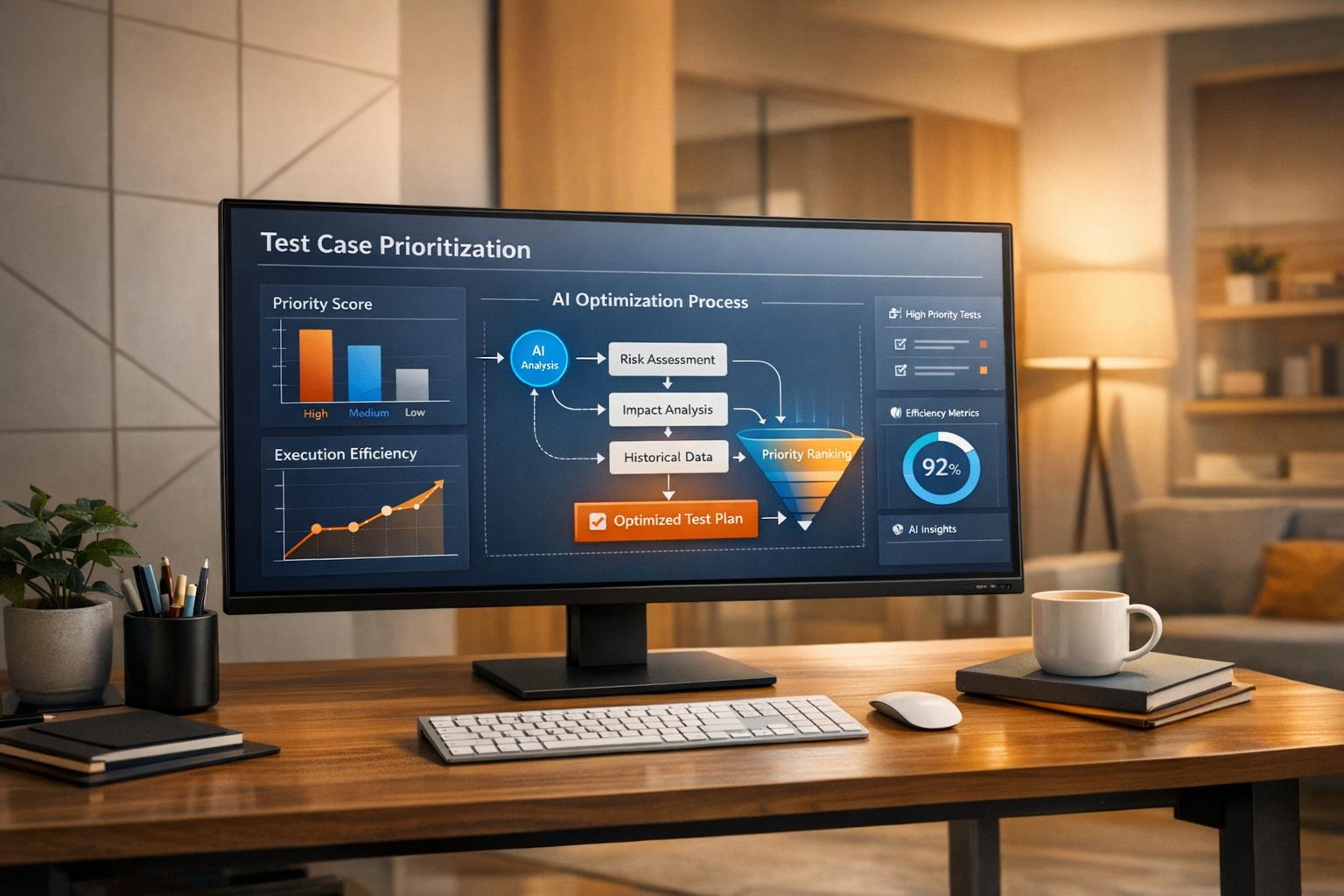
AI-driven test case prioritization helps teams focus on the most critical tests, saving time and resources while improving software quality. Instead of relying on outdated manual methods, AI uses data like historical test results, code changes, and defect patterns to identify high-risk areas. This approach reduces redundant testing, speeds up feedback loops, and minimizes bugs slipping into production.
Key Takeaways:
- Faster bug detection: AI prioritizes tests for areas most likely to fail, cutting regression cycles from days to hours.
- Resource efficiency: Eliminates duplicate and low-priority tests, saving up to 30% of testing efforts.
- Dynamic updates: AI adjusts test priorities in real-time as code changes, ensuring relevant tests are always run.
- Improved accuracy: Machine learning models detect errors with 33.9% higher efficiency than manual processes.
By integrating AI tools into CI/CD pipelines, teams can automate prioritization, reduce rework costs, and deliver updates more reliably. Combining AI with human oversight ensures critical tests align with business goals, making testing smarter and more effective.
AI for Test Prioritization | How to implement? | Benefits & Risks-Day 19 of 30 Days of AI in Testing
Problems with Manual Test Case Prioritization
Balancing thorough quality assurance (QA) with the need for rapid releases is a constant struggle when relying on manual test case prioritization. As test suites expand to thousands of cases, deciding which ones to run becomes a significant bottleneck, slowing down the release process. The crux of the issue lies in the fact that software evolves faster than manual QA teams can keep up. This growing gap highlights the pressing demand for AI-driven solutions.
Large Test Suites and Limited Time
Modern software applications generate massive test suites that quickly exceed human capacity to manage effectively. Manual regression testing often takes an entire week, while development teams frequently push updates. Even a single firmware patch can impact over 2,000 functions, leaving manual QA teams scrambling to keep up within tight release windows. With limited time and subjective decision-making, teams are constantly forced to choose which code changes to prioritize and which tests to run first. The outcome is predictable: QA consistently falls behind development sprints, creating a recurring bottleneck in the release cycle.
Guesswork and Mistakes in Decision-Making
When prioritization relies on subjective judgment instead of data, mistakes are inevitable. Decisions are often based on memory or guesswork, ignoring complex code dependencies and historical defect trends. This leads to a focus on low-risk areas while critical functionalities are overlooked. Additionally, external vendors often lack the necessary context for the product, requiring extensive walkthroughs for every new feature. The results are concerning: 58% of software teams report that fast release cycles allow defects to slip into production.
Slow Bug Detection and Pipeline Delays
Ineffective prioritization doesn’t just delay testing - it creates a ripple effect throughout the entire delivery pipeline. In 32% of cycles, QA enters the process too late, allowing defects to spread through multiple stages. This late detection significantly increases rework costs and prolongs the time required to fix issues. Bhavani Raman, COO of Element5, described the impact of their old manual process:
"Regression cycles used to take a week. Now it's a few hours."
When feedback loops stretch from hours to days, continuous delivery becomes unachievable. Teams are forced to choose between thorough testing and meeting release deadlines, a trade-off that underscores the need for smarter prioritization methods.
| Challenge | Impact on Teams | Resulting Inefficiency |
|---|---|---|
| Large Test Suites | Teams try to run all tests or pick randomly | Delayed testing cycles and pipeline slowdowns |
| Decision-Making | Subjective judgment drives prioritization | Missed critical tests and inconsistent results |
| Resource Limits | Testers focus on low-risk, repetitive tasks | High-risk areas are undertested; costs increase |
| Pipeline Speed | QA lags behind frequent development builds | Bottlenecks disrupt continuous delivery |
How AI Improves Test Case Prioritization
AI transforms test case prioritization from a subjective process into one driven by data. By analyzing historical defects, code complexity, and recent code changes, AI identifies critical tests with precision. Unlike manual methods, which can quickly become outdated, AI continuously adapts to changes in the codebase. This shift minimizes wasted resources, catches critical bugs early, and speeds up feedback loops. It’s a smarter, more efficient approach to managing test priorities.
Using Past Data and Current Information
AI leverages a combination of historical test results, defect logs, and commit histories to perform change impact analysis. When developers push new code, AI evaluates dependencies to identify which tests are most relevant to the updated areas. Tools like Microsoft’s Evo and Google’s TAP showcase how AI uses both past and real-time data to prioritize tests. The result? Testing becomes faster and more effective at catching issues.
Machine learning models, such as random forest algorithms, analyze patterns in the codebase to predict potential errors. These "Learn-to-Rank" methods have achieved a mean Average Percentage Fault Detected (APFD) value of 0.884 - 33.9% higher than traditional heuristic techniques. Unlike static methods that treat all tests equally, AI dynamically adjusts priorities for each build, integrating real-time feedback from CI/CD pipelines.
Focusing on High-Risk Test Cases
AI goes a step further by zeroing in on high-risk areas of the codebase. It assigns risk scores to individual test cases based on factors like defect density, code churn, and business impact. By identifying "hotspots" - the areas most likely to fail - AI ensures that tests covering these zones are prioritized. As Janakiraman Jayachandran, Global Head of Testing at Aspire Systems, puts it:
"AI significantly improves intelligent test prioritization by pinpointing the most crucial test cases for early execution, thereby optimizing time and resources while bolstering software quality."
Natural Language Processing (NLP) also plays a role by analyzing test case descriptions, user stories, and bug reports. This helps AI align tests with core business requirements, resulting in error detection rates that are approximately 90% higher than manual methods.
Removing Redundant and Unreliable Tests
AI uses clustering algorithms to group similar test cases, effectively eliminating duplicates. This is a significant improvement, considering that 58% of enterprises waste more than 30% of their testing resources on redundant or low-priority tests.
In addition, machine learning models identify "flaky" tests - those that fail sporadically due to environmental factors rather than actual code issues. AI-powered failure analysis can reduce the time spent diagnosing these failures by up to 95%. By categorizing failure reasons automatically, teams can quickly isolate and address unstable tests. As Jayachandran notes:
"AI focuses on historical failure patterns, but humans ensure new features get tested adequately."
AI adjusts test suites in real time, removing low-value tests and adding new ones based on recent code changes. This results in a streamlined, efficient test suite that provides actionable feedback in hours instead of days.
How Ranger Prioritizes Test Cases with AI
Ranger takes the concept of AI-driven test prioritization to the next level by blending the speed of artificial intelligence with the accuracy of human oversight. Its platform uses an AI-powered web agent to generate Playwright test code by navigating websites based on specific testing plans. But it doesn’t stop there - every line of code is carefully reviewed by QA Rangers to ensure the tests are reliable. This approach tackles the common challenges of manual prioritization, such as guesswork and inefficiency, while speeding up feedback loops and cutting down on repetitive tasks.
AI Automation with Human Oversight
Ranger’s AI agent simplifies the process by automatically analyzing test failures. When a test breaks, the AI categorizes the issue and flags it for human review. QA Rangers then step in to determine whether the problem is a real bug or just a false positive, significantly reducing unnecessary alerts. This hybrid system saves engineers over 200 hours annually by automating tedious testing tasks. Matt Hooper, Engineering Manager at Yurts, sums it up perfectly:
"Ranger helps our team move faster with the confidence that we aren't breaking things. They help us create and maintain tests that give us a clear signal when there is an issue that needs our attention".
Seamless Integration with Slack and GitHub
Ranger fits effortlessly into your existing workflow by integrating with tools like Slack and GitHub. It sends real-time alerts for high-risk failures directly to Slack and syncs test results with GitHub pull requests. In 2024, OpenAI and Ranger collaborated on the o3‑mini research paper, highlighting Ranger’s advanced web browsing capabilities. This integration ensures that even in complex testing scenarios, developers can stay focused without unnecessary disruptions.
Scalable Hosted Infrastructure
Ranger’s infrastructure automatically scales to meet the demands of growing test suites. It dynamically spins up browsers to test in staging and preview environments, maintaining consistent performance no matter the workload. Flexible pricing through annual contracts ensures that teams only pay for what they need. Brandon Goren, Software Engineer at Clay, shares his experience:
"Ranger has an innovative approach to testing that allows our team to get the benefits of E2E testing with a fraction of the effort they usually require".
sbb-itb-7ae2cb2
Benefits of AI-Driven Test Case Prioritization

Manual vs AI-Driven Test Case Prioritization: Performance Comparison
AI-driven test case prioritization transforms how teams approach software testing by improving efficiency and cutting rework costs. With AI-powered tools, error detection rates can soar by as much as 90% compared to manual inspections. On the flip side, traditional methods often lead to inefficiencies, with 58% of enterprises wasting over 30% of their testing resources on redundant or low-priority test cases.
Experts in the field emphasize that AI-driven prioritization sharpens the focus on critical test cases, making the entire process more streamlined. Supporting this, research using a "Learn-to-Rank" framework demonstrated a 33.9% higher Average Percentage Fault Detected (APFD) value compared to traditional heuristic approaches, achieving a mean APFD of 0.884.
Manual vs. AI Prioritization Comparison
When you compare manual testing methods to AI-driven approaches, the advantages of AI become strikingly clear. Here’s a breakdown of key performance metrics:
| Metric | Manual/Traditional Method | AI-Driven Approach |
|---|---|---|
| Bug Detection Speed | Slower; defects often surface late in the cycle or even in production | Faster; identifies critical flaws early using risk-based scoring |
| Resource Usage | High waste; excessive focus on low-priority tests | Optimized; targets high-risk tests, minimizing infrastructure strain |
| Error Detection Rate | Baseline manual inspection levels | Up to 90% improvement in detection efficiency |
| Delivery Time | Prolonged by lengthy regression cycles and feedback delays | Shortened; enables fast CI/CD releases with instant feedback |
| Adaptability | Static; manual re-prioritization needed after code changes | Dynamic; automatically adjusts test priorities based on real-time code updates |
| Annual Rework Cost | High, averaging $2.3M for mid-sized businesses | Dramatically reduced through early issue detection |
This comparison highlights how AI not only refines but also accelerates test prioritization, paving the way for a more agile and effective testing process.
AI fundamentally changes team workflows by focusing efforts where they matter most - on the highest-risk tests. Rather than relying on guesswork, AI evaluates historical failure data, code complexity, and recent changes to pinpoint areas of concern. The result? Faster feedback loops for developers, fewer last-minute surprises in production, and a smarter allocation of testing resources to maximize impact.
How to Add AI to Your Test Prioritization Process
Start by reviewing your current testing procedures to identify bottlenecks and areas with frequent defects where AI could make a difference. This step builds on the AI advantages discussed earlier, helping your testing stay agile and targeted. Next, gather historical data - such as past test results, defect logs, commit history, and execution times - to train your AI models effectively.
Choose AI tools that specialize in risk-based prioritization and predictive analytics, ensuring they integrate seamlessly with your existing CI/CD platforms. Before deploying across your entire test suite, run a small-scale pilot in areas with frequent changes. Use this pilot to validate the tool’s accuracy and measure how much it reduces execution time. By comparing AI-prioritized test suites with manual ones, you can establish a baseline to gauge improvements in defect detection. This approach also helps ensure smooth integration into your CI/CD pipeline, paving the way for dynamic test reprioritization.
Connecting AI Tools to CI/CD Pipelines
Once you’ve selected an AI tool, integrate it into your CI/CD pipeline to enable dynamic test reprioritization for every code change. Unlike static manual lists, AI tools can reprioritize the entire test suite for each build, focusing on the specific lines of code that were modified. Companies like Microsoft and Google already use AI in this way to analyze code changes and prioritize high-risk tests, dramatically reducing testing time.
Set up your system to log execution times and outcomes, creating a continuous stream of data to refine your AI model. This process ensures the AI learns from new test results and defect data, becoming more accurate and responsive over time. With this integration, continuous monitoring will help the AI stay aligned with shifting priorities and maintain its effectiveness.
Reviewing and Improving AI Results
Human oversight is critical to ensure AI prioritization aligns with your business’s most important functions. Regular reviews and audits can help keep the AI focused on what matters most, such as payment systems or security features. As Janakiraman Jayachandran, Global Head of Testing at Aspire Systems, puts it:
"AI improves efficiency, but humans bring business context, domain expertise, and real-world judgment to ensure intelligent test prioritization is accurate and effective".
Schedule routine audits of the AI’s threat scores for test cases to confirm they reflect current business priorities and recent code changes. Use metrics like Defect Detection Rate (DDR) and Average Percentage of Faults Detected (APFD) to evaluate whether the AI is successfully prioritizing critical failures. Also, monitor your Change Failure Rate - how often releases fail after passing AI-prioritized tests - to spot gaps in the model’s risk assessment. Regularly review AI decisions to ensure new features aren’t overlooked and that compliance or accessibility tests aren’t deprioritized simply because they’ve historically passed.
Conclusion
This article has highlighted how AI is reshaping the testing landscape, offering a faster and smarter approach to test case prioritization. By moving away from slow, manual methods, AI introduces a data-driven process that aligns with the rapid pace of modern development cycles. Instead of relying on intuition or running tests sequentially, AI examines historical defect trends, code complexity, and real-time changes to zero in on high-risk areas first. The result? Faster error detection and significantly less time wasted on redundant tests.
AI-driven prioritization tackles the key challenges that often slow down development teams. It removes bottlenecks, enables early bug detection, and keeps test priorities updated automatically. Industry leaders have already shown how AI can streamline these processes, setting the stage for smoother, more efficient testing workflows.
Ranger builds on these advancements with a hybrid model that balances automation and expert oversight. Using an AI-powered web agent, Ranger generates Playwright test code based on testing plans, which human experts then refine for clarity and reliability. This approach ensures that teams receive accurate, maintainable tests instead of a flood of unmanageable automated outputs. As Martin Camacho, Co-Founder at Suno, puts it:
"They make it easy to keep quality high while maintaining high engineering velocity. We are always adding new features, and Ranger has them covered in the blink of an eye".
Integrated with tools like GitHub and Slack, Ranger simplifies the entire testing process. By automating tedious tasks, it allows development teams to focus on shipping new features faster - without compromising on quality.
FAQs
How does AI improve test case prioritization to enhance software quality?
AI transforms test case prioritization by leveraging data such as historical defects, code modifications, and usage trends to rank tests based on potential risk. This ensures that the most crucial tests are run first, boosting the chances of identifying serious bugs early in the process.
By directing testing efforts to the areas that need the most attention, AI minimizes overlooked defects, shortens debugging time, and improves software reliability. This method not only saves time and resources but also enables teams to roll out high-quality features more efficiently.
How does AI enhance test case prioritization in CI/CD pipelines?
Integrating AI into CI/CD pipelines reshapes the testing process by focusing on what matters most - high-risk test cases. This smart prioritization catches critical issues earlier in the development cycle, minimizing the risk of bugs slipping into production.
AI doesn't just stop there. It trims down redundant tests, saving both time and money, while also boosting the precision of testing. The result? Higher-quality software that teams can roll out faster and with more confidence in its reliability.
How does AI adapt to real-time code changes for test prioritization?
AI keeps a close eye on code changes, evaluating their effects as they happen. By examining recent commits alongside historical defect data, it adjusts risk scores on the fly and reshuffles the priority of test cases. This approach ensures that the most important tests are executed first, allowing teams to identify potential problems early and deliver reliable, high-quality releases.
Related Blog Posts
Stop babysitting your coding agents. Use Ranger
%201%20(1).svg)
More signals, less noise, faster launches
Let Ranger be your guide to sustainable QA testing.

.png)