%201.svg)
How AI Optimizes Test Scheduling


AI is transforming how software teams schedule tests, making the process faster, smarter, and less wasteful.
Here’s the problem: Manual test scheduling is slow and inefficient, wasting time and resources. Many teams run redundant tests, delay feedback, and risk bugs slipping into production - all of which cost money and reduce quality.
AI offers a solution:
- Prioritizes Tests: Machine learning identifies high-risk areas in code and runs the most impactful tests first.
- Eliminates Redundancy: AI skips unnecessary tests by analyzing code changes and dependencies.
- Speeds Up Execution: Parallel testing drastically reduces testing time, delivering feedback in minutes rather than hours or days.
- Reduces Costs: Teams save time and money by solving common test maintenance issues and focusing only on relevant tests.
Tools like Ranger combine AI-driven automation with human oversight, integrating seamlessly into workflows like GitHub and Slack. This approach ensures faster releases, fewer bugs, and more efficient resource use - helping teams save hundreds of hours annually.
AI-powered test scheduling isn’t just about saving time; it’s about smarter testing that aligns with today’s fast-paced development cycles.
How AI Optimizes Test Scheduling
AI has revolutionized test scheduling by cutting out guesswork and accelerating the entire process. By combining techniques like test prioritization, redundancy elimination, and parallel execution, AI helps teams zero in on the most important aspects of their software while avoiding unnecessary tasks.
Machine Learning for Test Prioritization
When it comes to prioritization, AI shines by using machine learning to identify the most impactful tests. Advanced models analyze historical data and recent code changes to assign risk scores, making it easier to catch critical defects early on. Neural networks predict potential failures from new code, while clustering algorithms group similar tests to ensure diverse and efficient coverage. On top of that, natural language processing (NLP) digs into user stories and bug reports, flagging high-priority scenarios that might otherwise go unnoticed.
A hybrid approach - combining neural networks with heuristic methods - has shown impressive results, achieving a 93% fault detection rate, reducing maintenance efforts by 88%, and speeding up regression testing by 83%.
"By harnessing the power of artificial intelligence and machine learning, organizations can precisely identify critical test cases, optimize execution sequences, and significantly streamline testing processes." - Janakiraman Jayachandran, Global Head of Testing, Aspire Systems
Cutting Redundancy With Change Analysis
AI doesn’t just prioritize tests - it also eliminates wasted effort by identifying and removing redundant ones. By analyzing code dependencies and recent updates, AI determines which tests are relevant to specific changes. Change impact analysis links tests directly to the parts of the code they cover, skipping over those unaffected by updates.
This approach addresses a common problem: 58% of enterprises report wasting significant resources on redundant tests. AI techniques like clustering pinpoint duplicate tests, while historical data flags tests that consistently pass without uncovering defects. Reinforcement learning further refines test selection by learning from real-time feedback during test cycles. Teams can even track their "test redundancy rate" to measure how effectively the suite is being streamlined.
Parallel Execution for Faster Results
AI takes things a step further by enabling parallel execution, which dramatically accelerates testing cycles. By leveraging dependency graphs, AI maps out relationships between tests and breaks large, complex test suites into independent batches that can run simultaneously.
The results speak for themselves: AI-driven parallel execution can make testing up to 10 times faster than traditional methods. This means teams get feedback in minutes instead of hours or days, perfectly aligning with the fast pace of continuous integration workflows.
sbb-itb-7ae2cb2
Using Ranger for AI-Powered Test Scheduling
Ranger showcases how AI can revolutionize test scheduling, tackling the inefficiencies that come with manual processes. It provides a streamlined, automated solution that requires no additional infrastructure, handling everything from test creation to execution. By blending automation with expert oversight, it ensures that genuine bugs are identified and addressed effectively.
Integration with CI/CD Workflows
Ranger seamlessly integrates with platforms like GitHub and Slack, automatically triggering tests whenever code is updated. It keeps stakeholders in the loop with instant notifications and runs tests against staging and preview environments to catch issues before they hit production. Ranger also takes care of the entire testing infrastructure, including spinning up browsers for test execution. This level of automation has saved customers over 200 hours per engineer annually by removing repetitive testing tasks.
AI Scheduling with Human Oversight
Ranger combines the efficiency of AI with the precision of human review. Its AI web agent navigates your site based on a testing plan, automatically generating Playwright code. QA experts then step in to review the code, ensuring it's accurate, readable, and stable.
"Ranger is a bit like a cyborg: Our AI agent writes tests, then our team of experts reviews the written code to ensure it passes our quality standards." – Ranger
When a test fails, the AI analyzes the results, and a team of QA professionals verifies whether the failures indicate real bugs before notifying developers. This dual-layered process provides developers with clear and actionable insights. Matt Hooper, Engineering Manager at Yurts, sums it up:
"Ranger helps our team move faster with the confidence that we aren't breaking things. They help us create and maintain tests that give us a clear signal when there is an issue that needs our attention."
End-to-End Testing Solutions
Ranger automates every step of the testing lifecycle, from creating tests to maintaining them over time. Its AI web agent is at the core of test generation, which has been further refined through collaborations with industry leaders.
For teams that are constantly rolling out new features, this level of automation is a game-changer. Martin Camacho, Co-Founder at Suno, highlights this benefit:
"We are always adding new features, and Ranger has them covered in the blink of an eye."
Ranger also offers flexible pricing through annual contracts tailored to the size of your test suite, making it a scalable solution for teams big and small.
Benefits of AI-Optimized Test Scheduling
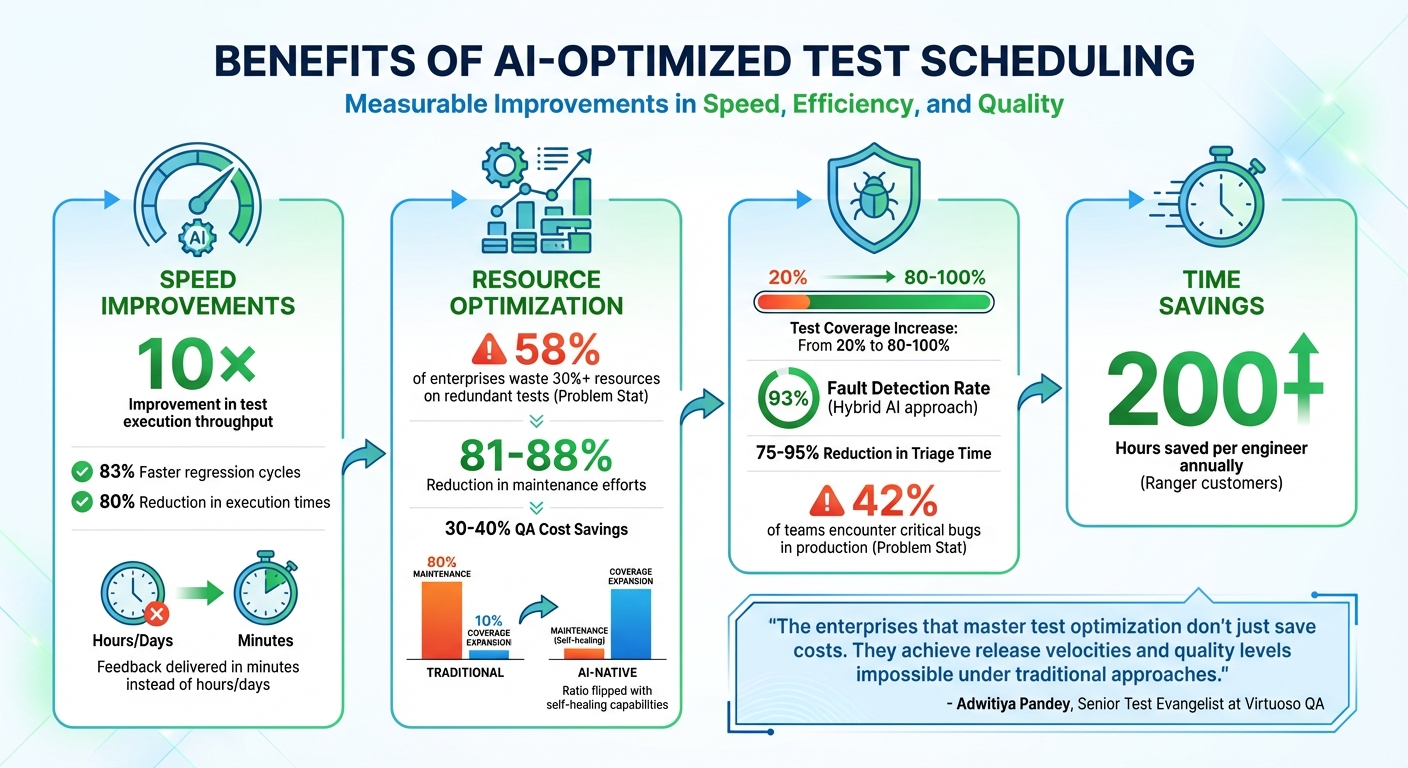
AI Test Scheduling Benefits: Performance Improvements and Cost Savings
AI-powered test scheduling brings measurable improvements that directly enhance development speed and software quality. For instance, it can reduce regression cycles by 83% and cut execution times by up to 80%. By moving away from manual processes, testing evolves from being a bottleneck to becoming a competitive edge. Let’s dive into how AI transforms both speed and resource management.
Faster Test Execution
AI speeds up testing by focusing only on what’s essential. Instead of running thousands of tests for every code update, AI analyzes dependencies and selects the most relevant ones, delivering feedback in minutes. This approach has enabled organizations to achieve a 10× improvement in test execution throughput, allowing teams to validate changes multiple times a day instead of waiting for lengthy regression cycles.
Parallel execution is another game-changer. AI distributes tests efficiently across resources, eliminating bottlenecks and significantly shortening timelines. The result? Regression cycles that once took hours are now 83% faster, turning extended processes into quick, manageable tasks.
Better Resource Allocation
AI doesn’t just save time - it optimizes how resources are utilized. Studies show that 58% of enterprises waste over 30% of their testing resources on redundant or low-priority test cases. By identifying and removing inefficiencies, AI frees up both infrastructure and engineering time for more impactful work.
One of the most striking benefits is the reduction in maintenance overhead. Traditional automation frameworks often require 80% of their effort for maintenance, leaving only 10% for expanding test coverage. AI-native systems flip this ratio, reducing maintenance efforts by 81–88% through self-healing capabilities that automatically update test scripts when UI elements change. This shift leads to QA cost savings of 30–40%, enabling teams to focus on innovation rather than upkeep.
Higher Bug Detection Rates
While speed and resource efficiency are crucial, the ultimate goal is to catch bugs early. AI prioritizes testing based on risk, using historical defect data, code complexity, and recent developer activity to ensure high-risk areas are tested first. This targeted approach can boost test coverage from a typical 20% to as much as 80–100%, significantly reducing the likelihood of bugs reaching production.
AI also uses predictive analytics to identify potential failures before tests are even run, helping teams concentrate their efforts where it matters most. When defects do occur, AI-powered root cause analysis can reduce triage time by 75–95%, offering developers precise guidance instead of vague error messages. As Adwitiya Pandey, Senior Test Evangelist at Virtuoso QA, puts it:
"The enterprises that master test optimization don't just save costs. They achieve release velocities and quality levels impossible under traditional approaches."
Conclusion
AI-driven test scheduling is reshaping quality assurance by analyzing code changes, pinpointing high-risk areas, and cutting out redundant tests. The result? Faster feedback cycles and reduced maintenance demands. When paired with expert oversight, this approach becomes even more effective.
The key to success lies in blending the speed of AI with human expertise. For example, Ranger's AI web agent generates Playwright test code, which QA professionals then review to ensure reliability and clarity. This "human-in-the-loop" approach strikes the perfect balance between rapid automation and thorough quality checks.
Ranger also integrates seamlessly with tools like GitHub and Slack, automatically triggering tests with every code commit. By catching issues in staging before they reach production, it supports a continuous testing workflow. Teams using Ranger report significant time savings - over 200 hours per engineer annually - on repetitive testing tasks.
Industry leaders have taken notice:
"They make it easy to keep quality high while maintaining high engineering velocity. We are always adding new features, and Ranger has them covered in the blink of an eye." - Martin Camacho, Co-Founder at Suno
For teams releasing updates on a weekly basis - and with 42% encountering critical bugs in production - AI-optimized test scheduling offers a smarter way to manage testing. It selects the most relevant tests, informs developers on what to focus on, and ensures smoother, more confident releases.
FAQs
How does AI decide which tests to run first?
AI sets test priorities by evaluating elements such as past test results, recent updates to the code, and areas with higher risks. Based on this analysis, it prioritizes and schedules the most critical or high-risk tests first. This ensures that potential issues are caught early and addressed efficiently.
By focusing on what matters most, this method minimizes repetitive testing, speeds up feedback loops, and ensures key tests are run without delay. The result? Teams can save valuable time while concentrating on delivering high-quality software.
How does AI improve test scheduling compared to manual processes?
AI is changing the way test scheduling works by examining factors like past test results, recent code updates, and risk indicators. This allows it to prioritize tests that are likely to have the biggest impact. The result? Developers get feedback faster, fewer low-value or repetitive tests are run, and overall execution times are cut down.
By predicting which tests are most likely to fail, AI helps catch defects earlier and with better precision. This means higher bug detection rates and fewer missed issues. On top of that, it saves money by reducing unnecessary test runs and cutting down the effort needed to maintain large test suites.
Ranger’s AI-powered QA platform takes these advantages a step further. It automates test creation, maintains self-healing scripts, and continuously fine-tunes test schedules. This makes it possible to release software faster and more reliably - without sacrificing quality.
How does Ranger work with my CI/CD pipeline?
Ranger fits right into your CI/CD pipeline, serving as an AI-driven testing stage that works smoothly with tools like GitHub Actions, Jenkins, and Azure DevOps. When a build kicks off, Ranger evaluates the latest code changes, past test outcomes, and potential risks to prioritize and run only the most crucial tests. This targeted approach slashes test run times while still catching critical bugs.
Beyond prioritizing tests, Ranger also automates test creation and upkeep. Its self-healing feature adjusts test scripts automatically to match changes in your UI or API, removing the hassle of manual updates. Plus, it integrates with platforms like Slack and GitHub to deliver real-time test alerts, defect reports, and execution logs directly to your team’s communication channels. This keeps feedback flowing smoothly and boosts collaboration.
Related Blog Posts
Stop babysitting your coding agents. Use Ranger
%201%20(1).svg)
More signals, less noise, faster launches
Let Ranger be your guide to sustainable QA testing.

.png)